Board of Peace

the chairman gets the money
Summary: Trump's Board of Peace charter names him Chairman for life with sole authority over membership, funding, vetoes, and succession. A billion-dollar entry fee flows into a fund he controls. His son-in-law and a private equity billionaire sit on the boards overseeing Gaza reconstruction contracts. Israel has a seat. Palestinians do not. Nine countries pledged $7 billion — ten cents on the dollar of what's needed. Trump pledged $10 billion more without congressional authorization. The reconstruction plan looks like a Dubai resort brochure. No timeline. No oversight. No Palestinian input. The structure isn't a peace plan. It's a land deal with a body count.
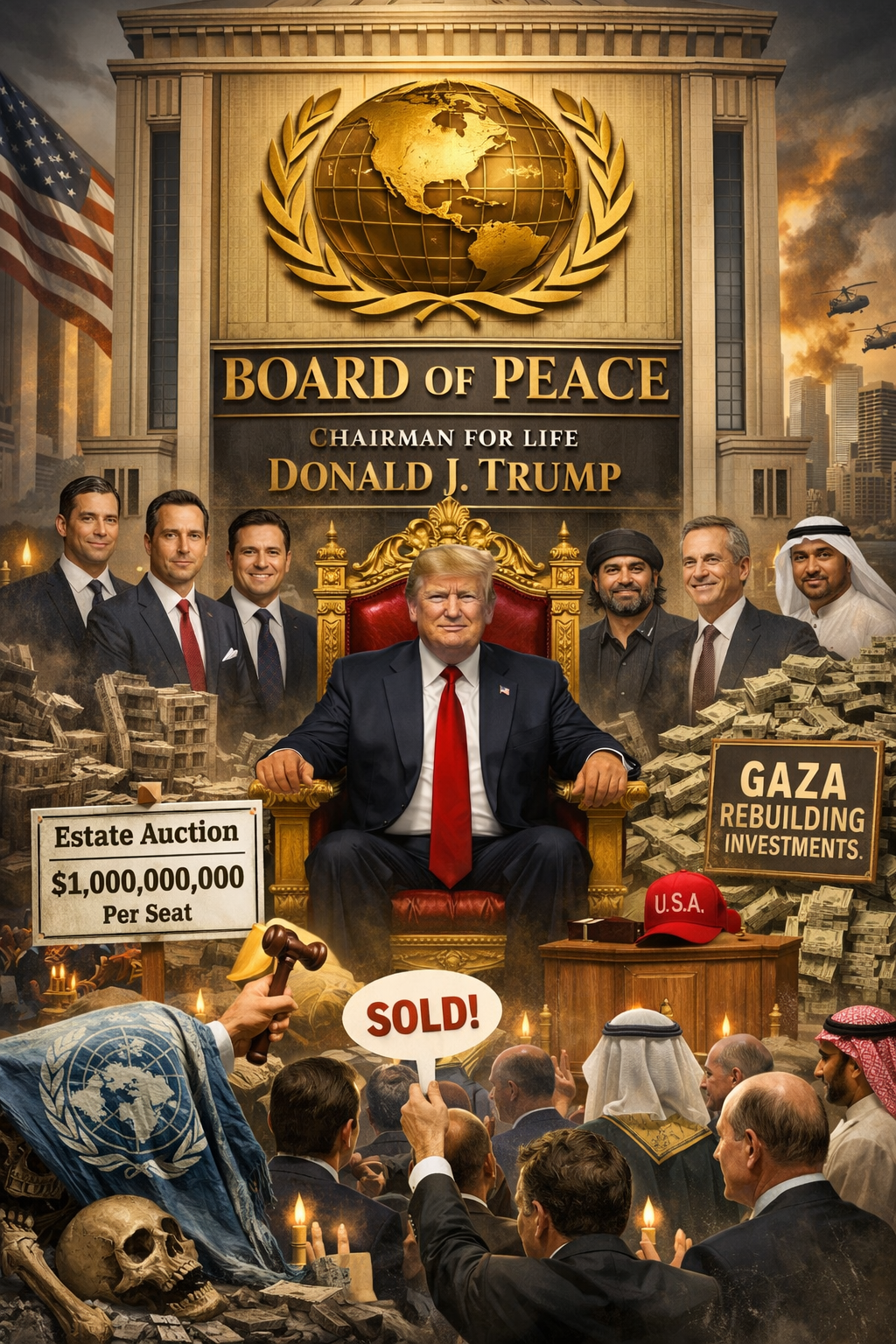
The United Nations is a corpse, and the Board of Peace is the estate sale. The auction is live, and the price of a seat is a flat billion dollars.
The charter is a masterpiece of authoritarian architecture. It names Donald Trump as Chairman for life. Not the President of the United States. Not the office. Donald J. Trump, by name. This is not a title he leaves behind at the White House. It is a permanent throne. He alone invites the members. He alone creates or dissolves the committees. He alone names his successor. Replacement can occur only following voluntary resignation or incapacity.
In the board’s 13-article charter, there are no fewer than 33 references to the chairman—who holds exclusive power to invite members, eject members, set agendas, approve or veto every decision, and create or dissolve any entity beneath him. He can initiate measures unilaterally. Every resolution passes through him. Every dollar passes through him.
Then there is the money.
The $1 billion “contribution” required for a permanent seat flows into a fund that the charter places under the Chairman’s total, personal authority. The Government of the United States serves as the official depository, but the Chairman—not Congress, not the State Department—controls how the money moves. A U.S. official promised “the highest financial controls and oversight mechanisms” but declined to clarify where the funds would actually be held or who would audit them. Congress played no role in authorizing any of this. Every resolution, every administrative directive, and every penny spent is subject to his approval. He holds the veto. He holds the ledger. He holds the purse.
The “founding Executive Board”: Jared Kushner, Steve Witkoff, Marco Rubio, Marc Rowan of Apollo Global Management—one of the largest private equity firms on earth—World Bank president Ajay Banga, and political adviser Robert Gabriel Jr.
Below that, the Gaza Executive Board—the arm that controls contracting, project financing, and procurement. That board adds Yakir Gabay, a Jerusalem-born Israeli real estate billionaire based in Cyprus with a $4 billion fortune built on European apartment blocks. It adds Turkey’s foreign minister, Qatar’s diplomatic envoy, Egypt’s intelligence chief, and a UAE minister. Kushner, Witkoff, and Tony Blair sit on both. These are not neutral bureaucrats. They are the Chairman’s deputies, and between the two boards, real estate developers and a private equity billionaire control the reconstruction of a territory where 72,000 people are dead. Israel joined the board in early February.
There are no Palestinians on either board.
The occupying power has a seat. The occupied do not.
They claim the billions are for the reconstruction of Gaza. Look at what reconstruction means to them.
At Davos, Kushner unveiled what he called a “master plan.” It treats Gaza as vacant beachfront property. A hundred eighty mixed-use towers along the entire Mediterranean coastline, designated for “coastal tourism.” Glass high-rises, seaside resorts, data centers, sports facilities, an airport. AI-generated renderings of a billionaire’s playground that looks like Dubai and nothing like Gaza. No Palestinians were consulted. Palestinian residents will be priced out of the prime new real estate built on top of their destroyed homes. The plan makes no reference to land deed transfers or how new housing would be allocated to the people who already lived there.
Trump said it plainly: “I’m a real estate person at heart, and it’s all about location.” He called Gaza “this beautiful piece of property.” Kushner called the reconstruction efforts “very entrepreneurial” and promised “amazing investment opportunities.”
So here is the structure. Nations pay billions into a fund Trump controls. His son-in-law, a private equity billionaire, and a real estate magnate decide who gets the construction contracts. The reconstruction plan looks like a resort brochure. Rowan filled in the brochure: 100,000 homes for 500,000 residents to start, $30 billion in infrastructure over time. No timeline. The money is controlled by real estate moguls in a structure that allows for “capital mobilization” without oversight.
In the United States, we used to call this a shakedown.
Today, February 19, 2026, the Board of Peace held its inaugural meeting at a building in Washington that used to be called the United States Institute of Peace. Congress created USIP in 1984 and it owned it’s own building. In March 2025, DOGE and DC police forced their way in and expelled the staff. Trump renamed it after himself. At today’s meeting, he claimed the building was “built without anybody in mind” and that “nobody knew what the purpose of it” was. It had been USIP’s permanent home for over a decade. Attendees were handed red MAGA-style hats reading “U.S.A.” in white letters.
Representatives of more than 40 countries showed up. Nine member states pledged a combined $7 billion for Gaza relief and reconstruction, mostly Gulf states. Trump then announced the United States would contribute $10 billion to the Board of Peace, without specifying what the money would be used for. Congress has not authorized the funds. The $7 billion sounds large until you set it against the UN’s estimate of $70 billion needed to rebuild Gaza. Ten cents on the dollar. The transitional committee meant to govern Gaza is based in Egypt and has not entered Gaza. It excludes both Hamas and the Palestinian Authority’s dominant faction. The body meant to govern Gaza has never set foot in Gaza and doesn’t include anyone who has actually governed Gaza.
The international stabilization force—the armed contingent supposed to police the strip and disarm Hamas—announced commitments from five countries: Indonesia, Morocco, Kazakhstan, Kosovo, and Albania. The force commander said plans call for 20,000 soldiers and 12,000 police. Egypt and Jordan committed to train police. Meanwhile, at least 600 Palestinians have been killed by Israeli forces since the ceasefire began in October 2025. Sixty million tons of rubble would take seven years just to clear before a single foundation is poured.
The UN Security Council, which originally scheduled its own session on the Gaza ceasefire for today, had to move the meeting to Wednesday because diplomats couldn’t attend both. The Board of Peace is already displacing the United Nations logistically before it even tries to do so formally.
Look at who showed up and who didn’t. The signing ceremony at Davos drew fewer than 20 delegations—mostly Middle Eastern, Asian, and South American nations. European leaders were visibly absent. Hungary was the only Western European nation represented, and Hungary is one of Russia’s closest allies in Europe. France, Germany, the United Kingdom, Italy, Norway, Sweden, Spain—they all refused to sign the charter. Several sent observers to today’s meeting, declining membership. The EU sent an observer. No sub-Saharan African country was even invited. Not one, out of sixty invitations. Putin floated paying his billion with frozen Russian assets—money seized to punish him for invading Ukraine, redirected to buy a seat at a table called Peace. Belarus signed up. The member list reads like a roll call of authoritarian states and countries looking to buy access to the man who holds the checkbook.
The Guardian called it what it is: a Trump-dominated pay-to-play club, a global version of his Mar-a-Lago court aimed at supplanting the UN itself. The charter signed at Davos—two months after the Security Council resolution—made no reference to Gaza at all. The body the Security Council thought it was endorsing and the body Trump actually built are two entirely different things. The EU’s Kaja Kallas pointed out at Munich that the resolution called for the Board to be limited in time until 2027, to include Palestinian participation, and to focus on Gaza—none of which appears in the actual charter.
Trump, addressing the countries that declined: “Some are playing a little cute. Doesn’t work. You can’t play cute with me.”
And the logo. It features a globe centered on the continental United States, omitting Europe, Asia, and Oceania entirely. Rendered in gold. Of course.
The Arab Center Washington DC read the same charter everyone else read and concluded that the Board of Peace is fully under Trump’s personal control and represents yet another moneymaking opportunity for Trump, his family, and his associates. Foreign Policy’s Aaron David Miller, a veteran of decades of Middle East diplomacy, wrote that Trump knows boards don’t do deals and mediate complex historic conflicts—but he also knows they can raise money, help him reprise his Apprentice role as chairman for life, and create camera-ready moments even if serious movement toward peace isn’t on the horizon.
This is not a peace plan. It is a land deal with a body count. The Chairman gets the structure. His family gets the contracts. Gaza gets a rendering. And 72,000 dead Palestinians get a coastline resort they’ll never afford, built on the rubble of the homes where they used to live, designed by men who never asked their names.
The Chairman doesn’t just manage the peace. He owns the franchise.