Boris

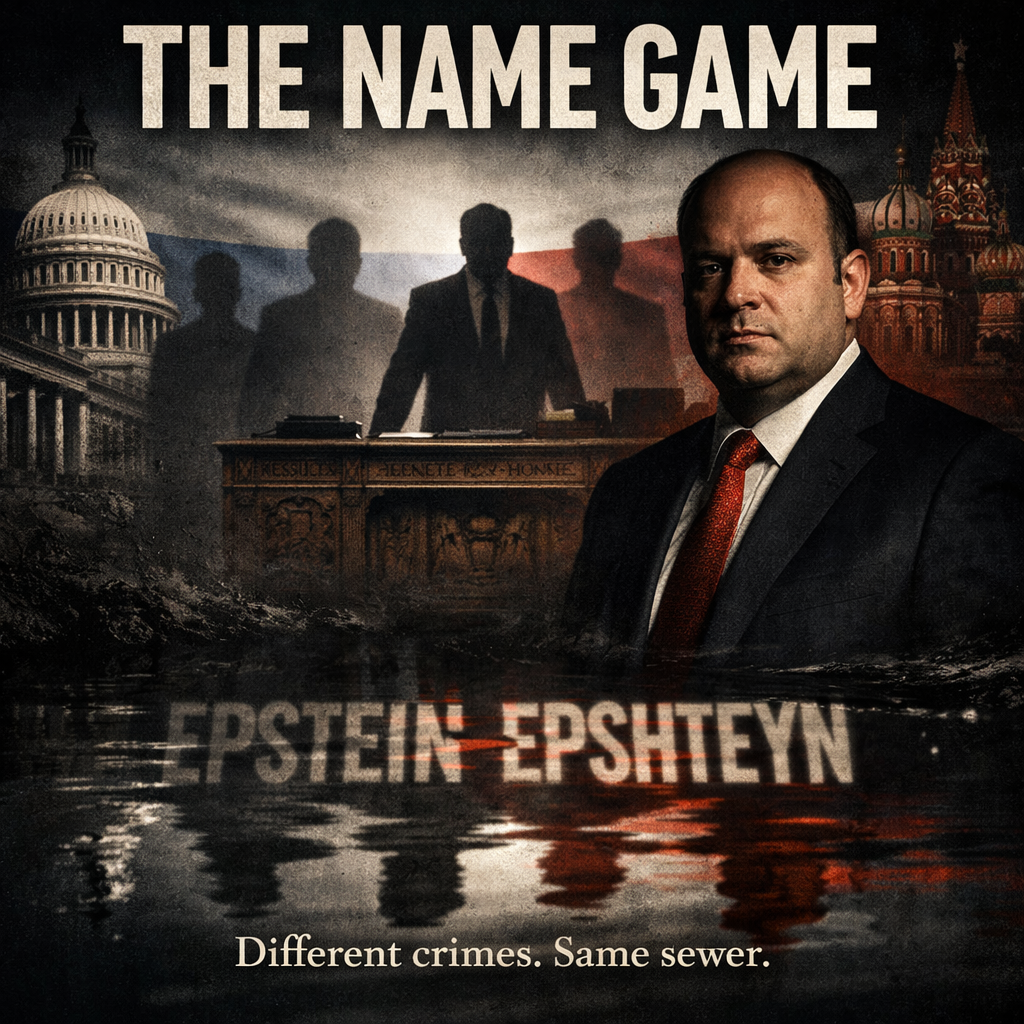
Summary: This essay disentangles the name confusion between Boris Epshteyn and Jeffrey Epstein to expose a system, not a typo. Epshteyn, a Moscow-born refugee turned Donald Trump fixer, operates through proximity, access, and legal leverage, not titles. From campaign surrogate to shadow adviser, he coordinates strategy, manages lawyers, and monetizes access, culminating in indictment over the fake electors scheme. The piece argues he is a type—an authoritarian apparatchik—akin to Vladimir Putin’s siloviki, alongside figures like Steve Bannon and Roger Stone. The shared surname becomes structural symbolism: different crimes, same sewer, sustained by power that treats law as weapon, democracy as theater, and rewards absolute loyalty.
It is easy to get confused. The swamp is deep, and the water is murky. You hear the name "Epstein" and the mind goes to the dead pedophile, the one who knew too much and died too soon.
But the man standing in the shadow of the Resolute Desk is different.
His name is Boris Epshteyn.
Born in Moscow in 1982. He arrived in the United States in 1993 as an eleven-year-old refugee who spoke no English. His family fled the collapsing Soviet Union and landed in New Jersey. He climbed the ladder of the United States legal system only to find himself fixing problems for Donald Trump. He is a lawyer, a strategist, and a survivor. He is not Jeffrey. But in the orbit of PrumpTutin, they are all swimming in the same sewer.
Boris Epshteyn is not an outlier. He is a type.
Every authoritarian needs them. The apparatchik. The bag man. The fixer who knows where the bodies are buried because he helped dig the holes. In Putin's Russia, they are called siloviki—the men of force, the ones who keep the machine running. In Trump's America, they do not have a name yet. But they are here.
Epshteyn is one. Steve Bannon was another. Roger Stone, still another. Men who understand that democracy is a performance, and behind the curtain, it is all just leverage and threats.
Boris Epshteyn arrived as a refugee and became a fixer.
By 2016, he was a Trump campaign surrogate, the kind of man who could go on television and say anything without flinching. After the election, he landed in the White House communications shop in January 2017. He lasted until March 2017—just over two months. Even by Trump standards, he was too much—abrasive, combative, the sort of operator who made enemies faster than he made coffee.
So he left. But he never really went away.
By the 2024 campaign, Epshteyn was back in the inner circle. Not on the org chart. Not on the payroll, officially. But in the room. Always in the room. Coordinating legal strategy. Managing the lawyers. Whispering in Trump's ear about who to trust, who to fire, who to pardon.
And getting paid. According to The New York Times and ABC News, he was charging people for access to Trump—a toll booth on the road to Mar-a-Lago. Want a meeting? A favor? A presidential endorsement? Talk to Boris. He'll see what he can do.
In April 2024, Arizona prosecutors indicted him as part of the fake electors scheme—accused of coordinating the plot to overturn the 2020 election. He pleaded not guilty. As of January 2025, the case remains pending. Epshteyn remains in Trump's orbit as an outside adviser.
That is who Boris Epshteyn is. Not a household name. Not a cabinet secretary. Just a man who understands that power is not about the title. It is about proximity. About knowing what the boss wants before he says it. About being indispensable in ways that do not show up on television.
The confusion with Jeffrey Epstein is not accidental. It is structural.
Both men exist because systems allow them to. Jeffrey Epstein trafficked children for decades because wealth insulates monsters. Because powerful men wanted what he offered and did not ask questions. Because the justice system gave him a sweetheart deal in Florida and pretended not to notice.
Boris Epshteyn traffics in a different currency—loyalty, access, legal cover. He exists because Trump needs men who will do what others will not. Men who do not flinch. Men who understand that in autocracy, the law is a weapon, not a constraint.
The name similarity is a joke. A cosmic prank. But the moral similarity is real.
One built an empire on exploitation. The other builds his career on enabling a man who tried to overturn an election.
Different crimes. Same sewer.
Further Reading:
The New York Times — “Trump Aide Is Said to Have Sought Retainer to Promote Presidential Pardons”, December 10, 2022.
ABC News — “Trump adviser allegedly sought payment for promoting candidates to president”, December 2022.
The Guardian — “Arizona indicts Trump allies in fake electors case”, April 24, 2024.
Politico — “Boris Epshteyn, Trump’s aggressive lawyer-fixer”, 2023.
The Miami Herald — “How a future Trump Cabinet member gave Epstein the deal of a lifetime”, 2018.
Brookings Institution — “Putin’s siloviki”.
The New York Times: "Trump Aide Is Said to Have Sought Retainer to Promote Presidential Pardons"
https://www.nytimes.com/2022/12/10/us/politics/trump-boris-epshteyn-pardons.html
ABC News: "Trump adviser allegedly sought payment for promoting candidates to president"
https://abcnews.go.com/Politics/trump-adviser-allegedly-sought-payment-promoting-candidates-president/story
The Guardian: "Arizona indicts Trump allies in fake electors case"
https://www.theguardian.com/us-news/2024/apr/24/arizona-indictment-fake-electors-trump-allies
Politico: "Boris Epshteyn, Trump's aggressive lawyer-fixer"
https://www.politico.com/news/2023/boris-epshteyn-trump-legal-strategy
The Miami Herald: "How a future Trump Cabinet member gave Epstein the deal of a lifetime"
https://www.miamiherald.com/news/local/article220097825.html
Brookings Institution: "Putin's siloviki"
https://www.brookings.edu/articles/putins-siloviki/
If this landed, send it to one person who needs to read it.