December 7th

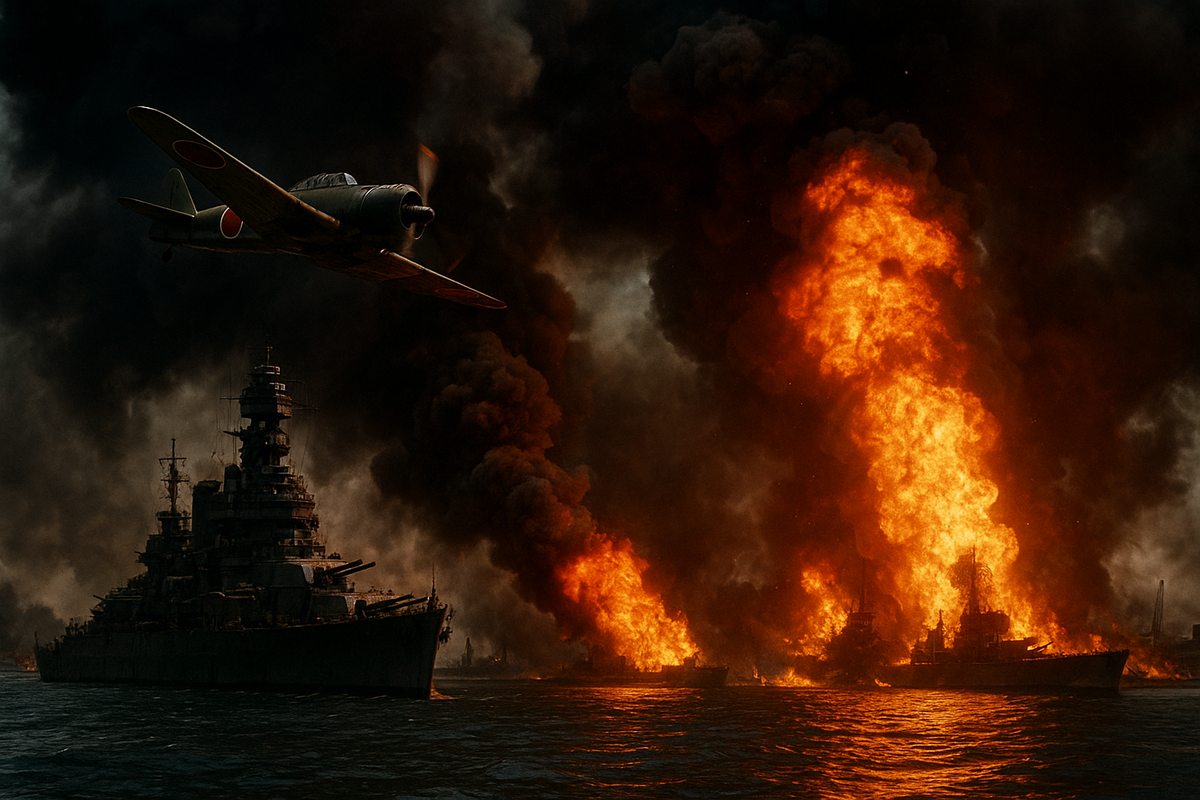
Warnings Ignored, Ships Burning
This is the day we remember. Not for medals. Not for speeches. We remember the dead.
Ships burned. Men died in pajamas. Sailors fired rifles at torpedo planes. Medics treated the wounded under smoke and fire. On the airfields, our pilots died running toward planes that were already burning—aircraft clustered wingtip to wingtip, easier to guard, impossible to scramble. When the Zeros arrived, they didn't find an air force. They found a parking lot.
My father fought in the war that followed. Two cousins died—one shot down over Africa, one over Germany. My granduncle traveled with General Douglas MacArthur as his personal physician. I once sat in his seat on that plane, which we tracked down decades later in Valle, Arizona. These are the moments that make history tangible: lives intertwined with the machines and decisions of war.
Today, we honor the dead of Pearl Harbor. The sailors who fought on burning decks. The medics who ran into fire. The men who died in their bunks before they knew what was happening. My father. My cousins. My granduncle. The 2,403 Americans who did not survive that Sunday morning.
Japan intended a formal declaration of war. Diplomats drafted the "14-Part Message," meant to reach Washington before the attack. Timing failed. But even if it had arrived, it likely would not have mattered. Pearl Harbor was already in motion.
When the attack began, the carriers were at sea. The Enterprise, the Lexington, the Saratoga—the only assets that would matter in the Pacific war—were conveniently absent. What remained were obsolete battleships. Heavy. Slow. Dinosaurs of a previous war. My father believed this wasn't luck. He believed Roosevelt needed a war to revive a broken economy and assert global power, and that the queens were moved off the board while the pawns were sacrificed. I cannot prove he was right. I cannot prove he was wrong. The carriers survived. The battleships burned.
We honor the warriors. But we also owe them the truth about why they died.
What happened at Pearl Harbor was systemic failure—fragmentation, arrogance, and bias operating in concert. Intelligence scattered across agencies that refused to share. Army and Navy with no unified command. Warnings that drowned in noise. As historian Roberta Wohlstetter wrote, "We failed to anticipate Pearl Harbor not for want of the relevant materials, but because of a plethora of irrelevant ones." The signals were there. No one was listening.
On Saturday, December 6th, 1941, Dorothy Edgers sat at her desk in the Navy's Cryptographic Section. She was a civilian translator, a former schoolteacher who had lived in Japan. She had been on the job two weeks. She had nothing assigned that morning, so she started digging through the "deferred" pile—low-priority intercepts from the Japanese consulate in Honolulu. What she found was not routine. A Japanese spy named Takeo Yoshikawa had been cabling Tokyo daily: battleship movements, the absence of torpedo nets, the positions of airfields. This was targeting information for a full-scale attack.
Edgers translated message after message and brought her findings to her supervisor. He saw their significance. But it was Saturday, and they were closing at noon. "We'll take it up on Monday," he said. She stayed anyway, working past her shift until 3:00 in the afternoon, waiting for the Translation Branch chief, Lieutenant Commander Alwin Kramer. When he returned, she briefed him on what she had found. Kramer was tired. He was annoyed she had worked late. He questioned the quality of her translation—she had only been there two weeks, after all. "Go home," he told her. She went home. The next morning, the bombs fell.
In 1944, when Congress held hearings on Pearl Harbor, Edgers' brother Fred Woodrough—who worked in the same office and had been there on December 6th—was called to testify. Dorothy Edgers was not allowed to. Same office. Same day. Same information. But she was a woman, and a civilian, and new to the job. So, the men spoke. She did not.
We honor them not with ceremony but with truth: warnings ignored carry irreversible cost. Arrogance and bias are as deadly as enemy bombs. And courage—the courage of the sailors, the medics, the pilots running toward burning planes, the woman who stayed late and found the warning no one wanted to hear—is the only answer when systems fail.