Fix ICE


Don't abolish it
Summary: ICE shouldn't be abolished—it should be rebuilt into something that deserves its authority. But that's not what's happening. Trump is building a federal force loyal to him personally, armed like soldiers, trained minimally, screened for compliance rather than competence. Two civilians dead in Minneapolis—Renee Good and Alex Pretti, both shot by agents who faced no threat. The rapid hiring, lowered standards, and immunity from accountability aren't bugs. They're features. When you staff an agency with people who owe their authority to one man and answer to nobody else, what you get is a militia. And militias loyal to individuals rather than institutions are how democracies die.
The Full Story:
A nation without borders is a slogan, not a country. Immigration enforcement is not optional. It is a basic federal function, as fundamental as courts, customs, and taxation. Anyone pretending otherwise is selling fantasy.
But anyone pretending that what we are watching now is legitimate law enforcement is selling something worse.
I don't want ICE abolished. I want it fixed. Rebuilt. Returned to a form that deserves the authority it exercises.
The problem is that Trump doesn't want it fixed either. He wants it loyal.
On January 7th, Immigration and Customs Enforcement agent Jonathan Ross shot and killed Renee Good in Minneapolis. She was 37 years old, observing federal operations, turning away from Ross at slow speed. On January 24th, Customs and Border Protection agents shot Alex Pretti ten times. He was 37, legally armed, already disarmed when they opened fire, shot repeatedly while prone on the ground.
Both killings were captured on video. In both cases, Trump administration officials rushed to call the victims "domestic terrorists." They claimed Good tried to run over an agent. They claimed Pretti intended a "massacre." The available evidence contradicted both claims immediately.
Trump called the protesters tracking ICE operations "paid agitators" and "insurrectionists." When he removed Greg Bovino—the senior Border Patrol officer who liked throwing tear gas grenades himself—from Minneapolis on January 26th, Trump insisted it wasn't a "pullback." The CBP agents who killed Pretti still haven't been identified. They're on administrative leave while the Department of Homeland Security investigates itself.
Not the FBI. Not an outside agency. DHS investigating DHS.
This is what happens when you give guns to people who have no business carrying them and tell them their job is loyalty, not law.
Building a Force, Not an Agency
Law enforcement is one of the few powers a democracy grants that can legally end a human life. That power is not symbolic. It is not rhetorical. It is real, irreversible, and supposed to be treated with fear by the people who carry it. Fear of getting it wrong. Fear of crossing a line that cannot be uncrossed.
Professional agencies screen for that fear. They want people who hesitate before pulling a trigger, who lose sleep over close calls, who understand that authority is a burden rather than a prize.
ICE is doing the opposite.
The agency is hiring at breakneck speed, lowering standards to fill quotas under political pressure to produce results measured in deportations and visible force. ICE's basic training runs four months. The FBI's Quantico academy runs 21 weeks, following a rigorous selection process most applicants fail. Municipal police academies typically require six months minimum, followed by field training that can last another year.
ICE doesn't do that. It can't. It's staffing up too fast.
But fast for what?
If the goal were professional immigration enforcement, you would slow down. You would recruit carefully, screen relentlessly, train until instinct is replaced by habit and ego is trained out of the system. You would remove people who cannot handle the responsibility. You would punish misconduct visibly, because legitimacy depends on consequences being seen, not promised.
If the goal is something else—a federal force loyal to one man, armed, aggressive, and operating outside the constraints that bind professional law enforcement—then everything ICE is doing makes perfect sense.
You don't want professionals. Professionals ask questions. Professionals hesitate. Professionals have loyalty to law and institutions that predate and outlast any individual president.
You want enforcers. People who follow orders. People whose authority derives entirely from the man who hired them and who understand that accountability flows in one direction only.
What you get isn't law enforcement. What you get is a militia with badges.
Training That Doesn't Train
What ICE calls training focuses overwhelmingly on arrest procedures and defensive tactics. Very little addresses de-escalation in civilian environments. Almost nothing prepares agents for the reality that most people they encounter are not violent criminals but workers, parents, neighbors—civilians operating under fear long before an agent arrives.
Professionals understand escalation. Amateurs provoke it.
Training would be better described as familiarization: here's your weapon, here's your authority, here's the paperwork, go forth and enforce. The psychological screening is minimal. The cultural indoctrination rewards toughness over judgment. Oversight is treated as interference rather than insurance against catastrophe.
When you train people minimally, screen them poorly, and reward aggression, you are making a choice about what kind of force you want. This isn't incompetence. This is design.
A poorly trained agent who escalates encounters, who treats civilians as threats, who shoots first and justifies later—that agent is a problem for a professional law enforcement agency.
But for a president building a personal force loyal to him rather than to law? That agent is an asset.
Loyalty Over Law
ICE's failure is cultural as much as operational. Culture eats policy for breakfast, and this culture is warped. Aggression is rewarded. Oversight is treated as sabotage. Accountability gets delayed until outrage becomes too loud to ignore—and even then, accountability means paid leave while the agency investigates itself.
This is not how professional agencies operate. This is how personal forces operate.
Professional law enforcement agencies understand that their authority derives from law, not from the person currently in power. They maintain institutional independence. They resist political pressure. They enforce law equally because that is what legitimacy requires.
Personal forces do the opposite. Their authority derives entirely from the individual who commands them. Their loyalty is personal rather than institutional. They understand that their power exists only as long as that individual remains in power—and that accountability, consequences, and constraints are luxuries they cannot afford if they want to keep their positions.
When Trump calls protesters "insurrectionists" and his agents shoot civilians who pose no threat, he is not describing law enforcement gone wrong. He is describing a force doing exactly what it was built to do: suppress resistance, demonstrate power, and make clear that loyalty to Trump matters more than adherence to law.
That is not a broken system. That is a different system entirely.
Why Do They Have Guns?
Here's a question nobody in Washington seems interested in asking: why is immigration enforcement armed at all?
Nobody is shooting at ICE agents.
This isn't narcotics interdiction. This isn't counterterrorism. This isn't fugitive apprehension of violent felons. This is civil immigration enforcement—tracking down people who overstayed visas, missed court dates, or crossed a border without permission.
The vast majority of immigration violations are administrative, not criminal. The people ICE is sent to arrest are electricians, dishwashers, construction workers. They're not armed. They're not dangerous. They're trying not to be noticed.
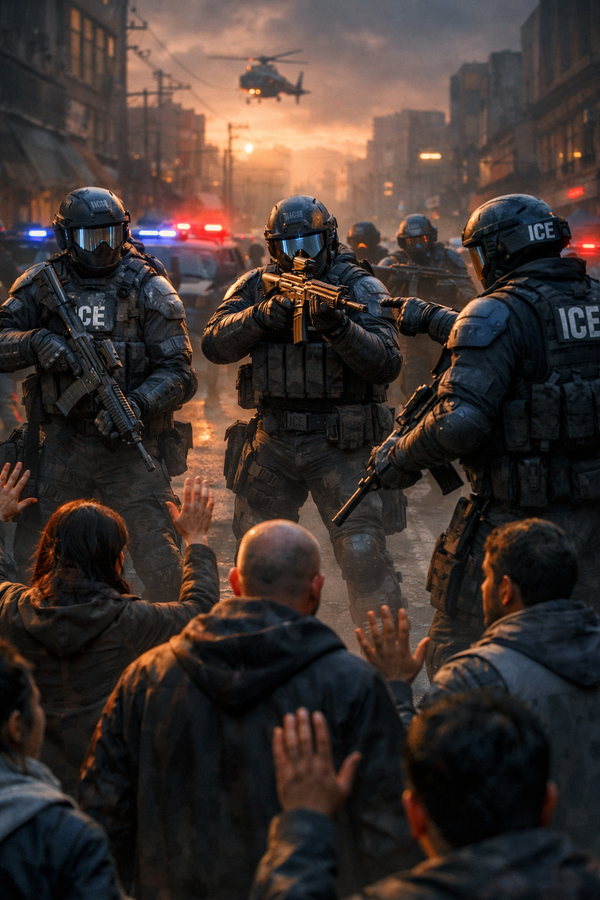
So why does every ICE operation look like a military raid?
Why the body armor? Why the tactical gear? Why the rifles? Why the posture of soldiers entering hostile territory when the territory in question is a neighborhood in Minneapolis?
The answer has nothing to do with necessity and everything to do with purpose.
Armed forces look different from civilian agencies. They act different. They think different. They inspire fear rather than cooperation. They treat territory as contested rather than communities as shared.
And fear is useful if your goal is dominance rather than enforcement.
Other countries manage immigration enforcement without turning it into theater. Their agents are armed lightly, if at all. They rely on legal authority backed by courts, not tactical displays backed by firepower. They understand that treating enforcement like warfare guarantees resistance, because people do not cooperate with occupiers.
ICE could operate the same way. It chooses not to.
The guns are not about safety. They're about power. And power concentrated in the hands of people loyal to one individual rather than accountable to institutions is how democracies turn into something else.
History Doesn't Repeat, But It Rhymes
Authoritarian systems don't begin with secret police kicking down doors. They begin by normalizing impunity, blurring authority, and rewarding aggression in the name of order.
They begin by building forces loyal to individuals rather than institutions.
They begin by hiring rapidly, training minimally, and screening for compliance rather than competence.
They begin by arming those forces beyond what their mission requires and deploying them in ways that demonstrate power rather than enforce law.
They begin by insulating those forces from accountability—internal investigations, paid leave, no consequences until outrage forces a temporary retreat that never quite reverses the underlying expansion of authority.
The uniforms change. The logic doesn't.
Renee Good and Alex Pretti are dead because ICE operates with the assumption that force is always justified and accountability is always optional. Their deaths were not aberrations. They were predictable outcomes of a system designed to reward aggression and punish restraint.
But they are also warnings.
When federal agents shoot unarmed civilians observing their operations, and the president calls those civilians terrorists, and the agents face no meaningful consequences, and the hiring continues, and the weapons remain, and the mission expands—this isn't law enforcement failing.
This is something else succeeding.
What Happens Next
I said at the beginning that I don't want ICE abolished. I want it fixed.
But you cannot fix something that is working as designed.
If ICE were simply broken—poorly managed, undertrained, institutionally adrift—then reform would be possible. Raise standards. Improve training. Impose accountability. Disarm when appropriate. Return the agency to its core mission executed professionally.
But if what Trump is building is a personal force loyal to him rather than a professional agency loyal to law, then none of those reforms are possible under this administration. The brokenness serves a purpose. The violence is not a failure to be fixed but a feature to be expanded.
You cannot reform an agency whose mission is loyalty rather than law.
You can only recognize what is being built and decide whether you will resist it.
The activists in Minneapolis tracking ICE operations through Signal groups, following armed federal agents in cars, risking arrest and worse to witness what happens when nobody is watching—they understand something that most of Washington refuses to acknowledge.
This is about power. Power wielded without accountability, concentrated in forces loyal to one man, deployed against civilians who pose no threat—that power does not stop at immigration enforcement.
It expands.
Fix ICE. Professionalize it. Disarm it unless threat is real and present. Strip it of people who confuse aggression with competence. Impose independent oversight with teeth. Make misconduct expensive and competence mandatory.
Or recognize that what Trump is building is not an agency at all.
It is a militia. And militias loyal to individuals rather than institutions are how democracies die.
Further Reading:
- The Economist: "Inside the movement challenging—and disrupting—ICE" (January 31, 2026)
- ProPublica: "How ICE Picks Its Targets in the Surveillance Age"
- Brennan Center for Justice: "The President's Private Army: A History of Federal Forces"
- ACLU: "The Constitution in the 100-Mile Border Zone"
Timothy Snyder: "On Tyranny: Twenty Lessons from the Twentieth Century"