
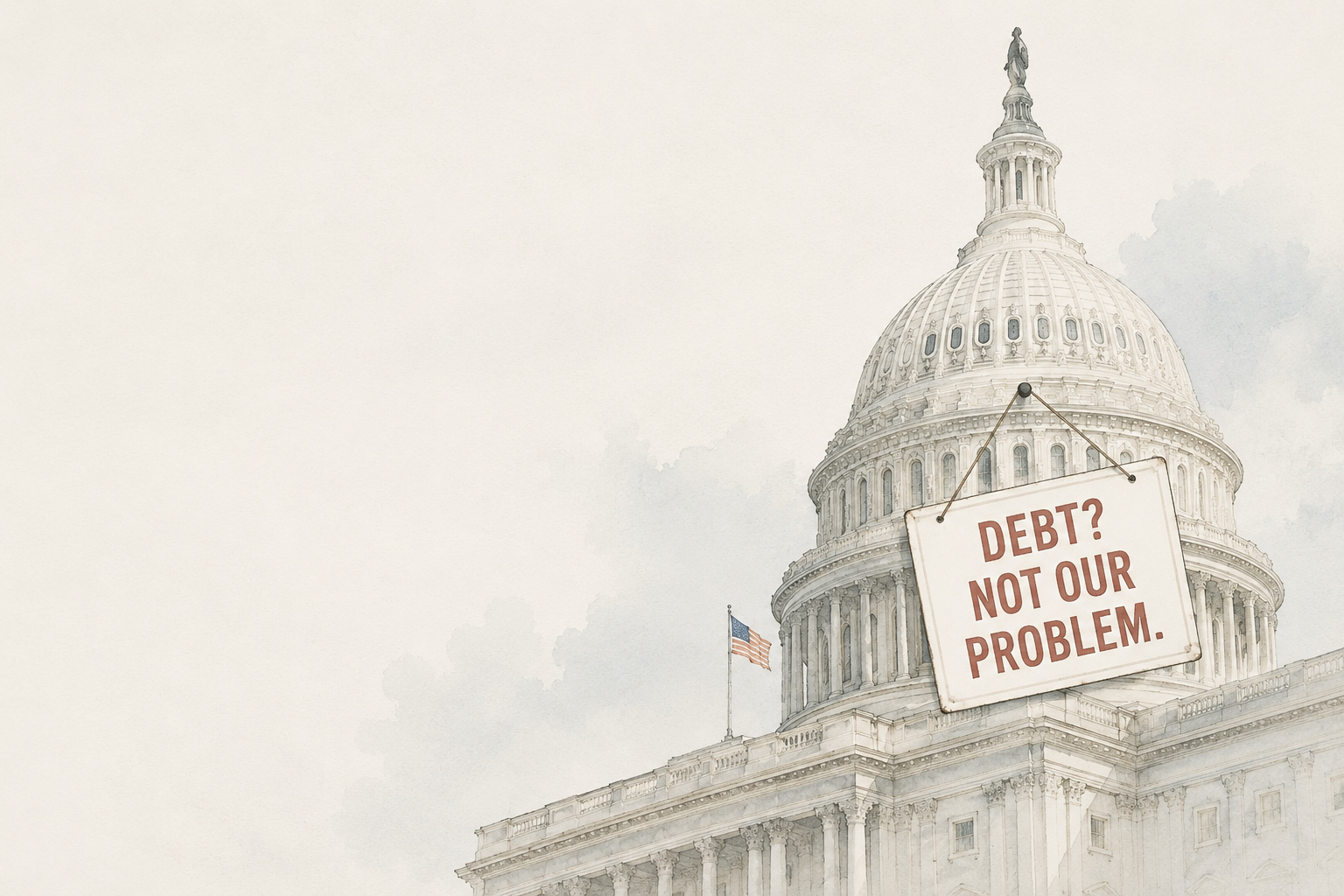
The debt is only an emergency when the other guy is holding the pen.
The Treasury posts the number every business day the way a hospital posts visiting hours. Quietly, without comment, as if it were weather. The books closed above $40 trillion on August 18, and the figure went out to the public the next morning. It reads higher now. It will read higher when you finish this sentence and higher again when you finish the essay.
Forty trillion is worth your attention. The louder question is who screams about it and when they decide to start.
A Democrat takes the oath. Within a month, a caucus of House Republicans rediscovers arithmetic. They stand in front of a debt clock and talk about their grandchildren, and they say “kitchen table” until the words go soft in the mouth. Then a Republican takes the oath, the clock goes into a storage closet, and the same men vote for the largest deficit-financed tax cut in the history of the republic. The grandchildren are never mentioned.
I sold computers for a living when the first of these bills passed. Accelerated cost recovery let a small business write a machine off fast, and for a few years the last week of December was the best week of my year. Men who had not returned a phone call since October came through the door on the twenty-eighth wanting anything with a serial number on it. Then the 1986 reform stretched the schedules out and killed the investment credit, and December went quiet. Nobody in Washington called that a tax increase. It was one, and my customers paid it.
Reagan campaigned on balancing the budget by 1984. The debt stood just under a trillion dollars when he raised his hand and roughly $2.7 trillion when he left. He nearly tripled it. The 1981 tax act cut the top rate from 70 percent to 50 and blew a hole so wide that his own people spent the rest of the decade quietly patching it: a corporate and excise increase in 1982, the payroll tax increase in 1983, another round in 1984, and one more in 1987. David Stockman, his own budget director, told The Atlantic in 1981 that the supply-side case had always been a Trojan horse for cutting the top rate. Congress passed Gramm-Rudman-Hollings in 1985 and promised automatic balance by 1991. The Supreme Court gutted the enforcement mechanism the next year. Congress amended the law, missed the new date, and stopped mentioning it. Since then, no one at a Republican convention has called Reagan a spender, and no one at a Democratic convention has done so either.
His successor is the tell. George H. W. Bush looked at the arithmetic in 1990 and signed a tax increase. The recession and the savings-and-loan cleanup drove the deficit to a record $290 billion anyway, and the savings-surplus deal arrived later, on another man’s watch, inside another man’s surpluses. His own party never forgave him for any of it. The only Republican president who took action against the debt was destroyed by his own party for doing so, which is a lesson that a party typically learns only once.
Clinton raised the top rate to 39.6 percent in 1993. Not one Republican voted for it in either chamber. Gore broke the tie in a 50-50 Senate. Gingrich promised a recession, and Dick Armey promised job losses. John Kasich said the plan would not work, and that if it did work, he would have to become a Democrat. Four consecutive surpluses followed: 1998, 1999, 2000, and 2001. The Congressional Budget Office projected $5.6 trillion more over the coming decade. Kasich stayed a Republican.
Democrats wanted to pay down the debt. Republicans wanted a refund. It is not the government’s money, George W. Bush told crowds on the campaign trail. It is the people’s money.
Then he arrived and announced that the surplus proved the people were overtaxed. The 2001 cuts ran about $1.35 trillion. The 2003 cuts came on top. When Paul O’Neill, his own treasury secretary, raised the deficit in a cabinet meeting, Dick Cheney told him that Reagan had proved deficits do not matter, which is O’Neill’s account by way of Ron Suskind. They fired O’Neill weeks later. Two wars ran outside the regular budget through emergency supplementals, year after year, specifically so they would not show up in the baseline: more than $2 trillion, every cent borrowed, and not one dollar of it paid for by a war tax on anybody. In 2003 they added Medicare Part D with no offset and a legal ban on negotiating drug prices, a subsidy routed to Pfizer with seniors as the delivery mechanism. They told Congress it would cost $395 billion. Richard Foster, the program’s chief actuary, had run the number at $534 billion, and he said afterward that Thomas Scully, his boss, threatened to fire him if he handed it over. The leadership held the House vote open for nearly three hours in the middle of the night and worked members over on the floor. Bush walked in with $5.7 trillion of debt and walked out with $10.6 trillion.
Eleven weeks into the Obama administration, the deficit became a national emergency again. The same men who had voted for Part D, two unfunded wars, and two rounds of unfunded tax cuts appeared on television in tricorn hats. In 2011 they did something no party had done before. They threatened to default on debts the United States had already incurred, and they used the threat as leverage. Standard and Poor’s downgraded the country on August 5, 2011, and said plainly that what it had downgraded was the political process. The Budget Control Act and the sequester that followed cut research and infrastructure and left Social Security alone, because Social Security has voters. In 2013 they shut the government for 16 days over a health care law they had already lost on in Congress, and at the ballot box, and in front of the Supreme Court. The deficit they were screaming about fell from $1.4 trillion in 2009 to $442 billion in 2015.
December 2017. Republicans hold everything. The Tax Cuts and Jobs Act drops the corporate rate from 35 to 21 permanently, makes the individual cuts temporary, and scores at about $1.5 trillion, close to $1.9 trillion once you count the interest. Growth will pay for it, they said. It did not. The deficit went from $665 billion in 2017 to $779 billion in 2018 to $984 billion in 2019. In the third year of an expansion, with unemployment at 3.5 percent, no recession, and no new war, the country ran a deficit of 4.6 percent of GDP. Peacetime numbers like that normally require a crash or a war. Congress raised or suspended the debt ceiling three times in those years, and nobody said a word. Then COVID hit, and the deficit ran $3.1 trillion in a single year, most of it necessary, most of it bipartisan, and I will not pretend otherwise.
Biden takes office. The hawks are airborne inside a week. In the fall of 2021 Mitch McConnell spent two months refusing to supply votes to raise the ceiling on debt already run up, most of it under his own party’s tax law, before he found a way to let it pass anyway. In 2023 the House took the ceiling hostage again and traded it for the Fiscal Responsibility Act. That August, Fitch downgraded the United States and named the brinkmanship as the reason.
The One Big Beautiful Bill Act arrived in 2025 with a name that tells you everything about the seriousness of the people who wrote it. PrumpTutin had promised in 2016 to erase the entire national debt in eight years. The Congressional Budget Office scored his law at $3.4 trillion added to the deficits through 2034, or $4.1 trillion counting interest, or roughly $5.5 trillion if you assume Congress extends the temporary pieces, which Congress always does. To get it past the rules, the Senate changed the scoring convention and declared about $3.8 trillion of tax cuts to be existing policy and therefore free. Under that math the bill costs $441 billion. Every serious scorekeeper in Washington, left and right, called it a gimmick. On May 16, 2025, Moody’s took away the last AAA rating the United States had, a rating it had held since 1917, and the White House put out a statement blaming President Biden.
Then the tariffs. Fiscal 2025 closed at a $1.775 trillion deficit, and it closed that low only because of a record $195 billion in net customs receipts. A sales tax on your own consumers did the heavy lifting, and they ran victory laps on it. On February 20 of this year, in Learning Resources v. Trump, the Supreme Court ruled six to three that the International Emergency Economic Powers Act gives a president no tariff authority at all. Roberts wrote that the statute never mentions tariffs or duties and that no president before this one had read it that way. The structure came down. The Congressional Budget Office puts the money taken under that authority at $166 billion and expects most of it refunded inside this fiscal year, with roughly $100 billion already back out the door by the end of July. In June the government paid out $49 billion against $23 billion collected, putting net customs revenue at negative $25.6 billion, a figure that had never appeared in the country’s books before. July came in at negative nine. CBO has raised its fiscal 2026 deficit estimate to $2.1 trillion and expects net customs revenue to land $250 billion under the February baseline. Ten months into the fiscal year the deficit stands at $1.798 trillion, more than the whole of last year. July alone ran $431 billion, the fourth-largest monthly deficit ever recorded.
They funded the government with a tax they had no authority to levy, spent the proceeds, lost in court, and are now mailing the money back while the meter runs. No hearing has been called about it and nobody has put on a hat.
Net interest crossed a trillion dollars in fiscal 2025, the first time in the country’s history, and it is running 14 percent ahead of that pace this year. It is the second largest line item in the federal budget, behind Social Security and ahead of the Pentagon. Debt held by the public hit $31.7 trillion at the end of June, up $2.7 trillion in 12 months. That money goes to people who already have money, for the privilege of having borrowed from them.
Democrats are not frugal, and my own side does not enjoy hearing it. Obama added roughly $9 trillion. Biden added roughly $8 trillion, and the American Rescue Plan ran a couple hundred billion larger than the moment required. Neither party will touch Social Security or Medicare, because the arithmetic of an aging country is the actual long-run problem and saying so out loud ends careers. The difference is not that one party balances the books. Neither one does. One of them holds a press conference about it.
The story you are told is a lie about welfare queens and foreign aid. Foreign aid runs under one percent of the budget. Since 2001 the largest single contributors to the debt are the Bush tax cuts and their extensions, the 2017 cuts, the 2025 cuts, two wars, two financial catastrophes, and the compounding interest on all of it. Revenue last year ran about 17 percent of GDP. Spending ran about 23 percent. Call that a spending problem or a revenue problem as you like. Both sides of the minus sign are real, and only one of them gets argued on television, which is how a country ends up fighting about food stamps instead of the top rate.
Hypocrisy is not arithmetic. The debt is real no matter who ran it up, and cataloging the men who scream loudest does not retire a dollar of it. That objection is correct as far as it goes. It also misses the function of the screaming, which was never to reduce the debt.
For the modern Republican Party the debt works as a tool, and it has worked that way since Stockman said so out loud. Norquist put it his own way when he talked about drowning the government in a bathtub. The strategy has a name they used themselves: starve the beast. You cut revenue on purpose, you wait for the deficit to appear, and then you point at the deficit as proof that the country cannot afford the things you never wanted to pay for anyway. It only works from the outside. In power the deficit is a feature. Out of power it is a crisis. Same men, same month, different chair.
The 2025 law is the proof. It cut about a trillion dollars from Medicaid, pushed roughly 10 million people off health insurance, and still added trillions to the debt. Nobody who wrote it was confused about that. The money came out of the medicine cabinets of poor people and went into the portfolios of rich ones, and every member who voted had read the score first.
The bill is here now, and it is not waiting for the grandchildren. Interest buys nothing. No road. No vaccine. No veteran’s knee. No kid’s lunch. It is rent on decisions made by men who are mostly dead or retired to gated communities with very good health insurance. Forty trillion dollars, and not one of them will tell you he did it. Eventually the bond market prices in what the ratings agencies have already said out loud, and the bond market does not care whose turn it was.
I do not have a fix for you. Nothing that could pass would touch this.
So watch the men who go quiet in January. They are not embarrassed and they have not changed their minds. They are waiting for the pen to change hands, and when it does you will hear about the grandchildren again, and the arithmetic will not have moved an inch.
Joe Zeigler’s The Art of the Lie argues that Trump did not corrupt the system, he revealed it. Full catalog at Arrakis Publishing.