The Blind Leading the Blind
The United States has a new monument to the void.
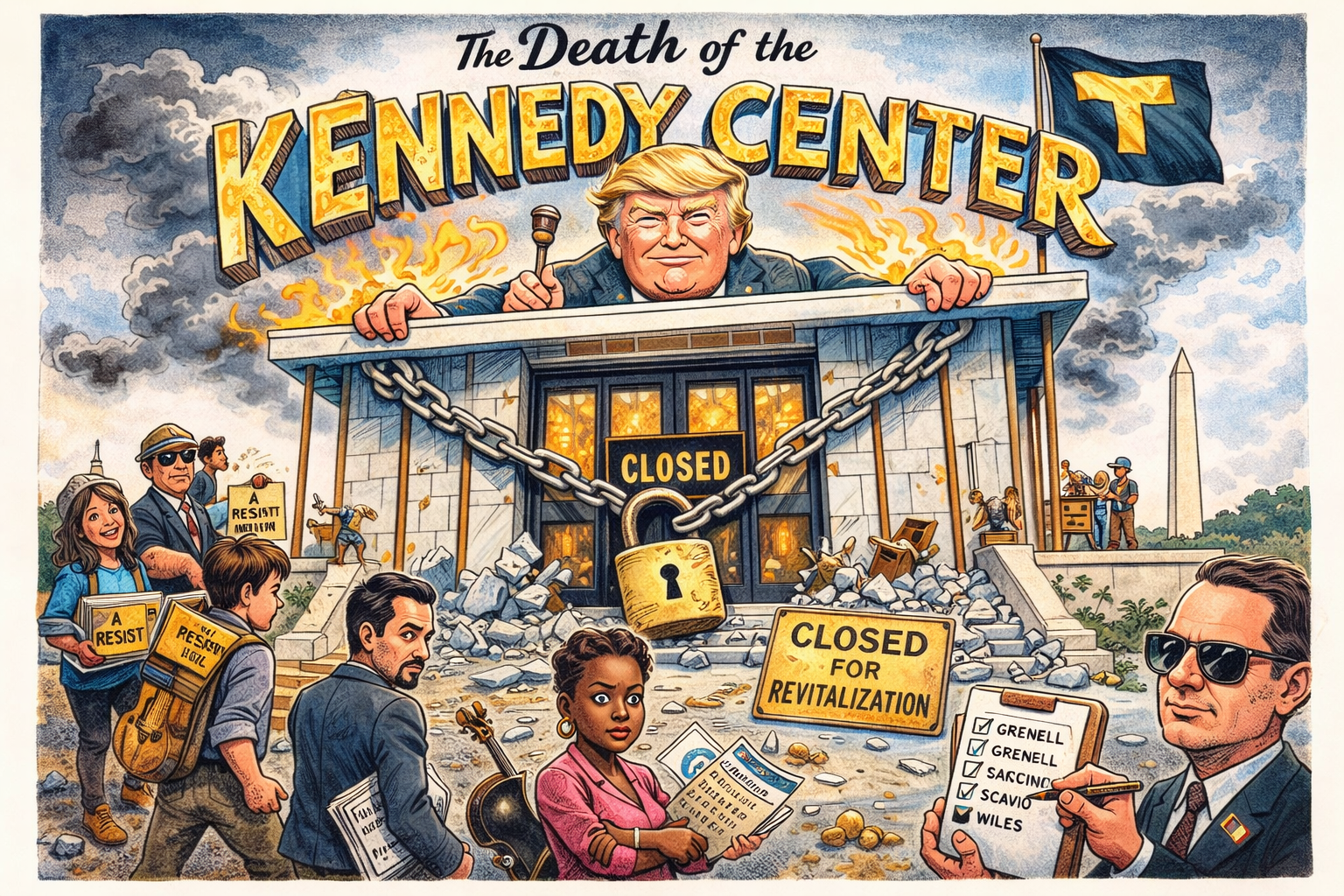
The Kennedy Center is closing. It isn't a renovation; it is a tactical retreat. For a year, PrumpTutin tried to force the culture to bend. In February 2025, he purged the board of Biden appointees, fired President Deborah Rutter, installed Richard Grenell as interim executive director, and made himself chairman. He replaced arts professionals with political loyalists—Susie Wiles, Dan Scavino, Usha Vance. People who know nothing about the performing arts now run the nation's performing arts center. The culture didn't bend. It walked out. Hamilton canceled. Issa Rae canceled. Philip Glass withdrew his symphony. The Washington National Opera left after seventy years. Béla Fleck said the place had become "less and less a musically and artistically based situation and more of a highly politicized and divisive one." Seats stayed empty. The Washington Post reported 43 percent unsold between September and October, compared with 7 percent the year before. Attendance at National Symphony Orchestra concerts dropped by half.
When you lose the room, you don't apologize. You lock the doors.
The announcement is classic Trump. Two years of darkness, starting July 4th. A promise of "revitalization." In the vocabulary of power, "revitalization" is the polite word for an erasure. CNN reported the growing artist boycott had become untenable; the programming vice president quit days after his appointment because he couldn't book anyone. But for the next two years, maybe longer, the only news out of the Kennedy Center will be about chandeliers and marble. Tackiness is easier to spin than rejection. You can sell gold leaf to the base. You cannot sell a boycott.
By the time the doors open in 2028, the memory of what happened here will be thin. The artists who stayed away will be replaced by those who don't mind the new décor. The protesters will have moved on to fresher outrages. And the building will reopen scrubbed clean of its own recent history.
Gold is the point. NPR reported that among the changes Trump has expressed enthusiasm for is putting marble armrests at each seat in the main theater—cold, uncomfortable, and acoustically destructive. It is the signature of a man who believes that if you cannot earn legitimacy, you can buy its likeness. He wants to turn a civic space into a showroom. He wants to replace the messy, democratic friction of the performing arts with the static, unblinking stare of a monument. Culture, to him, is décor. It exists to flatter the owner, not to challenge the audience.
But culture isn't a real estate deal. You can't flip an institution like a failing hotel. You can gild the columns and polish the floors until they reflect every camera flash in the city, but you cannot mandate the soul of a building. Art requires risk. It requires the possibility of failure, of offense, of truth that makes powerful people uncomfortable. A performing arts center under the thumb of a man who fires anyone who doesn't applaud is not a stage. It is a mausoleum with better lighting.
The Kennedy Center was built to honor a president who believed that art was essential to democracy. It was meant to be a place where the nation could argue with itself in the language of music, theater, and dance. Now it will sit dark while contractors measure the walls for whatever gilded future awaits.
Two years of silence is a long time. Audiences will find other venues. Artists will build other stages. The ecosystem of culture doesn't wait for buildings to reopen; it routes around the obstruction and keeps moving. When the gold is finally dry and the doors swing back, the people might find that the building isn't a temple anymore. It's just a vault. A place to store the memory of something that used to matter, polished until it no longer resembles itself.
That may be the point. PrumpTutin doesn't want culture. He wants compliance dressed in velvet trimmed with gold.. The Kennedy Center will reopen eventually, and it will be beautiful in the way that empty things are beautiful. But the artists who made it matter will be somewhere else, playing to rooms that still know the difference.