I was born in Selma, Alabama, and lived there six months. Then my father, a Navy officer and pilot, took us into the strange, enclosed world of the United States military, and there I spent the rest of my childhood.
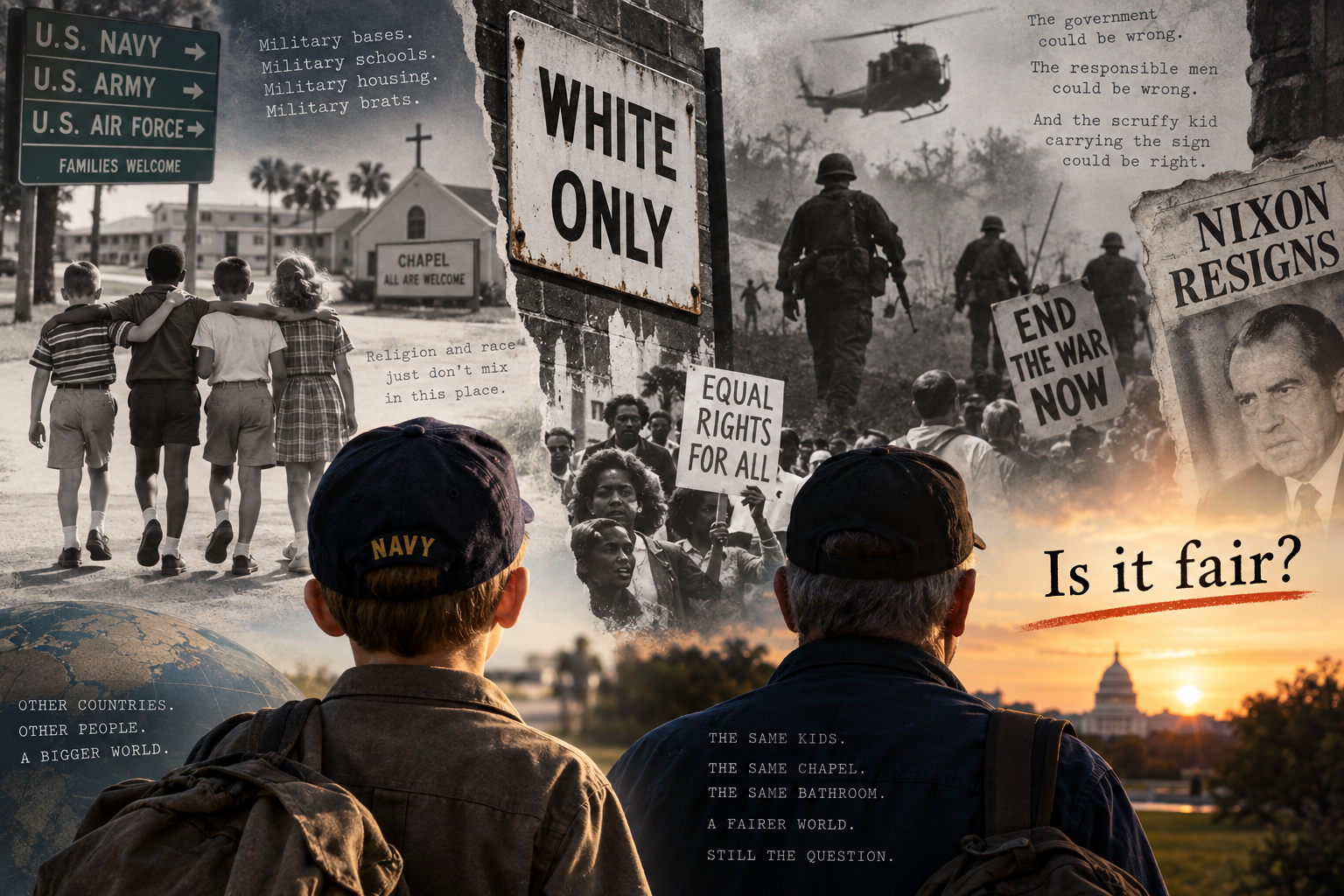
Military bases. Military schools. Military housing. Military brats. Almost every friend I had was another one.
My childhood was beyond sheltered.
One saying still plays in the back of my head.
Don’t be a slow Joe. Be in the know, Joe.
Songs about religion and race went around too. The exact words have faded. The lesson hasn’t.
Religion and race just don’t mix in this place.
Overseas especially, everybody went to the same generic chapel. You went. Your friends went. Their parents went. The chaplain handled the theology. Religion wasn’t absent. It was everywhere, in a mild government-issue way.
But it didn’t sort us. Neither did race. I had Black friends and white friends, and I don’t remember thinking much about the difference. We were Navy kids, Army kids, Air Force kids. Mostly we were kids. Nobody had yet explained all the reasons we were supposed to separate ourselves.
Somewhere in that world I became a Republican. A soft one. Ike was a Republican. The service was strongly Republican. The adults around me were Republicans. So I was a Republican.
My political thinking went no deeper than that. I wasn’t reading Edmund Burke or studying economics. I wasn’t comparing liberalism with conservatism. I wasn’t interested in politics at all. Republicanism came with the furniture.
What I understood of it seemed reasonable. Be responsible. Do your job. Pay your own way. Take care of your family. Don’t complain. Be strong when strength is required.
Something manly ran through it the way my father presented it. Not macho. Not loud. Responsible. A man took responsibility for himself and for the people who depended on him.
That seemed reasonable. It still does.
No day came when I left the Republican Party. One event came closest.
Vietnam.
The calendar argues with my memory. Selma and the war landed in the same few years. Memory sorts by weight, not by date, and the war weighed more.
I came to believe it was wrong. Not mistaken. Not poorly managed. Wrong.
That created a problem for a young man his father had raised to respect authority. Everyone I trusted said the protesters were the irresponsible ones. The troublemakers. The radicals. The long-haired kids shouting at the grown-ups. But they were saying something I increasingly believed. The war is wrong.
I drifted toward them. Then I marched. Then I protested.
I don’t think I became a liberal that day. I think I became suspicious.
The institutions I had been taught to trust could be wrong. The responsible men could be wrong. The government could be wrong. The generals could be wrong. And the scruffy kid carrying the sign could be right.
Quite a discovery for a military brat.
Beneath it sat a simpler thought.
It isn’t fair.
That sounds childish. It is. But childhood had handed me a simple test. You don’t cheat. You don’t bully. You don’t lie. You don’t hurt somebody because you can. And if you hold authority, the rule binds you harder, not looser.
Once I began applying that test, I started seeing things differently.
In 1965 I saw the civil rights struggle directly. White-only bathrooms in Selma.
WHITE ONLY.
I had been born there. Now I was old enough to understand what the words meant. I had gone to school with Black kids. I had played with them. Now a sign told one of them he could not use my bathroom. Why? Because he was Black.
It isn’t fair.
That was enough. I did not need a constitutional argument to understand a bathroom door.
The outside was invading, and it was uglier. Vietnam. Civil rights. Then Nixon. Another responsible adult. Another institution. Another lesson.
I didn’t suddenly become a Democrat. I drifted. Vietnam moved me. Civil rights moved me. Nixon moved me.
As I paid more attention, the Republican slogans I had once found reassuring began sounding different. Simple became simplistic. Self-reliance became indifference to somebody else’s suffering. Law and order meant plenty of law for somebody else and very little interest in the conduct of the men enforcing it. Religious belief became an excuse to tell another person how to live. Patriotism became an instruction not to question the government.
I began to see selfishness where I had once seen self-reliance, cruelty hiding behind toughness, and a hunger for a strongman where I had once seen respect for order.
Eventually I began using a harsher word.
Fascist.
Not as an insult for a man I dislike. I mean one leader placed above the institutions, and a country sorted into real citizens and enemies. I am not waiting politely for the historians.
A long way from Ike.
By then I wasn’t much of a Republican anymore. I just hadn’t announced it. No reason to. You don’t resign from a political party. You wake up one day and realize you haven’t lived there in years.
Then came Trump.
He did not make me leave. He arrived decades too late for that. Vietnam started it. Selma sharpened it. Nixon helped. Trump made the distance impossible to ignore.
And I had changed. Other ideas. Other people. Other countries. Other ways of looking at the world. That sheltered military brat finally got outside the gate.
The farther I traveled from that childhood, the more useful its simplest lessons became.
The Black kid is just another kid. The Catholic kid is just another kid. Everybody can sit in the same chapel. Everybody can use the same bathroom. Authority does not make you right. Strength does not give you permission to bully. Responsibility runs uphill; toward whoever holds the power.
And fairness matters more than anything else on the list.
I have lived long enough to know politics is complicated. War is complicated. Race is complicated. Religion is certainly complicated. But we use complexity to avoid seeing what stands in front of us.
A sign says WHITE ONLY. A government sends young men to die in a war that should never have been fought. A president abuses his power. A politician tells you which of your neighbors to fear.
We can write books about all of it. Sometimes we should. But somewhere behind those books stands the little military brat who grew up in a world so sheltered that nobody had yet taught him whom to hate.
He is still there. Still measuring. Still asking the same embarrassingly simple question.
Is it fair?
He asks it of other people more easily than he asks it of me.
I am often wrong. Usually, if I add it up honestly. I was wrong about the war before I was right about it. I was wrong about the party for years after the evidence was in. I have spent a life applying a simple test to other people and grading myself on a curve.
The sign in Selma is the one I keep. I knew what it meant the second I read it. Knowing what a thing means and doing something about it are not the same act, and at 19 I was much better at the first.
The test does not exempt the man holding it. Fairness isn’t a position you take. It’s a bill, and I have let some of them go unpaid.
I never left the Republican Party. I kept walking toward what looked fair, and one day I looked back. The party was a long way behind me.
Somewhere, faintly, the old songs still play.
Religion and race just don’t mix in this place.
I sang that for most of my life without hearing it. A child hears a rule about getting along. Read it the other way and it is an order. Keep them apart. Don’t let them mix.
I don’t know which way the man who wrote it meant it.
I know which way the bathroom door meant it.