
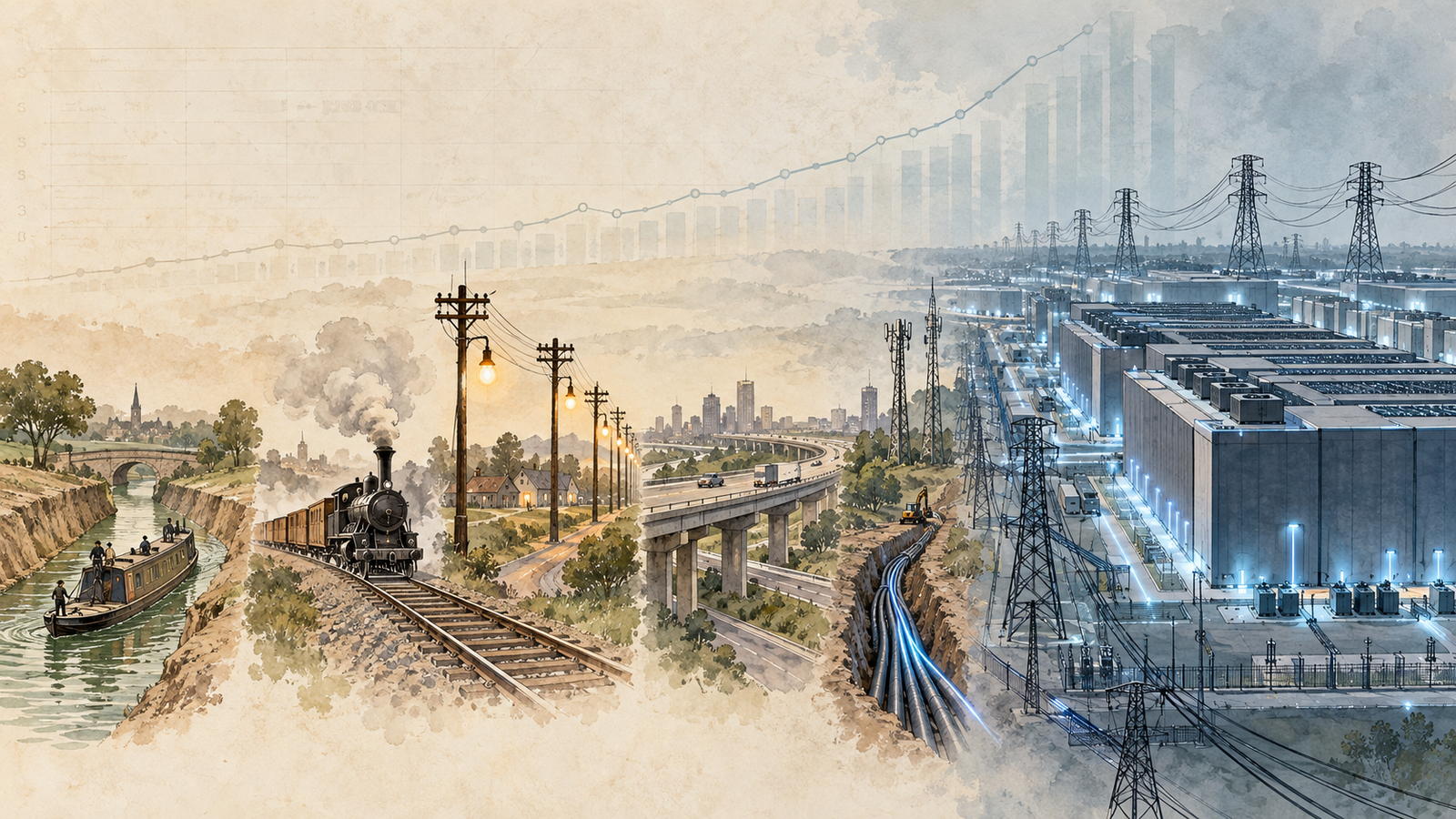
This is about A.I. spending.
I owe you a couple of posts. My back took them. It picked a fight last week, won, and put me in the hospital for five days. I spent those days looking at the health care system of the United States from the inside, which is the one angle it does not want you to have, and I am writing that down while it is still fresh. You will get that essay soon. I am home now. The back is not much better. I write anyway. Lying still is the one thing the back permits and the one thing I have never been able to do. Tuesday I see the doctor who last worked on it. Yes, Tuesday. Election day. I know. I will vote today so the back cannot take that from me too. I may miss another post or two before this is settled. At 80 you learn the body keeps its own calendar and does not check yours.
For now, I offer you this:
Inspired by Paul Krugman.
Selected U.S. Capital Expenditure Booms
|
Episode |
Period |
Size (% of GDP) |
|
Canals |
1836–1841 |
0.66 |
|
Railroads |
1870–1890 |
2.24 |
|
Electrification |
1905–1925 |
0.50 |
|
Highways |
1956–1973 |
1.13 |
|
Telecom and fiber |
1996–2003 |
1.10 |
|
AI buildout |
2025–2032 |
3.63 |
Canals (1836–1841)
The Erie Canal opened in 1825 and paid for itself so fast that every state with a creek and a legislature felt cheated. Pennsylvania, Ohio, Indiana, and Illinois borrowed in London and started digging. Indiana passed the Mammoth Internal Improvement Act of 1836, which committed the state to spending more money than the state had. The name was the most honest part of it. The Panic of 1837 arrived before the water did. Tolls never covered the interest. By 1842 nine states had defaulted, and Indiana's canals ran from one cornfield to the next and stopped. The railroad made the finished ones obsolete inside a generation. Indiana farmers spent decades paying for a ditch they could step across, and the state wrote its hangover into the 1851 constitution, where it still forbids itself to borrow. The ditch never cared. Water does not do gratitude.
Railroads (1870–1890)
The golden spike went in at Promontory in 1869, and the United States spent the next 20 years laying track as if steel were a crop. Mileage tripled, from about 53,000 miles to more than 160,000. A good share of it ran alongside a competitor's line to towns that existed only on the promoter's map. Jay Cooke's Northern Pacific failed in 1873 and took the economy down for six years. Credit Mobilier showed where the money went: through Congress, in both directions. The Panic of 1893 put a quarter of the nation's railroads into receivership. Investors lost everything twice, which takes commitment. The rails stayed. They stitched the country into one market, invented standard time, and turned a swamp on Lake Michigan into Chicago. They also built a thousand towns, then moved the junction and killed them. Kansas still has their names on the map and nothing else. The bondholders paid for all of it. The rest of us inherited the furniture and never sent a note.
Electrification (1905–1925)
Samuel Insull arrived from England as Edison's secretary and ended up owning the lights in 5,000 towns. He built the generating stations, strung the wire, and sold electricity to people who had never owned anything that hummed. Urban homes with power went from a sliver in 1907 to two-thirds by 1930. Factories tore out the steam shaft and the leather belts, bolted a motor to every machine, and arranged the floor around the work for the first time since the water wheel. That was the productivity miracle of the 1920s, and nobody got a medal for it. The spending looks modest here, half a percent of GDP, because a monopoly borrows cheap. The bust came in the paperwork. Insull stacked holding companies on holding companies until the pile fell over in 1932 and buried 600,000 shareholders. He fled to Greece. The United States hauled him home, and he walked out of three trials acquitted. The law had no word for what he did, so Congress invented one in 1935. The farms waited for the government to wire them that same year, because no private company saw a profit in a man with 80 acres and a mule. Capital lighted the homes that could pay. The rest sat in the dark, which is where capital prefers to keep its costs.
Highways (1956–1973)
Eisenhower remembered a 1919 Army convoy that took 62 days to cross the country, and he had seen the autobahn on his way to Berlin. He signed the Federal-Aid Highway Act in 1956, and the United States set out to pour 41,000 miles of concrete, paid for by a gas tax so small that nobody noticed it for 40 years. This is the one boom on the list that never busted, because nobody asked the road to earn a dime. The government just built it. Eisenhower was a Republican, and he sold the road as national defense so nobody could call it socialism. Today's conservatives would call it exactly that, then drive on it to the rally. That is their way. They never refuse the thing. They refuse the bill. The interstates delivered the suburb, the shopping mall, the long-haul trucker, and Walmart. They also delivered six lanes through the middle of Black neighborhoods in Detroit, Nashville, New Orleans, and a dozen other cities because the land was cheap and the people could not stop a bulldozer with a petition. Downtowns emptied. The streetcar died. Passenger rail went on a ventilator and is still there. We got the road. The road got the cities. The ledger only counts what you poured, never what you poured it over.
Telecom and fiber (1996–2003)
The Telecommunications Act of 1996 opened the market, and Wall Street found half a trillion dollars for WorldCom, Global Crossing, Level 3, Qwest, and a hundred companies whose names now live in a bankruptcy lawyer's filing cabinet. They laid fiber across the country and under two oceans on the theory that internet traffic doubled every 100 days. It doubled about once a year, which is a magnificent growth rate and nowhere near the one in the prospectus. Most of the glass went dark before anyone turned it on. I was in the software business then and heard the pitch more times than I can count. The old rules were dead, every CEO with a slide deck told me. The old rules sent Bernie Ebbers to prison for 25 years after WorldCom hid 11 billion dollars in losses and became the biggest bankruptcy in the nation's history. Investors lost about two trillion dollars, and a great deal of it belonged to pension funds, which is to say to teachers and firemen and the woman who answered the phone at the plant. Then the dark fiber sold for pennies on the dollar, and that cheap bandwidth is the only reason YouTube and Netflix exist. The companies died. The glass outlived them. The men who bought it at the bottom got very rich, and not one of them had laid a foot of it.
AI buildout (2025–2032)
This row is a forecast, and the forecast is the only part of a boom that always gets built. The 3.63 would make it the largest capital boom in the history of the United States, bigger than the railroads, which at least had somewhere to go. Microsoft, Amazon, Google, Meta, and OpenAI are spending hundreds of billions of dollars a year on data centers, Nvidia chips, and the power plants to feed them. Utilities that could not find the money to bury a wire for 50 years have found it now, because a server pays its bill faster than a grandmother in a heat wave. Every row above this one tells the same story in different handwriting. The money evaporates. The builders fail. The hardware survives and serves people who never paid for it. The difference this time is shelf life. Fiber still carries traffic 25 years later. A chip is obsolete in three. The canal at least held water. I spent 40 years in software, and I respect what these machines can do. I have met the men who own them, or men just like them, and I would not lend them a lawnmower. Every boom on this list promised to carry something. Grain. Passengers. Current. Cars. Bits. This one promises to carry us, and nobody has said where.