Is the Invasion Legal?

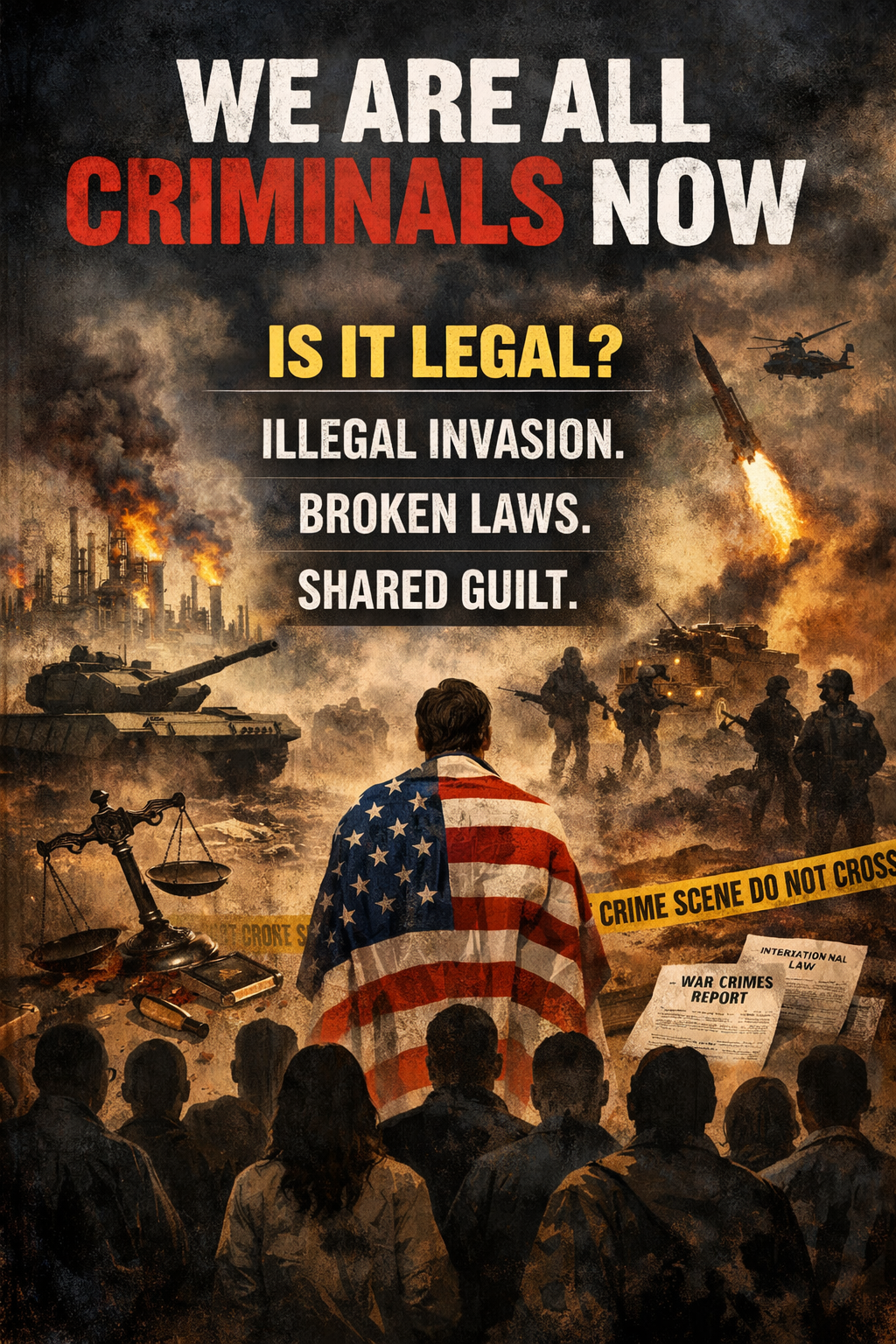
We Are All Criminals Now
That's the first question. Not whether it feels justified. Not whether we're angry. Not whether the other side is awful.
Is it legal.
Because if it isn't, then this isn't policy. It's a crime.
International law is boring on purpose. Two lanes. No detours.
A country can use force only if it is defending itself from an actual or imminent armed attack, or if the UN Security Council explicitly authorizes it.
That's it.
Venezuela has not attacked the United States. Not troops. Not missiles. Not anything that qualifies. And there is no Security Council authorization. None. Zero.
So if we invade, it's illegal.
Not controversial. Not nuanced. Arithmetic.
Everything that comes after is justification shopping.
Drugs. Corruption. Migration. Humanitarian collapse. Democracy.
All real problems. None of them legal reasons for war.
If corruption justified invasion, Washington would be a smoking hole. If incompetence were a casus belli, half the planet would already be occupied.
Law exists to stop power from deciding it's special.
And when power ignores the law, the act is criminal. That word makes people flinch, because it sounds personal. It isn't. It's structural. States commit crimes. Citizens inherit them.
That's where Venezuela's oil enters the story.
Venezuela nationalized its oil. Completely. Foreign operators were pushed out or subordinated, contracts rewritten, profits routed through the state oil company, PDVSA, instead of multinational balance sheets.
And here's the part that never makes the speeches.
Foreign operators were paid after international arbitration. Slowly. Reluctantly. But lawfully. Disputes were heard. Awards were issued. Compensation followed.
That closes the legal file.
Expropriation with compensation is allowed under international law. Period. What Venezuela did afterward—mismanagement, corruption, collapse—is tragic, but it is not a license to invade.
Other countries have done the same thing.
Norway built a modern state on nationalized oil and was praised for it. Saudi Arabia nationalized Aramco entirely and became indispensable. Mexico did it in 1938 and survived. Iran did it in 1951 and got a coup. Iraq did it in the 1970s and later got tanks. Bolivia did it in 2006 and got labeled unstable. Russia does it and gets lectures.
The rule isn't law. It's usefulness.
If you nationalize oil and stay obedient, you're sovereign. If you nationalize oil and say no, you're a problem.
That explains motive.
Now the part we usually try to dodge.
We voted for Trump.
Enough of us did. Knowing who he was. Knowing how he talked. Knowing the wreckage behind him. Knowing the lawsuits, the lies, the rot.
He is a criminal. Not as insult. As description. Courts, records, evidence. And he is our leader.
Which means when crimes are committed in our name, they belong to us too.
That's how citizenship works. You don't get the power and outsource the guilt. You don't get to say "he did it" when you handed him the wheel.
Illegal war isn't a personality flaw. It's a collective act.
We are all criminals now. Not because we're evil. Because we chose power over law and called it strength.
That doesn't make us irredeemable. But it does make us responsible.
The oldest lie in politics is that only leaders commit crimes. The truth is uglier. Crimes of state require consent, silence, or applause.
We gave at least one of those.
The crime isn't that Trump did this—it's that we let him do it for us.
Share on FacebookIf this landed, send it to one person who needs to read it.