Not Yet Enough to Matter

How Jeffrey Epstein Survived Decades of Institutional Failure
The press writes Jeffrey Epstein as a dark magician who appeared from nowhere, bought half the ruling class, and carried his secrets to the grave.
That version is dramatic. It is also too easy.
It lets institutions off the hook.
The real story is uglier, more ordinary, and native to the United States. Epstein did not rise because he was mysterious. He rose because powerful people rewarded fraud, mistook access for intelligence, and treated young women as expendable collateral around a man who made money. Or seemed to.
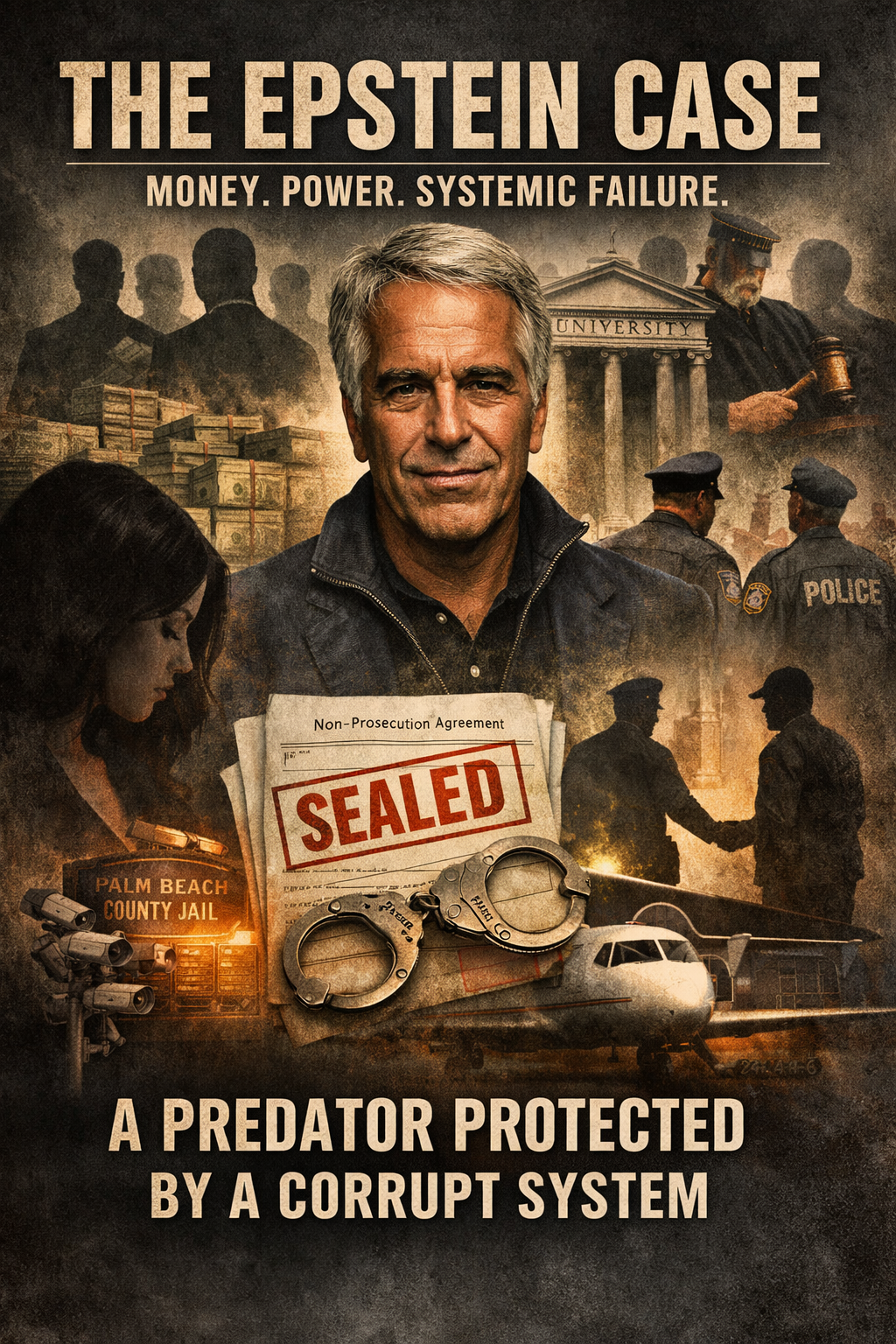
The record points to the same conclusion again and again. A predator protected by money, vanity, class deference, and institutional failure.
The first lie was the myth of Epstein as financial genius.
For decades, Epstein cultivated the image of a billionaire who moved money for powerful men. The reality was less glamorous. He was a skilled manipulator. He possessed a talent for attaching himself to institutions too vain, too compromised, or too lazy to examine him closely.
The story begins in the 1970s at Bear Stearns.
Epstein taught mathematics and physics at the Dalton School in Manhattan. A parent introduced him to Ace Greenberg, a senior executive at the investment bank. Greenberg brought the young teacher to the firm, ignoring Epstein's total lack of Wall Street experience.
Soon after hiring him, Bear Stearns discovered Epstein fabricated his college degrees. They confronted him. He admitted the lie. Instead of firing him, senior executives kept him.
There it was, early and plain. Deception followed by institutional forgiveness.
The indulgence did not stop there.
Colleagues watched Epstein bend internal rules, cultivate powerful patrons, and use senior executives as insulation. In the early 1980s, Bear Stearns investigated him for questionable conduct involving IPO share allocations and personal loans.
Rather than fire him, they let him resign.
He did not leave finance disgraced. He left with something better.
Connections.
Bear Stearns executives kept introducing him to wealthy clients. The institution that investigated him became the launching pad for his career.
During the years that followed, Epstein built his fortune through opportunism, manipulation, and the confidence game that passes for sophistication in elite circles.
One early episode involved Michael Stroll, a video-game executive who handed Epstein $450,000 for a supposed oil deal. Most of the money disappeared. Stroll sued. Epstein avoided personal liability.
Other ventures included his association with Steven Hoffenberg, whose company, Towers Financial, later collapsed as a massive Ponzi scheme.
None of it produced lasting professional consequences.
Instead, Epstein climbed.
He cultivated wealthy families, socialites, and financiers. He sold himself as a specialist in hidden assets and tax-efficient structures. Whether he actually possessed extraordinary financial skill mattered less than whether powerful people believed he did. In elite circles, belief is usually enough.
The turning point came through Leslie Wexner, the billionaire behind The Limited and Victoria’s Secret.
Epstein gained power of attorney over Wexner’s finances. He managed significant portions of his wealth.
That relationship gave Epstein something more valuable than money. It gave him legitimacy.
With Wexner behind him, Epstein moved through elite financial circles as the trusted adviser to one of the richest men in the United States. That single credential opened doors everywhere. Wall Street. Universities. Philanthropy. Politics.
Even then, the financial mystery never disappeared.
He had few visible clients. His trading activity remained opaque. Yet he accumulated extraordinary assets. Mansions. Aircraft. A private island in the Caribbean.
What mattered more than the exact mechanics of his wealth was the system that accepted it.
Banks accepted him.
Elite social circles absorbed him.
Academia proved just as hollow. Epstein recognized that universities run on the same fuel as Wall Street. Cash and vanity. He poured millions into Harvard and the Massachusetts Institute of Technology. He funded evolutionary dynamics and theoretical physics. In return, the brightest minds in the United States lent him their prestige. Gell-Mann and Krauss attended his dinners. Church took his money. They rode his planes. They treated a predator like a visionary because he wrote the checks. The pursuit of knowledge bowed to the pursuit of funding.
By the late 1990s, Epstein built relationships across politics, business, and celebrity culture. His Manhattan townhouse became a salon for prominent scientists and ambitious men who enjoyed orbiting status.
Behind that façade, Epstein built a sexual-abuse network involving underage girls.
The abuse required logistics. It required an infrastructure of complicity. Assistants managed the schedules. Housekeepers stocked the mansions. Private pilots filed the flight plans. The machine was not just billionaires and politicians. It was a payroll of ordinary people who looked the other way for a salary. They normalized the grotesque because the checks cleared.
The machine did not merely tolerate him at the top. It tolerated him at the gates.
Federal records show how he bought relationships with U.S. Customs and Border Protection officers stationed in St. Thomas. Favors. Friendliness. Access. The quiet softening of scrutiny. Epstein understood that power does not only live in boardrooms. It lives with the people who wave others through.
The same pattern defined his elite friendships.