Paradise, Paved

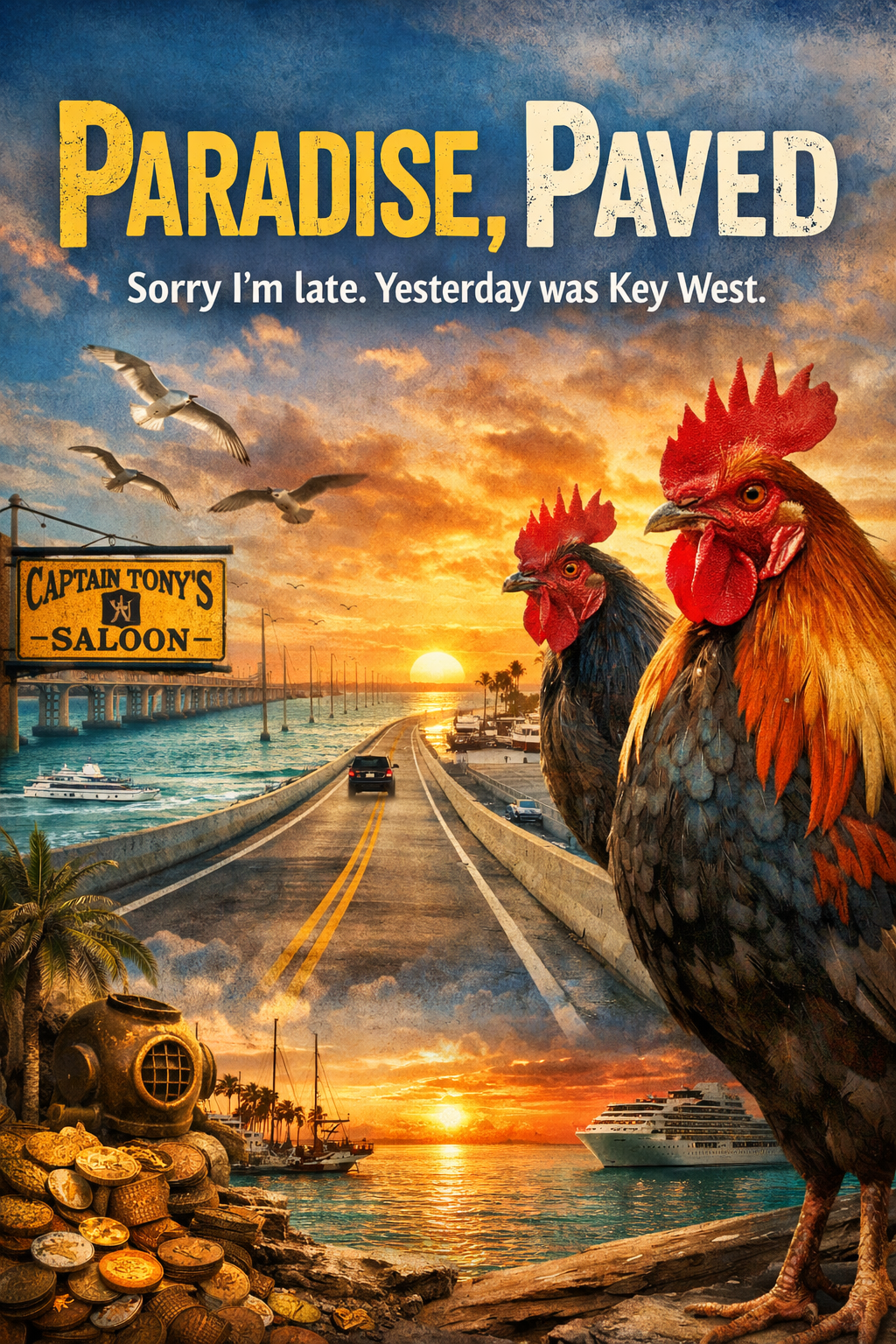
Sorry I'm late. Yesterday was Key West.
If you've never done the drive down the Keys, it starts to feel like the ocean is closing in around you, which it is. Strip of road, water on both sides, and eventually the end of the country. We're in the Keys for a while. The weather is perfect. The ocean is beautiful. And there are roosters everywhere.
That part isn't new. The roosters have been there for two hundred years, brought from Cuba in the 1860s by immigrants who liked their cockfighting and needed the raw material. Florida outlawed cockfighting in 1986. The roosters stayed. Nobody asked them to leave and nobody could make them go. The city hired a professional chicken catcher in 2004—$20 a bird—and he quit before the year was out, driven off by residents who loved the roosters more than they loved quiet mornings. The chickens are now protected, marketed, and celebrated. There is a waiting list from farms across the country to adopt Key West roosters. That's the island in a sentence.
We drove down yesterday. I had an agenda.
First stop: Hemingway's actual bar. Not the one you're thinking of. Everyone goes to Sloppy Joe's on Duval, which is loud and bright and sells t-shirts with his face on them. He never set foot in it. The real bar—the one where he showed up every afternoon at 3:30 with his circle of local drunks, fishermen, and low-lifes—was at 428 Greene Street, now called Captain Tony's Saloon. Small. Dark. Dollar bills covering every surface. A tree growing through the middle of the room that was Key West's actual hanging tree in the 1800s. Hemingway's friend and boat captain Josie Russell owned the place. Hemingway called him Freddie in To Have and Have Not. In 1937, the landlord raised the rent from three dollars a week to four. Russell moved the bar half a block to Duval, taking the name and the customers with him. Hemingway was already leaving Key West by then—his marriage falling apart, a new woman, Cuba waiting. His drink was Teacher's Scotch and soda.
I ordered something cold and sat under the hanging tree for a while.
I never met Hemingway. Nobody alive in Key West did. But his spirit is pervasive the way smoke is pervasive—you can't see it and you can't quite locate it and you know it soaked into the wood. He wrote Death in the Afternoon here. Green Hills of Africa. To Have and Have Not. He fished with the Cubans and drank with the locals and left. The legend outlasted everything else. The cats are still there, technically descendants of his six-toed originals. They have their own gift shop.
The Navy was enormous when I lived here. The submarine base at the Truman Annex—the western end of the island, where President Truman kept his winter White House—was decommissioned in 1974 because nuclear submarines had grown too large for the harbor. The government put the property up at public auction in 1986 and sold it for seventeen million dollars. It is now a gated community. The median property price is $1.2 million. What was a working military installation is now somewhere you need to be buzzed through a gate to enter, assuming you can cover the admission. The tour guides at the Little White House will tell you that the Secret Service once built Truman a private beach — sand hauled in, secured perimeter, the whole apparatus — and he walked to the public beach instead. That also sounds right. The Naval Air Station is still running, six miles east on Boca Chica. The Navy hasn't left entirely. It just moved somewhere less valuable.
I used to deliver papers to the row of homesteader houseboats on the east side of the island. They were odd and wonderful—people living on the water in structures that were partly boats and partly houses and entirely their own idea of how to exist. Working class. Eccentric. Key West before Key West became a product. The city decided they needed to go in the early 1990s. The last one was hauled away in 2002. Multi-million dollar condos materialized across the street almost immediately. The cynic's argument writes itself. The official history declines to write it.
The gatherings at the waterfront were something else when I was young. Every evening a real circus assembled at the breakwater—a trapeze walker, cats jumping through flaming hoops, fortune tellers, food trucks, all independent performers, all locals working without a net in every sense. The tradition started with Tennessee Williams, who one evening began applauding the sun as it went down and kept doing it until other people joined in. There was never enough parking, so the city paved over the performance area to create a parking lot. Joni Mitchell wrote a song about that exact sequence of events, applied to a different parking lot. She was right then and she's right now. The performers work for the resorts and hotels lining the waterfront—enormous structures carefully designed to look smaller than they are. The cruise ships at the nearby dock are not designed to look smaller. They are twenty stories of floating American mall, and when they arrive, thousands of people pour into downtown riding rented motor scooters with the confidence of people who have never operated a motor scooter.
The beaches are nice, though artificial. The breakwater where a barracuda once kidnapped my bicycle is still there.
Lanying and I had lunch at our favorite Chinese restaurant, same place we've been going for years. It sits in what used to be a normal strip mall, now wedged between a large Publix and a large T.J. Maxx. The food is excellent. They've lost one employee to ICE and the rest live in terror. They are the kind of people Key West was built by—working, feeding people, keeping their heads down and their kitchen clean. Residents don't pay Key West prices. Everyone else does.
Mel Fisher is dead. I met him once, on a dock, on collection day for my paper route. He was already hunting for the Atocha—the Spanish galleon that went down in a hurricane in September 1622 with forty tons of gold, silver, and Colombian emeralds aboard. He had the salesman's gift, that warm absolute certainty that you'd both be rich very soon. He talked me into handing over my paper route funds to invest in his venture.
He found the motherlode on July 20, 1985. His son Kane radioed in from the search vessel: Put away the charts. We've got the mother lode. Four hundred million dollars on the bottom of the Florida Straits. His mantra every morning for sixteen years: Today's the day. He died of lymphoma in 1998, ashes scattered along the ocean floor where he made his fortune.
My share was magnificent. It still is.
If this reads like a eulogy for a place that's been paved over and sold, it isn't. I love Key West. So does Lanying. So, apparently, does the Cat, who comes with us and seems entirely unbothered by the roosters. We come here often and we will keep coming. Paradise has proven more durable than its enemies.
In my younger days, Lanying would fly us down in her plane every Fourth of July for the lawn party at the Casa Marina—Henry Flagler's hotel, built in 1920 as a monument to his Overseas Railroad and the end of the line. It opened on New Year's Eve 1920; Warren Harding arrived three days later and established the tone. It has hosted everyone from Gregory Peck to the U.S. Army's Sixth Missile Battalion during the Cuban Missile Crisis. The fireworks over the water were something you don't easily describe to someone who hasn't seen them from that lawn. We don't fly in for the Fourth anymore, but the memory sits where good memories lie.
Key West has always been a refuge for people the mainland didn't know what to do with. Tennessee Williams found it in the 1940s and told his friends. By the 1970s the stream of gay men and women coming to the island had become a torrent—over thirty same-sex guesthouses on a four-mile island, and a community that rebuilt whole neighborhoods the rest of the city had given up on. In 1983, Key West elected Richard Heyman as mayor, one of the first openly gay mayors in the country. Then AIDS arrived and killed more than a thousand people on an island of fewer than thirty thousand. The community didn't leave. It built a memorial. It stayed and fought and kept the place alive.
What finally did the damage wasn't a plague. It was success. The neighborhoods they restored became desirable. Desirable became expensive. Expensive became unaffordable. Gay bars and guesthouses that had operated for decades are closing or going straight—not out of hostility but out of arithmetic. The cruise ships accelerated it. A thousand strangers flooding Duval Street twice a day don't need a gayborhood. They need a souvenir. The rainbow flags still fly. The drag shows still run. But the community that planted those flags is getting priced out of the island it saved, one $1.2 million condo at a time.
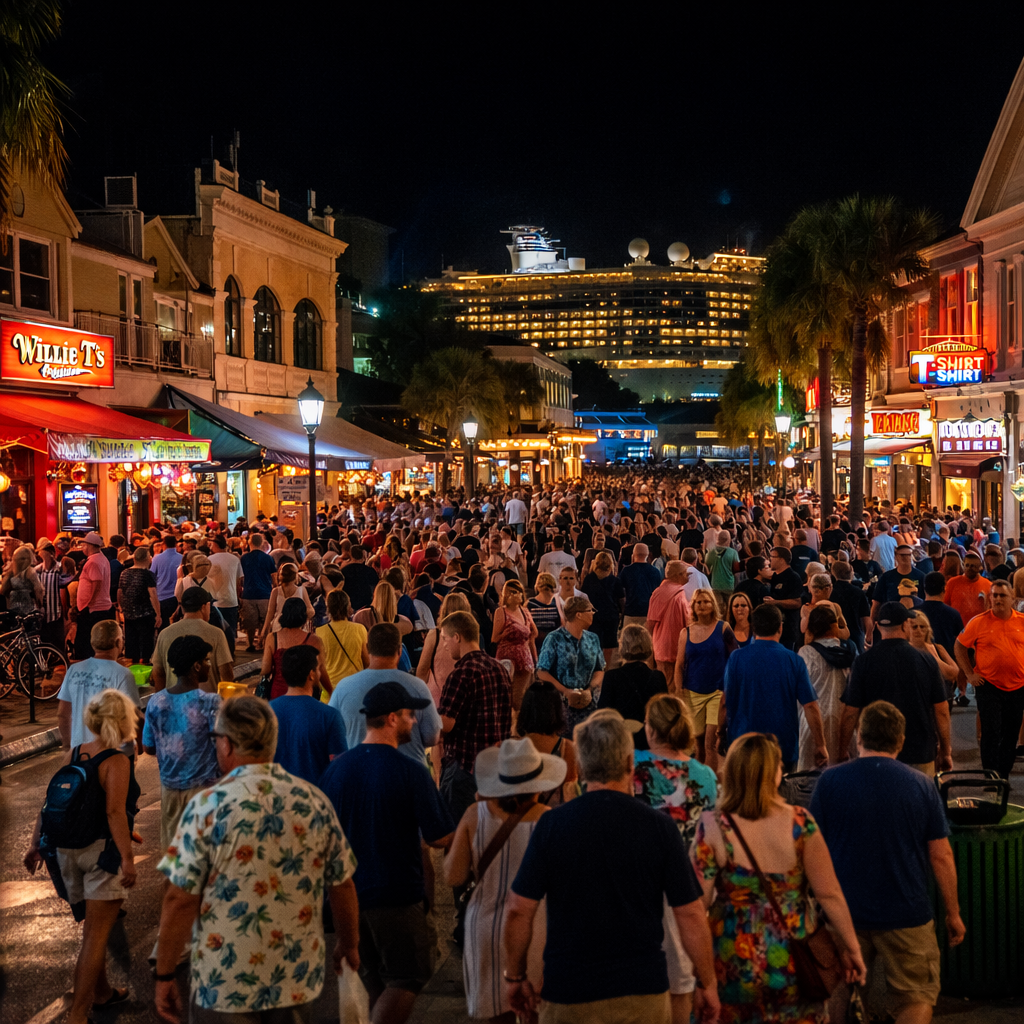
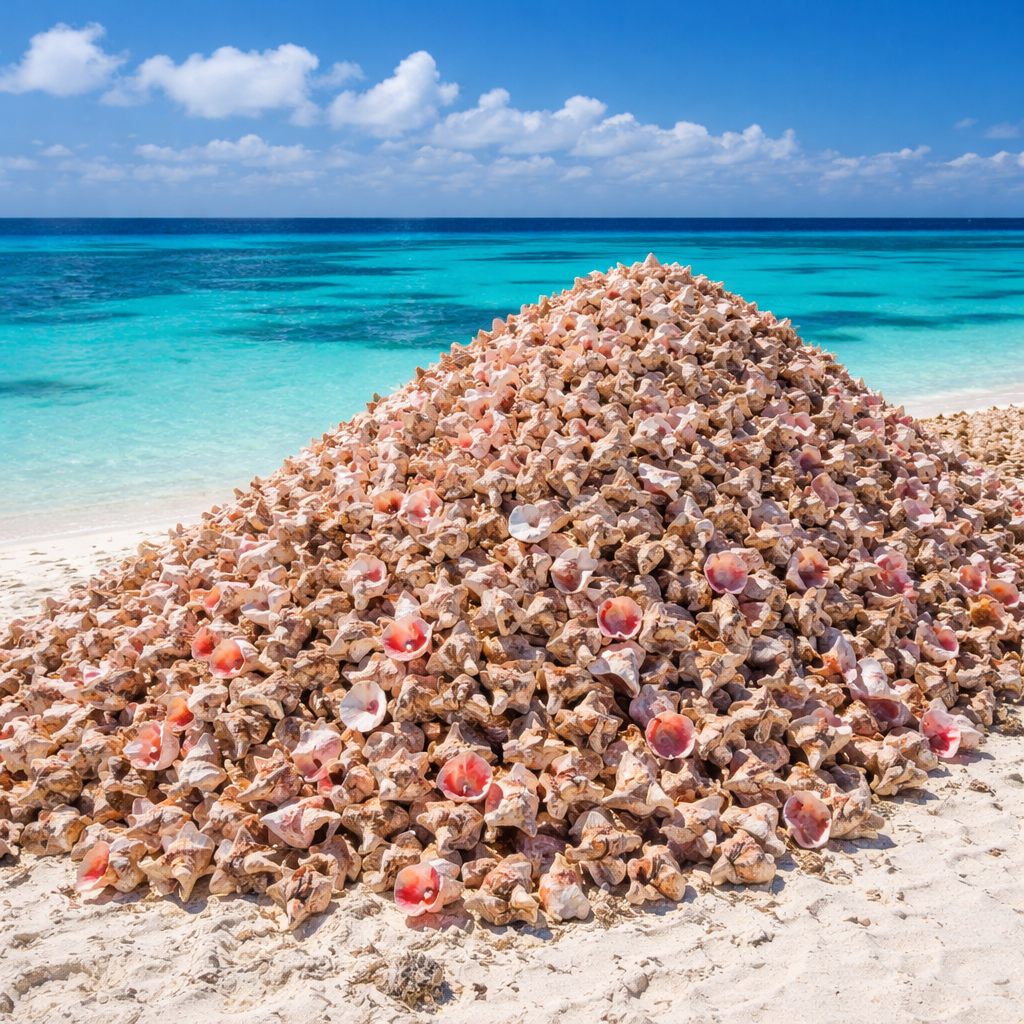
The artists are still there, for now. You can find them on the side streets and in the small galleries, selling paintings of the water and the light and the roosters to people who've just spent $28 to park and $19 for a margarita in a plastic cup. A good watercolor of the harbor goes for what used to be a month's rent. A meal for two without alcohol runs $90 before tip. Coffee is $8. There are restaurants where a conch chowder appetizer costs more than the fisherman who caught the conch makes in an hour. The souvenir shops sell queen conch shells—big pink ones, nine inches across—for $40, $50, $60 apiece. In the Bahamas, fishermen crack them open on the beach, pull out the meat, and leave the shells where they fall. Over the years the piles stack up several feet high along the shoreline, pink interiors catching the light, nobody wanting them, nobody selling them, no price tags, no display stands. Just the record of what was eaten.
And still. The light hits the water at five in the afternoon and there is no arguing with it. The roosters stand in the middle of the street and dare you to move them. The ocean does exactly what it wants. The old bones of the place are still under everything the money built on top of them. Key West is resisting, but the parts that have surrendered are indistinguishable from every other tourist trap on the coast — the same overpriced T-shirts, the same plastic cups, the same restaurants with laminated menus and no local on the payroll. Vanilla with a sea breeze.
Paradise remains. Slightly out of breath. Still here.
If this landed, send it to one person who needs to read it.