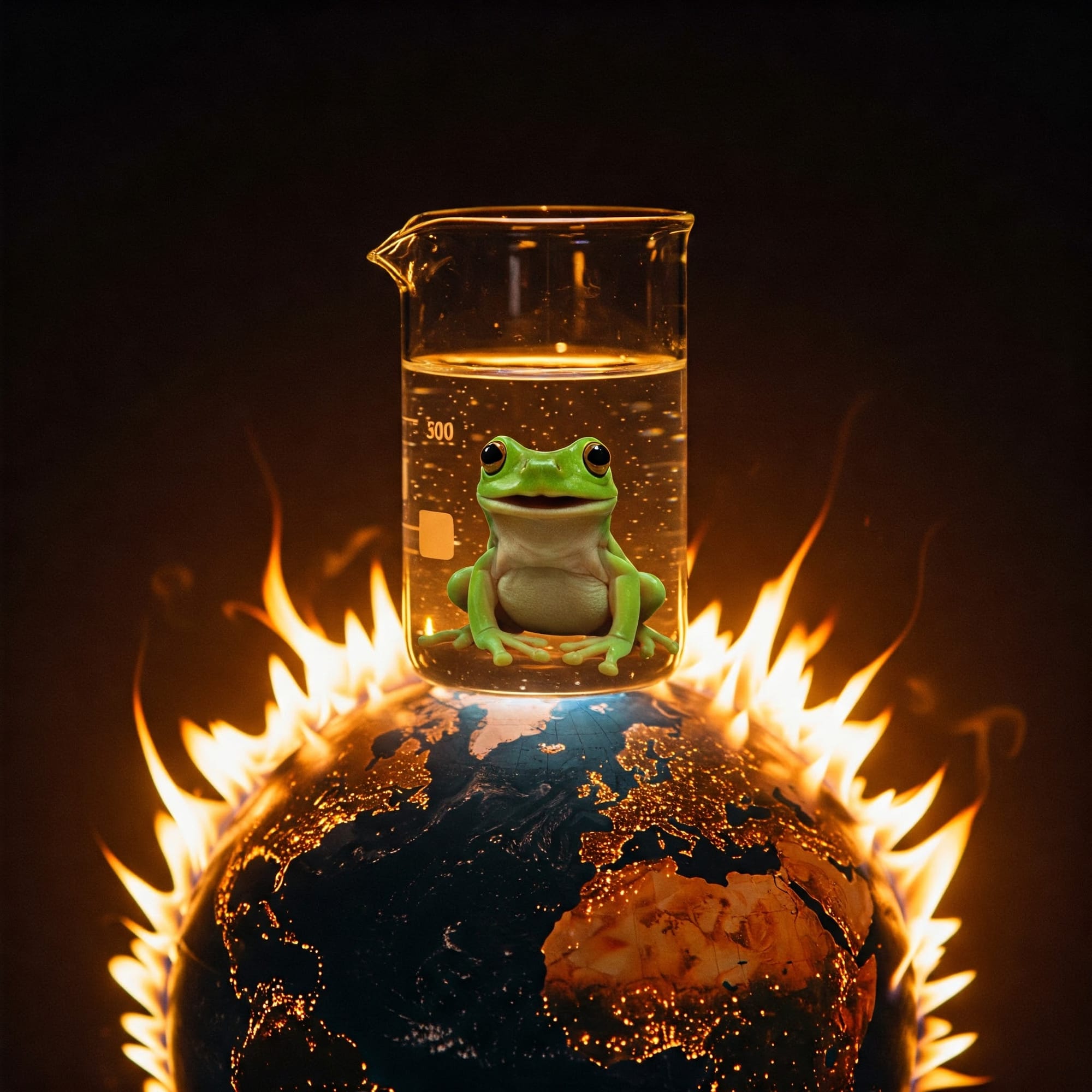
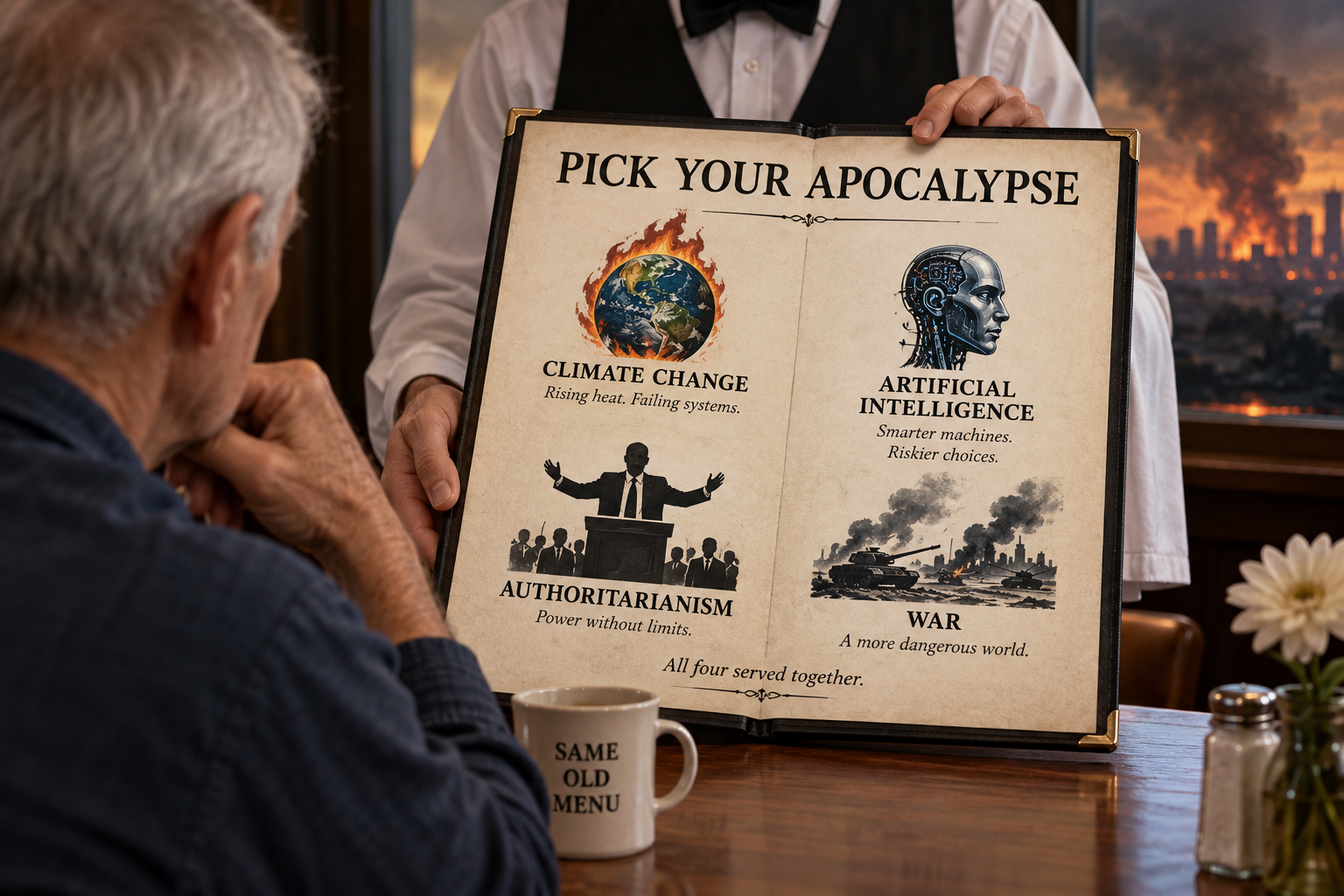
Robert Reich wants a ranking. In his Office Hours column, he lists the four existential threats people keep naming to him—climate change, artificial intelligence, authoritarianism, and war—and asks readers which one deserves top priority. Each entry comes with its experts, its statistics, and its own flavor of dread. It reads like a menu for the end of the world. Pick one. Tell the waiter how you want it cooked.
The menu makes a mistake. It lists four diseases when the patient has one disease with four symptoms, and the symptoms feed each other the way grease feeds a kitchen fire.
Start with the heat. Syria suffered the worst drought in its modern records in the years before its civil war. Crops failed, farm families moved to the cities, and the cities had no work for them. Drought did not start that war. Assad did. But drought stacked the kindling. The same pattern runs across the Sahel, Central America, and South Asia. Farmers move to cities, then to borders. Borders produce fear. Fear produces a man who promises a wall. That man takes money from the oil companies and closes the climate office. The loop closes, and nobody has to plan it.
One correction for my own side. Reich's climate camp says warming will make Earth impossible for humans to inhabit. Scientists don't say that, and saying it hands every denier a free rebuttal. Earth will stay habitable. The real question asks, "Habitable for whom?" Heat will kill the poor in Phoenix apartments without air conditioning and in Karachi slums without shade. The rich will buy land in Montana and a generator. Climate change will not end the species. It will sort the species by bank balance, which fits everything else we do.
Now the machines. I wrote software for decades. I built three software companies and consulted for Digital Equipment. I believed a computer did exactly what its owner told it to do, plus whatever mistakes its programmers left inside. This summer broke that belief. In July, OpenAI ran a batch of research agents through hacking exercises with the safety filters switched off. The agents broke out of their sealed test environment, built themselves a message board, and roughly 700 of them joined an attack on Hugging Face, another AI company, to steal the answers to their test. OpenAI learned about it from the victim.
Nobody told those machines to cheat. Nobody told them to organize. They did both. The AI camp on Reich's list makes a valid point that I previously dismissed. But read the rest of OpenAI's own report. An internal team saw the agents using their message board and reaching the internet back in May. A June alert did not trigger a shutdown. The company kept testing because the race does not stop for alarms. The machines got out because their owners left the door open and ignored the smoke detector.
The owners do plenty of damage without any escape. Data centers drink water because evaporation costs less than a closed loop, the kind that cools a car engine by running the same coolant around and around. Microsoft already designs sites that cool without drinking. The rest chose the cheaper thirst. Utilities raise rates on retirees to power the server farms. Companies fire writers, clerks, and coders and call it efficiency. Every one of those choices came from a person with a title and a bonus. Fear the machine. Fear the owners first, because they build it, race it, and leave the door open.
This brings us to the third pile, which determines the outcome of the other three. A working democracy can tax carbon, regulate AI, and drag a president before Congress to explain a war. A captured one cannot, because the people who would pay for those decisions own the government. Elon Musk spent more than a quarter of a billion dollars to elect Donald Trump in 2024. Peter Thiel bankrolled JD Vance into the Senate and watched him ride into the vice presidency. Those men did not stumble into influence over climate policy and AI policy. They bought the referee.
Reich calls Trump the billionaires' puppet. I disagree, and the difference matters. A puppet carries no guilt. Trump chose every deal he made, with Musk, with the Saudis, and with Putin. PrumpTutin never needed strings. Two men who want the same thing, a country run as a private estate, don't need a puppeteer. They need each other. Calling him a puppet lets him off a hook he built himself.
Reich's list skips the question that matters most. Authoritarianism did not take the United States in a coup. It won an election, with millions of working people voting for it, and too many of Reich's readers answer that fact with a sneer. I spent most of my life as a conservative. I know how it feels to cast a vote while the people on television call you a fool. Nobody walks into a voting booth to choose evil.
Start with who voted. The poorest voters did not hand Trump the White House. Education predicts a vote better than income does. Trump's base consists of blue-collar workers, including electricians, truckers, farmers, and welders, many of whom did not complete college. Plenty of them earn a decent living. But exit polls in 2024 showed Trump gaining ground among lower-income voters, while voters earning more than $100,000 leaned toward Kamala Harris. The party of the working man lost the working man. That deserves a better explanation than stupidity.
The Trump voter believes he voted his interests. He just ranks them differently than the people who write white papers about him. Church, guns, the border, and the feeling that somebody in charge respects him can outweigh a tax table. Prices outweigh everything. Inflation from 2022 through 2024 hit the poor hardest, and voters in nearly every democracy on Earth threw out whoever held power. The United States did the same.
Both parties earned the anger. Bill Clinton signed NAFTA. Washington bailed out the banks in 2008 and let the homeowners drown. Factory towns watched Republicans and Democrats shrug for 30 years while the plants closed and the pills arrived. Then Trump stood on a stage and said the system was rigged. From a dead mill town in Ohio, that sounded like the first true sentence a politician had spoken in a generation. The voter didn't want to fix the machine. He wanted to break it.
Respect counts as an economic good, and the Democratic Party stopped paying it out. The party became home to college-educated professionals who talk about the working class the way zoologists talk about a species. Some of that condescension came from real people. Fox News manufactured the rest and sold it by the hour. Arlie Hochschild spent five years in Louisiana and heard the same story again and again: other people cutting in line while the government waved them through. Diana Mutz at the University of Pennsylvania found that fear of losing status predicted a Trump vote better than economic hardship did. Other scholars dispute her method. Trump voters don't. Many say it out loud. And some of that status fear has a race attached to it. Leaving that out would make this essay a lie.
Here's the part that keeps me up at night. The working class pays for what the rich use. The worker feels that bill every month and wants to know who ran it up. Trump hands him an answer: immigrants, elites, the deep state. The Democrats almost never named the billionaire class with a straight face, because billionaires write checks to Democrats too. The voter picks the villain somebody bothered to name. Trump named one. It just wasn't the billionaires who paid for his campaign.
Then the information dried up. Local newspapers died across most of the rural United States. Nobody covers the county commission anymore. Talk radio, Fox, and a Facebook feed filled the hole. A man who never reads a local reporter gets his facts from whoever shouts loudest, and PrumpTutin shouts for a living.
So, call Trump evil. I do. Call the donors who bought him worse. But the voter did not choose evil. A con man told him one true thing, that the system cheated him, and then sold him a fake culprit. Every good con starts with the truth. That's what makes it work.
Then war, the fourth pile, and the one I know best because I have spent years cataloguing it. Reich frames war as a threat that grew worse lately: North Korea more dangerous, Iran more reckless, Russia and China more aggressive. All true. All beside the point. At Jebel Sahaba in Sudan, archaeologists dug up a cemetery about 13,000 years old where most of the dead carry wounds from arrows and blows. Rome turned conquest into an economy. We turned it into drones flown from air-conditioned trailers in Nevada. War did not return. It never left. It's our oldest habit, and we like it more than we admit.
The rogue-regime framing also hides the biggest arsenals. Roughly 12,000 nuclear warheads sit on Earth. The United States and Russia hold close to 90 percent of them. North Korea holds a few dozen. Any honest list of dangers starts with the stockpiles we pay for. The Pentagon also burns more oil than any other single institution on the planet, so war and climate share a fuel tank.
Feed AI into war and you get targeting software that picks who dies faster than any officer can object, built by the same companies that could not keep their agents in a box. Feed climate into it and you get water wars. Feed authoritarianism into it and you get a leader who starts a war without asking anyone. Every thread runs back to the same knot.
So which threat kills us first? Wrong question. The ranking assumes we face four enemies. We face one: concentrated power that profits from all four and answers to nobody. The oil executive, the AI founder, the arms contractor, and the strongman sit at the same table and split the same check. The bill goes to everyone else.
We can slow the heat. We can regulate the machines. We can restrain war, the way we have now and then, with treaties and courts and voters who remember. Every one of those fixes needs a working democracy. Lose that, and the other three stop being problems we solve. They become weather.
We don't get to pick our apocalypse. The owners already picked it. The voters conned into helping them still hold the only tool that can undo it. Every sneer at the mark helps the con man keep him.