PrumpTutin

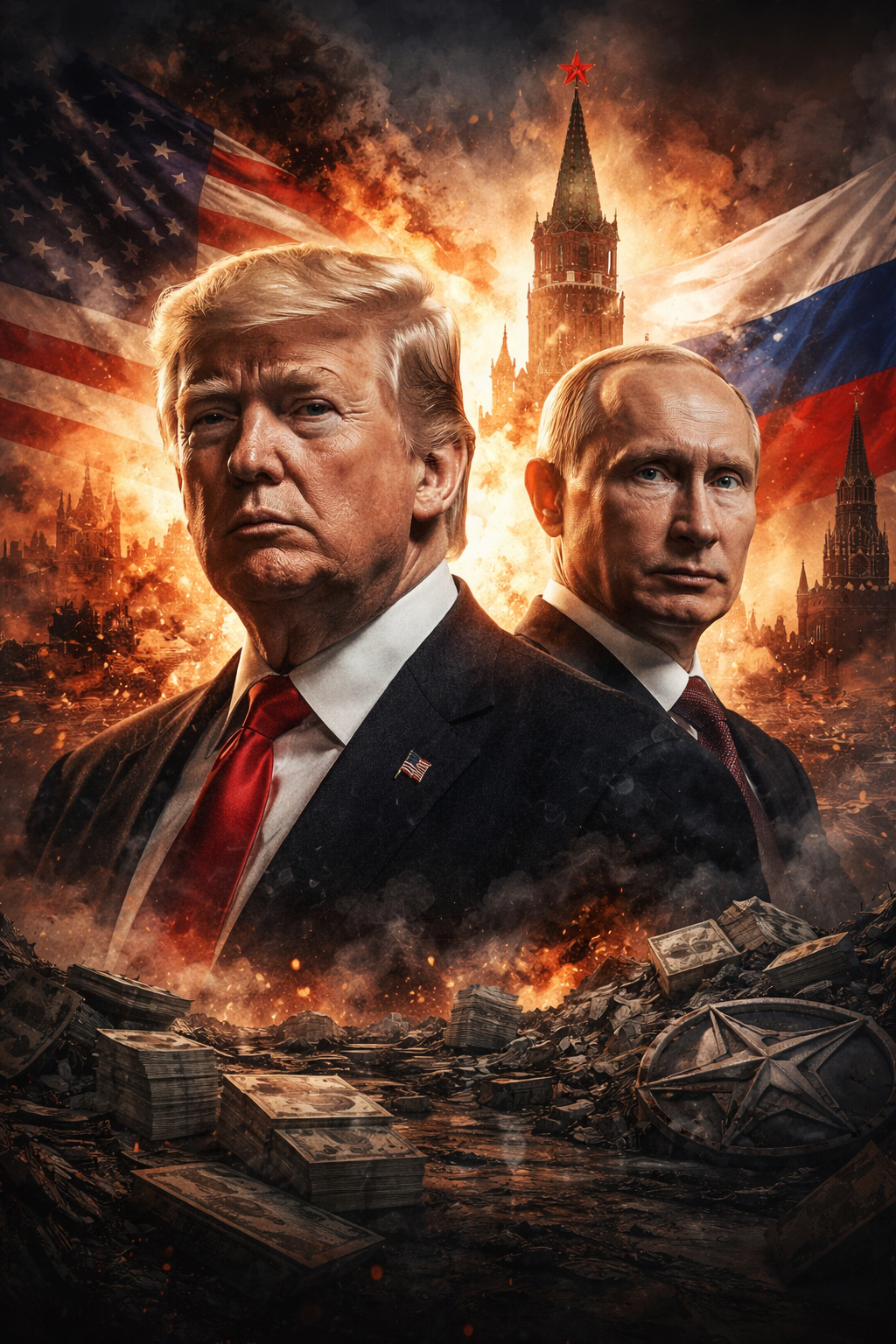
What Trump Gave Away
Summary: Trump’s rise wasn’t chaos. It was pattern. What looked like incompetence aligned too cleanly with Russian interests to be accidental. From weakening NATO to discrediting U.S. intelligence, from amplifying disinformation to hollowing institutions, his presidency advanced Moscow’s goals with uncanny efficiency. Whether through ego, debt, or design, Trump functioned as a strategic asset—eroding alliances, empowering autocrats, and exhausting democratic norms. This wasn’t a coup with tanks. It was erosion by influence, money, and narrative control. The most dangerous part wasn’t the betrayal. It was how easily millions learned to cheer while the foundation cracked.
In late 2015, I smiled and said aloud, “Trump seems to work for Putin.”
It was half a joke. A pressure valve for unease.
The smile didn’t last.
What followed wasn’t chaos. It was pattern. Clear, repeating, and increasingly impossible to explain away. The theory didn’t just hold—it explained everything.
Trump was recruited in 1987. That’s the claim made by former KGB operatives. They saw what intelligence services always look for: vanity, debt, and a hunger to be admired. When U.S. banks cut him off in the early 1990s, Russian money moved in—mob-linked, state-tolerated, laundered through real estate. His towers became washing machines. The rinse cycle never stopped.
And now? Trump is reshaping the American state with the precision of a guided weapon—its trajectory aligning neatly with the strategic interests of Moscow. Courts weakened. Civil service hollowed out. Journalism degraded. Truth exhausted. Not through force, but through erosion. Delay. Mockery. Delegitimization.
This doesn’t feel like chaos anymore.
It feels like demolition.
We may already be living through a coup. Not one with tanks or uniforms, but one executed by attorneys, donors, and consultants. A soft coup. The kind that looks like politics until the lights don’t come back on.
This didn’t begin with Trump. It began with Reagan, when “government is the problem” became doctrine instead of rhetoric. Deregulation followed. Then dark money. Then the normalization of sabotage. Trump didn’t invent the rot. He accelerated it.
What Trump Did That Benefited Russia
He weakened NATO.
Trump called the alliance “obsolete,” publicly attacked member states, and ordered U.S. troop withdrawals from Germany—moves that directly benefited Moscow’s strategic goals.
He abandoned strategic ground.
The withdrawal from Syria handed territory and leverage to Russia and Iran without negotiation or gain.
He discredited U.S. intelligence.
Standing beside Putin in Helsinki, Trump rejected the unanimous conclusions of American intelligence agencies about Russian election interference.
He extorted Ukraine.
Trump withheld congressionally approved military aid to pressure Ukraine into manufacturing political dirt—an act later ruled illegal by the GAO and central to his first impeachment.
He amplified Russian disinformation.
Trump and his allies pushed the false claim that Ukraine—not Russia—interfered in the 2016 election, a narrative born in Moscow and laundered through American media.
He attacked democratic institutions.
Calling the press “the enemy of the people” wasn’t rhetoric—it was imported authoritarian language.
He weakened sanctions.
Congress imposed penalties on Russia; Trump delayed, diluted, or declined to enforce them.
He fractured alliances.
Trade wars and public humiliation of allies weakened relationships built over decades.
He inflamed internal division.
Race, immigration, grievance—every fracture widened. Exactly as Russian hybrid-warfare doctrine prescribes.
He withdrew from stabilizing agreements.
The Iran nuclear deal. The Paris Climate Accord. Each exit created geopolitical vacuum space Moscow was eager to fill.
This isn’t corruption.
It’s capture.
What we’re watching isn’t political dysfunction—it’s the late stage of a long operation. A war waged without bombs. A war fought through influence, money, and ego.
Whether by design or narcissism, Trump advanced Russian strategic interests while dismantling the institutions that once stabilized the United States.
And millions cheered.
That’s the part that still hurts.
Repeated lies, delivered confidently, begin to feel like truth.
That’s the weapon.
And it works.
How Russia Benefited Trump
Cultivation
Former KGB officers have stated Trump was identified as a potential asset during his 1987 Moscow visit.
Financial lifelines
After U.S. banks cut him off, Russian and post-Soviet capital flowed into Trump properties through opaque structures.
Property laundering
High-value purchases—such as the Rybolovlev Palm Beach transaction—fit classic money-laundering patterns.
Cyber operations
U.S. intelligence agencies concluded Russia conducted cyberattacks and document releases to harm Clinton and aid Trump.
Disinformation campaigns
The Internet Research Agency ran coordinated social media operations boosting Trump and undermining his opponents.
Psychological reinforcement
Putin’s public praise mirrored intelligence tradecraft designed to reinforce ego dependence.
Political access
Multiple investigations documented contacts between Russian intermediaries and Trump associates, including figures tied to Manafort and Maria Butina.
Citation Appendix
- New York Times — Trump Calls NATO “Obsolete” (2017)
- Wall Street Journal — Trump Approves Plan to Withdraw Troops From Germany (2020)
- Brookings Institution — Strategic Consequences of the Syria Withdrawal (2019)
- Office of the Director of National Intelligence — Assessing Russian Activities and Intentions in Recent U.S. Elections (2017)
- The Guardian — Trump Sides With Putin Over U.S. Intelligence (2018)
- U.S. House Intelligence Committee — Ukraine Impeachment Report (2019)
- Government Accountability Office — OMB Withholding of Ukraine Aid (2020)
- Senate Select Committee on Intelligence — Russian Active Measures Campaigns (2020)
- Mueller Report — Russian Interference in the 2016 Election
- Kalb, M. Enemy of the People (Brookings Institution Press)
- Congressional Research Service — U.S. Sanctions on Russia
- Law Society Journal — Future of Magnitsky Laws
- BBC News — G7 Tensions Under Trump
- Chatham House — Trump and Alliance Erosion
- CSIS — Russia’s Hybrid Warfare Strategy
- U.S. Intelligence Community Assessments on Election Interference
- New York Times — U.S. Withdraws From Iran Nuclear Deal
- BBC News — U.S. Exits Paris Climate Agreement
- India Today — Claims of Trump Recruitment by Soviet Intelligence
- Reuters — Trump Business Ties and Russian Money
- Adam Insights — Trump Real Estate and Oligarch Transactions
- Tech Policy Press — IRA Disinformation Campaigns
- Analysis of Putin–Trump Public Interactions (Multiple Sources)
- Senate Intelligence Committee — Manafort, Butina, and Russian Contacts
Further Reading on Burnt Ground
PrumpTutin’s Fortress
How Trump and Putin fused grievance, ego, and power into a single geopolitical engine.
→ https://burnt-ground.com/prumptutins-fortress
The System We Built and the Beast That Ate It
A system designed to prevent collapse instead trained itself to invite it.
→ https://burnt-ground.com/the-system-we-built
They Don’t Need to Win. They Just Need You Tired.
Propaganda doesn’t convince. It exhausts.
→ https://burnt-ground.com/they-just-need-you-tired
When Democracy Becomes Performance Art
When politics becomes theater, accountability becomes optional.
→ https://burnt-ground.com/democracy-as-performance