
Fifteen Hours
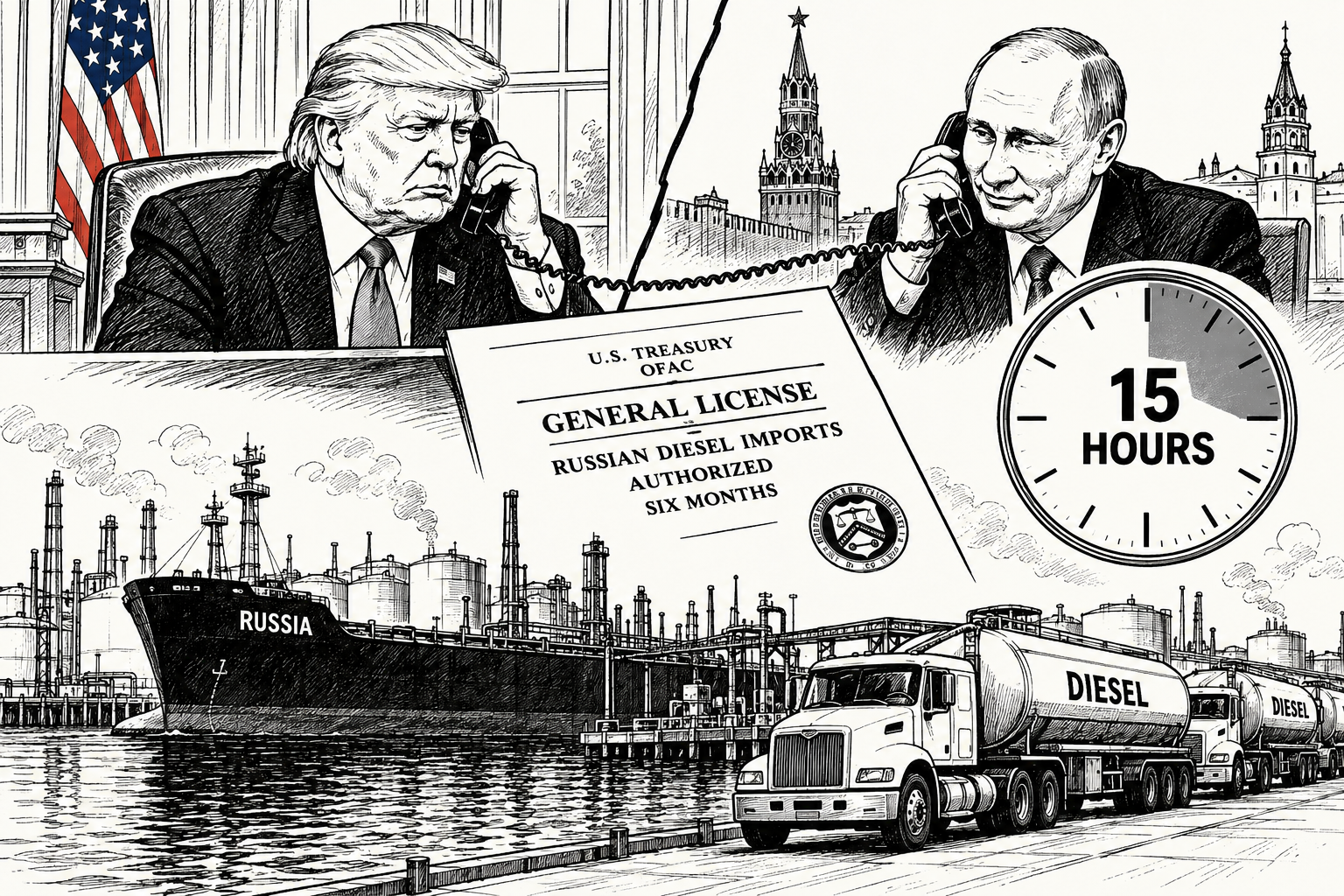
On Friday, October 9, Donald Trump got on the phone with Vladimir Putin. When he hung up, the United States was buying diesel from Russia.
He announced it himself on Truth Social, in capital letters: 300,000 tons right away, 500,000 more in November, a million after that. Within hours the Treasury Department's Office of Foreign Assets Control issued a general license authorizing the sale, delivery, and importation of Russian diesel into the United States for six months. Deputy Prime Minister Alexander Novak told TASS that Moscow would lift its export ban ahead of schedule. By Saturday it had.
One phone call. Three steps. Four years of policy, gone before dinner.
Trump thanked Putin for it. "I want to thank President Putin, to be honest with you." Note the hedge at the end. Even he could hear how it sounded.
Start with why Russia had diesel to sell. It did not, for most of the summer. Ukraine spent the warm months putting drones into Russian refineries, and the International Energy Agency says Russian diesel output fell about 30 percent. Putin banned exports in July to keep his own trucks running. On October 1, at the Valdai forum, he complained that Russia had plenty of diesel but sanctions kept it off the world market. He said that out loud, to an audience, and nobody in the room laughed.
Eight days later Trump solved his problem for him.
Now the price side. Diesel in the United States hit a record high this fall. Trump blames Ukraine for hitting Russian refineries. He does not mention the war he started with Iran, or the tankers that stopped moving through the Strait of Hormuz when he did. The man who lighted the fire blames the fire department.
Then the arithmetic, which is the part nobody at the White House wants read aloud. Vladyslav Vlasiuk, Ukraine's sanctions commissioner, did the sums. The United States burns 3.5 million tons of diesel a week and refines 4.9 million. The 300,000 tons Putin promised cover 15 hours of United States demand. A day and a half of what we export. A European diplomat told the Kyiv Independent the deal was unlikely to touch prices but that the symbolism would.
So the diesel is not the point. The diesel is the cover story. What Putin actually got was a six-month hole in the sanctions wall, billions in revenue, and something better than money: a precedent. The United States has now paid Russia to stop a shortage Russia created by invading its neighbor.
Trump threw in a bonus. Asked Saturday about Ukraine's refinery strikes, he said Zelensky "better damn well stop," and added that Ukraine should get a new president. Ukraine's negotiators were in Florida that same day, talking to Trump's envoys about an energy ceasefire. Zelensky said his team was being used as a smokescreen. Hard to argue. You do not open the market to Russian fuel on the morning you sit down to bargain over Russian fuel. Unless the bargaining is theater.
Here is where the law comes in, and the law is not vague. In 2022 Congress banned imports of Russian energy. The ban can be lifted, but only if Russia withdraws its troops, and only after consultation with Congress and a formal review. Senator Jeanne Shaheen says the administration skipped both. Three weeks ago, on September 18, Trump signed a second bill, the one named for Lindsey Graham, who died this year after a trip to Kyiv. That bill gives Trump authority to put 100 percent tariffs on any country still buying Russian oil. The clock on enforcing it runs out October 18.
Read that again. The president signed a law to punish nations that buy Russian fuel. Then he bought Russian fuel. Senator Mark Kelly asked the obvious question: are we sanctioning ourselves now?
This is not a Democrats-only complaint. Lisa Murkowski said the president should be using the new sanctions instead of letting Russia rake in revenue. Don Bacon said buying Russian fuel rewards a dictator who is still killing Ukrainian civilians. Brian Fitzpatrick promised a bipartisan bill to block all Russian oil purchases and said he will force it to the floor by discharge petition. Richard Blumenthal called the deal an insult to Graham's memory and told any United States company thinking about taking Putin's money that Congress is watching.
And the civilians Bacon mentioned were not hypothetical. Saturday morning, while the Treasury license was hours old, Russian guided bombs hit a residential block in Zaporizhzhia and killed at least 20 people, three of them children. At 2 p.m. Russian missiles hit Kyiv. Zelensky's reaction was a single sentence: every extra billion will be spent on this. He is right. Russia does not buy bread with diesel money. It buys Shaheds.
Why would any president do this? The midterms are November 3. Diesel is expensive. Trump needs a number that looks like relief before voters see a ballot, and he needs it from someone who will pick up the phone. Putin picks up the phone. Putin always picks up the phone. He has been waiting four years for a call like this one, and Trump made it on the first ring.
I have called them PrumpTutin for years, one organism with two heads, and I keep getting told the word is a cheap shot. Look at Friday. One head spends a year hitting the refineries' enemy with insults and pressure. The other head opens the United States market the moment the refineries run short. One head calls Ukraine's leader weak. The other hands Ukraine's attacker a check. That is not two governments negotiating. That is one body feeding itself.
The 300,000 tons cover 15 hours. The precedent covers the rest of the war.