
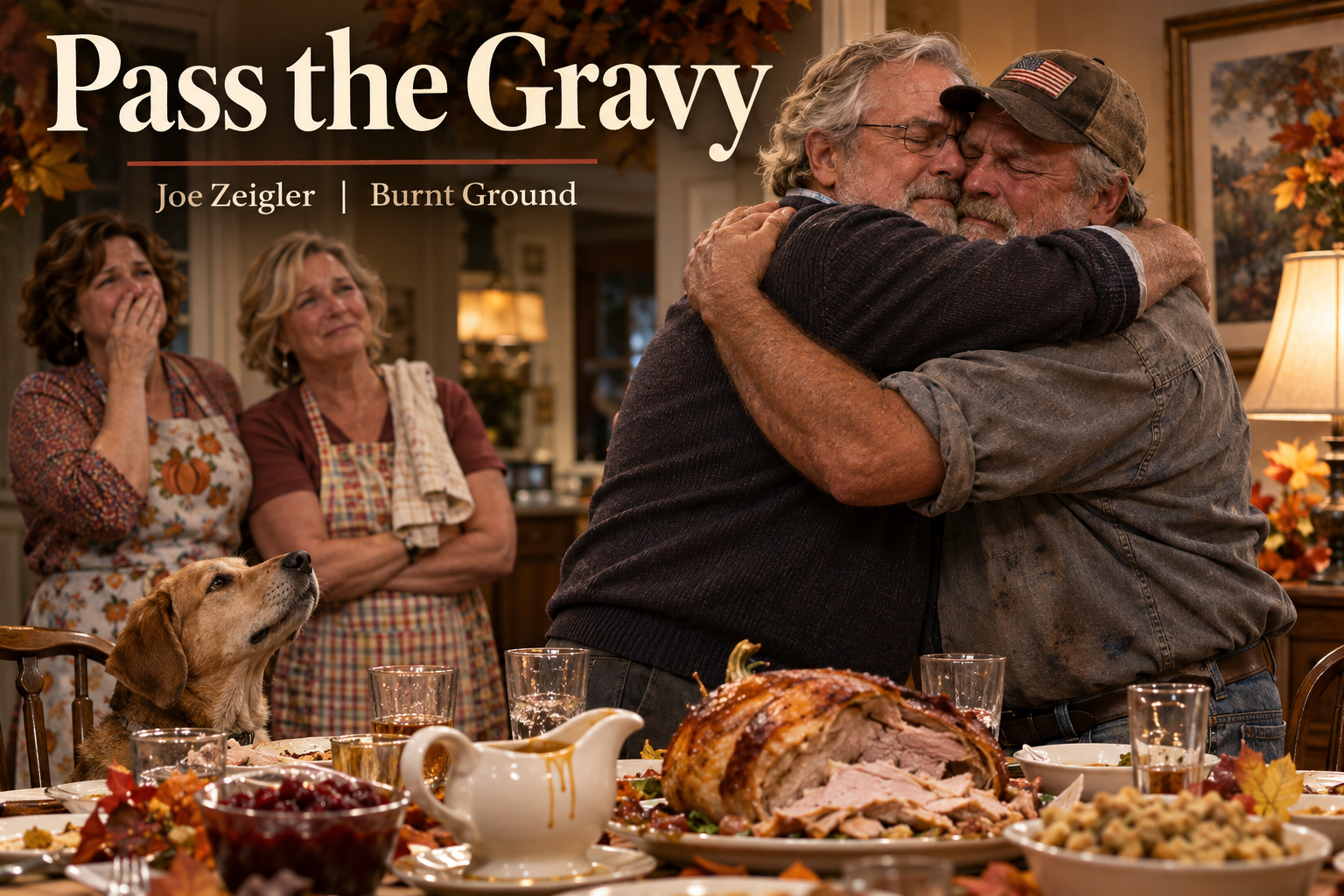
Pass the Gravy
Marketing note: I have a new book, 1776 Caleb Doyle lands at seventeen in John Hancock's warehouse and spends the next half-century inside the founding of the United States. Fifty years later, on the morning Jefferson and Adams both die on the Fourth of July, he sits his grandson down and tells him the version the schoolbooks left out. The smugglers, the grabbers, the slave holders. The one he was inside of.
It’s available at all your favorite book vendors including Amazon.
On to the essay
Thanksgiving arrives in nine days, and in a few million dining rooms two men who married sisters will pick up the argument where they dropped it last year. I wrote out both sides so you can read the shouting and skip doing it.
Call them Walt and Dale. Walt taught high school civics for 31 years and votes Democratic. Dale runs a heating and air business, owns three trucks, and voted for Trump three times. Neither man is stupid. That is the problem.
Dale opens, because Dale always opens.
“Say it, Walt. You won. Fifty-five seats in the Senate. You took Texas. Go ahead and gloat.”
“I’m not gloating. I’m carving.”
“You’re carving like a man who’s gloating.”
“Kansas sent a Democrat to the Senate for the first time since 1932, Dale. Mississippi sent one.”
“The president’s party loses midterms. It has for a hundred years. That’s weather, not a verdict.”
“Weather doesn’t flip Mississippi.”
Dale puts down his fork, which in this family means the same thing as a gavel.
“Then let’s talk about what he did. In April the Border Patrol caught 8,943 people at the southern border. One month. Under Biden that number topped 200,000 some months. Your side told me for four years that nobody could fix the border without a grand bargain in Congress. He fixed it with a phone and a bad attitude.”
“You’re right about the border.”
“Somebody write down the date.”
“My party treated a real problem as a manners problem. People said the line was too long, and we called them names. We earned what that cost us. But he promised you the criminals, and the agents now work the Home Depot parking lot. Who put your roof on?”
“Luis is legal.”
“And Luis’s cousin?”
Dale studies the stuffing.
“You cheered the raids for a year. Then they came within one cousin of your roof, and you got quiet. Hold that thought. I’m coming back to it.”
“My father built furnaces in Ohio for 29 years. In 2001 the plant went to Monterrey. An economist went on television and explained that my father would come out ahead on cheaper televisions. He was 54. He never came out ahead on anything again. They sold us out, Walt.”
“Who is ‘they’?”
“Clinton, who signed NAFTA. Bush, who waved China in. The Chamber of Commerce. And you.”
“Me?”
“Nobody ever shipped a civics teacher to Monterrey. You had tenure and a union. You read about my father in the newspaper, and you turned the page. It wasn’t going to affect you, so what did you care?”
Walt puts down his own fork. Two gavels.
“That’s fair. Every word of it.”
“Two in one dinner. You feeling all right?”
“Trump was the first one to say out loud that somebody did it to you. I’ll give him that. Then he prescribed the wrong medicine. A tariff is a sales tax with a flag on it. The New York Fed checked. Prices on everyday goods would have fallen without the tariffs. They rose instead, and the goods made here rose with them. What did a compressor cost you in 2024?”
“Don’t.”
“What does it cost now?”
“I said don’t.”
“You were fine with the tariffs until the invoice had your name on it. Same as the raids. That’s the thought I told you to hold. You just said it about me and the furnace plant, and you were right. Now I get to say it about your whole party. Nothing counts until it lands on you.”
“That’s a bumper sticker.”
“Then let’s go through the receipts. In 2020 you took a PPP loan. How much did you pay back?”
“That was a pandemic. The government made the mess.”
“The government forgave it. It forgave most of the $793 billion. Two years later your nephew asked for $10,000 off his student loans, and you called it a handout.”
“Nobody ordered him to study sociology.”
“Fine. Now the big one. The bill your Congress passed last year takes more than $900 billion out of Medicaid over 10 years. You told me in July that Medicaid is for men on couches. Where does your mother live?”
Dale says nothing.
“Maple Grove. Who pays for the room?”
“She worked her whole life. She paid in.”
“She paid in to Medicare. Medicare doesn’t pay for a long stay. Medicaid does, for 63 percent of the people in this country’s nursing homes. It’s welfare, Dale. Welfare is the word for money that goes to somebody you never met. When it goes to your mother, it’s something she earned.”
The dog, sensing a change in the weather, leaves Dale’s chair for neutral ground under the table. The dog votes with whoever drops food, which makes him the most honest voter in the room.
Dale comes back slowly, and he comes back swinging.
“You done? You retired at 55 on a pension my property taxes pay for, and you call my tax cut greed. You have a sign in your yard that says everybody is welcome, and you went down to the zoning board to stop the apartments on Maple. I was there, Walt. I bid the ductwork. You people are generous with every dollar that isn’t yours and every street that isn’t yours.”
“The traffic study said the road couldn’t take it.”
“Somebody always has a traffic study. I gave more to the church pantry last year than you gave to anything, and nobody had to send a man with a badge to collect it. I’ll help anybody who asks me. I won’t be robbed and then called selfish by the fellow holding the bag.”
Walt chews on that longer than the turkey requires.
“The sign comes down or the apartments go up. I can’t have both. You’re right. But can the church pantry cover Maple Grove?”
“No.”
“That’s all I’m saying. Your charity is real. I’ve watched you do it. It reaches as far as the people you can see. Past that it takes a government, and you keep hiring men who tell you the people past that are thieves.”
Dale goes quiet. When he speaks again he has stopped performing for the table.
“You want to know why I voted for him? Your side looks at me like something on its shoe. I crawl under houses in January at two in the morning so somebody’s grandmother doesn’t freeze, and a woman with a podcast tells me I’m the privileged one. He never talked down to me. Not once.”
“No. He talked you up and then picked your pocket. My side lost you, and my side deserved to lose you. But he took your anger to Washington, handed the tax cut to the men who own the building, and sent the bill to your supply house and your mother’s nursing home.”
“I’m still not voting for a Democrat.”
““Keep my mother out of your mouth.”
I didn’t ask you to. I asked who pays for the room.”
“She’s in the bill, Dale. Your people put her there.”
Dale stands. His chair goes over behind him.
“My people fix your furnace. You never built one thing in your life. You spent 31 years telling children how the country works, and you couldn’t keep one plant open in it.”
Walt stands too.
“And you would let a stranger’s kid go without a doctor to save a few dollars, then pass the plate on Sunday and call it Christian.”
“You’d vote that kid a doctor as long as he never moves in next door.”
“You’d give him your shirt as long as you meet him first. Your party votes like he doesn’t exist until he turns out to be your mother.”
“You smug, pensioned hypocrite.”
“You selfish, frightened little man.”
Dale’s fist hits the table, and the gravy jumps in the boat. Both men shout at once now, and nobody could write down the words. Dale’s finger stops an inch from Walt’s chest. Walt finds the carving knife still in his hand, looks at it, and sets it down. The dog leaves the room. In the kitchen the sisters stop talking.
Then the two men stop. Nobody tells them to. They stand straight, breathing hard, with 26 Thanksgivings and one turkey between them.
For a moment the house makes no sound at all.
Dale comes around the table. Walt meets him halfway. They put their arms around each other and hold on, and neither man says a word.