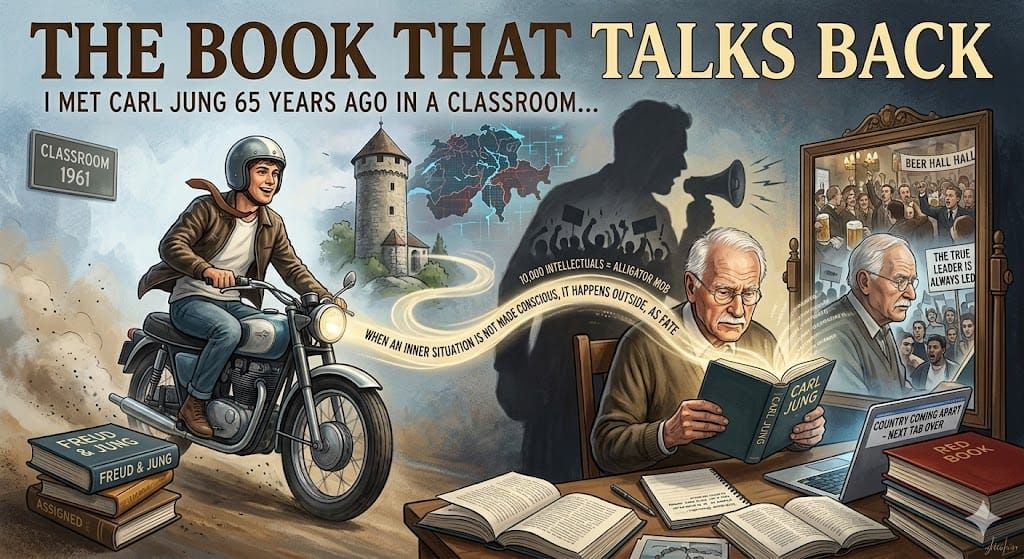
I met Carl Jung 65 years ago in a classroom, and I left him there.
I want to be fair about it. He didn’t make much of a first impression. He was assigned, which is the worst thing that can happen to a writer, and he came stapled to Freud, which is the second worst. I was a kid with a motorcycle and a future, and he was a dead Swiss psychiatrist with a great deal to say about dreams. I skimmed what had to be skimmed, passed whatever had to be passed, and walked out into the next six decades without him. He died the following year. I have checked the dates. I do not believe the two events are connected, but at 80 you check everything.
Then a few months ago I tripped over an article. That’s the only honest verb. I wasn’t looking for him. I was doing what I do every day now, documenting a country coming apart in the next tab over, and somebody had written about an interview Jung gave in 1938, with Europe going under, in which an American reporter asked him to explain the dictators. I read it. Then I read it again. Then I went and found the books I had ducked in school, and I have been reading him every night since, at a desk, with a notebook, like the student I refused to be the first time around.
People ask why. They expect me to be reading the news harder, or the historians, or the angry men who are angry about the same things I am angry about. I read those too. But it is Jung I reach for when I want to understand a thing instead of just being furious at it, and I have finally worked out why, and the answer is a little embarrassing, so here it is.
He agrees with me.