
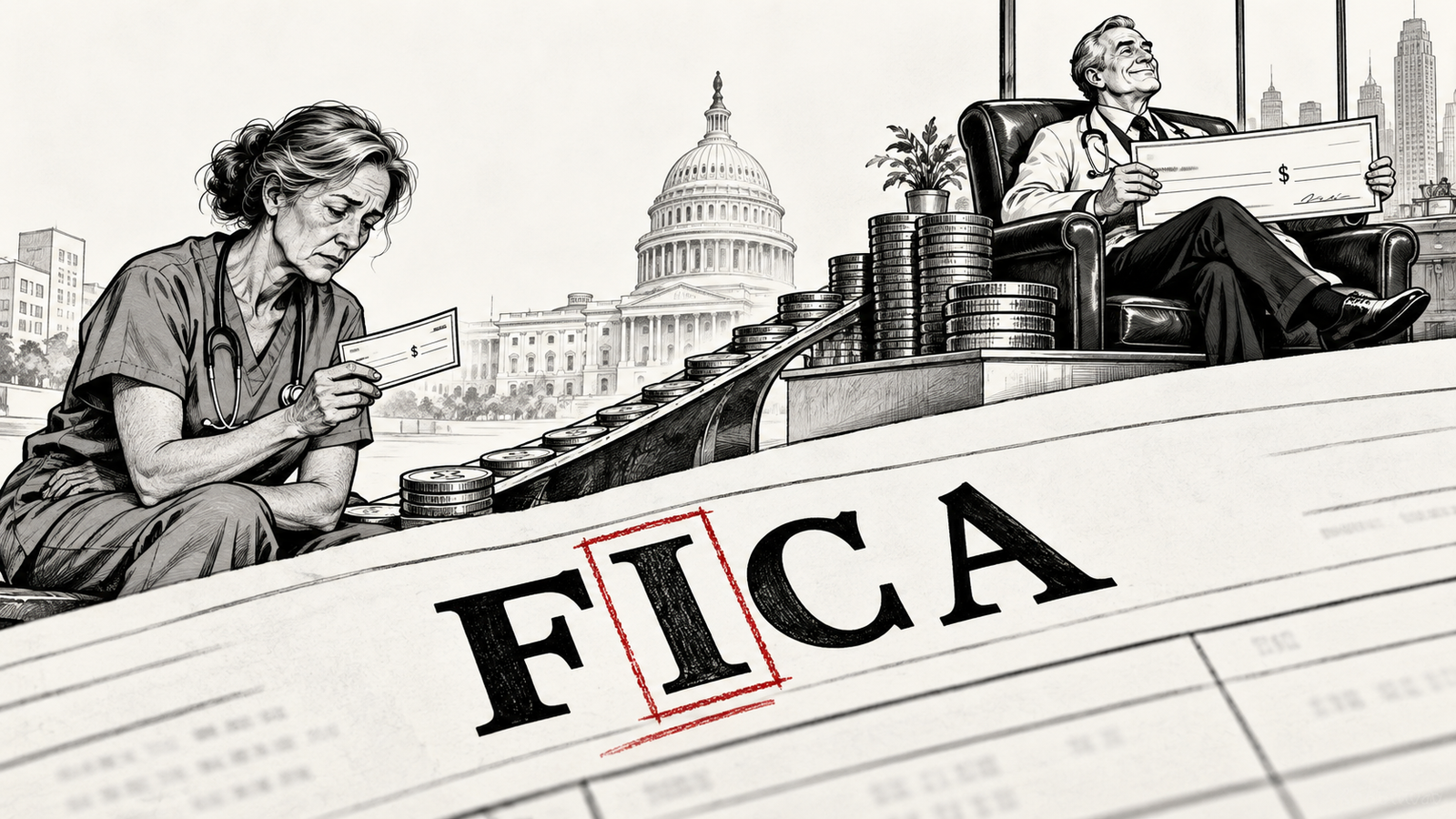
Look at your pay stub. The line says FICA. The F is for Federal, the I is for Insurance. The program it funds carries the word in its own name: Old-Age, Survivors, and Disability Insurance. Roosevelt chose the word on purpose in 1935 and said why. Contributions gave workers a legal, moral, and political right to collect, so no politician could ever scrap the program. He wanted the word to be a lock.
Insurance means something. You pay a premium against a risk you cannot carry alone. The people who can carry the risk pay in and mostly never collect. The people who cannot carry it collect when it lands. That is the whole idea, and every insurer on earth runs on it. Nobody calls it unfair that the healthy fund the sick.
So hold Social Security up against its own name and see what you get.
Start with the premium. The payroll tax stops at a wage cap, about $184,000 for 2026. A nurse making $60,000 pays 6.2 percent on every dollar. A surgeon making $600,000 pays 6.2 percent on the first $184,000 and nothing on the rest, which comes to about 1.9 percent of his pay. A hedge fund partner clearing $5 million pays two tenths of one percent, and only on the part he bothers to take as salary. His real money, the carried interest and the capital gains, never touches the program at all. It is the only major tax in the United States that gets cheaper as you earn more. No insurer prices a policy that way. The richest customer gets the smallest premium.
Now the payout. The benefit formula pays more to people who earned more. It bends toward low earners in percentage terms, but the dollars still flow uphill. The surgeon's check is bigger than the nurse's. Then longevity finishes the job. Men in the top fifth of earners outlive men in the bottom fifth by 12 to 14 years. The surgeon collects the larger check for more years. The nurse funds his retirement and dies before she finishes collecting her own. Call that whatever you want. Do not call it insurance.
And when the question finally reached the Supreme Court, the court agreed. Helvering v. Davis in 1937 upheld the program as a tax and a spending plan, not insurance. Flemming v. Nestor in 1960 said it plainly: a worker has no contractual right to benefits, the word insurance in the statute creates no property interest, and Congress can cut what it likes. Nestor had paid in for 19 years. Congress stripped his benefits retroactively and the court let it stand. So the country kept the word on the pay stub and ruled that the word means nothing.
Which leaves the premium payers holding a policy with no contract, priced backward, and paying out to the people who need it least. Then Congress starts slicing.
Inflation ran 3.7 percent this year. The adjustment is 3.6. One tenth of a point, two dollars a month on the average check. Nobody marches over two dollars. That is the point of two dollars.
The slice before that was the index. The adjustment tracks what working-age clerks buy, not what retirees buy. Retirees buy medicine, doctors, housing, and heat, and those climb faster than the basket the formula watches. The Bureau of Labor Statistics has kept an honest index for the elderly since the 1980s. It runs higher. Congress has never adopted it.
The slice before that was the Medicare premium, taken out of the check before the check reaches the bank, climbing faster than the adjustment in most years I can remember. The announced number is gross. The deposit is net. Nobody announces the net.
The slice before that was 1983, when Congress raised the retirement age and began taxing the benefit itself, money already taxed on the way in, phased over decades so no single cohort would feel the knife.
Each slice comes with a press release. Each press release says the program is strong and the adjustment is fair. Each one is true for about 11 months.
Here is what the cap, the formula, the court, and the slices say together. A country that is broke cuts everyone. A country that cuts only the people with the least leverage is not broke. The United States found trillions for tax cuts aimed at people who pay two tenths of one percent into this program. It found money for a war in Iran. It found money for television ads congratulating PrumpTutin on his own government. What it cannot find is the rounding error that would let a retired nurse come out even on a policy she paid for every week of her working life.
The fix is not complicated. Run it like the insurance it claims to be. Everyone pays the premium on every dollar, salary or not. The people who can carry the risk pay in and do not collect. The people who cannot carry it get the payout, whole, indexed to what they actually buy. Roosevelt would have objected. He believed that once the rich stopped collecting they would stop defending the program. He was right about them and wrong about the result. They collect, and they do not defend it. They just stand in line ahead of the nurse.
The word on the pay stub is Insurance. Somebody should make it true.