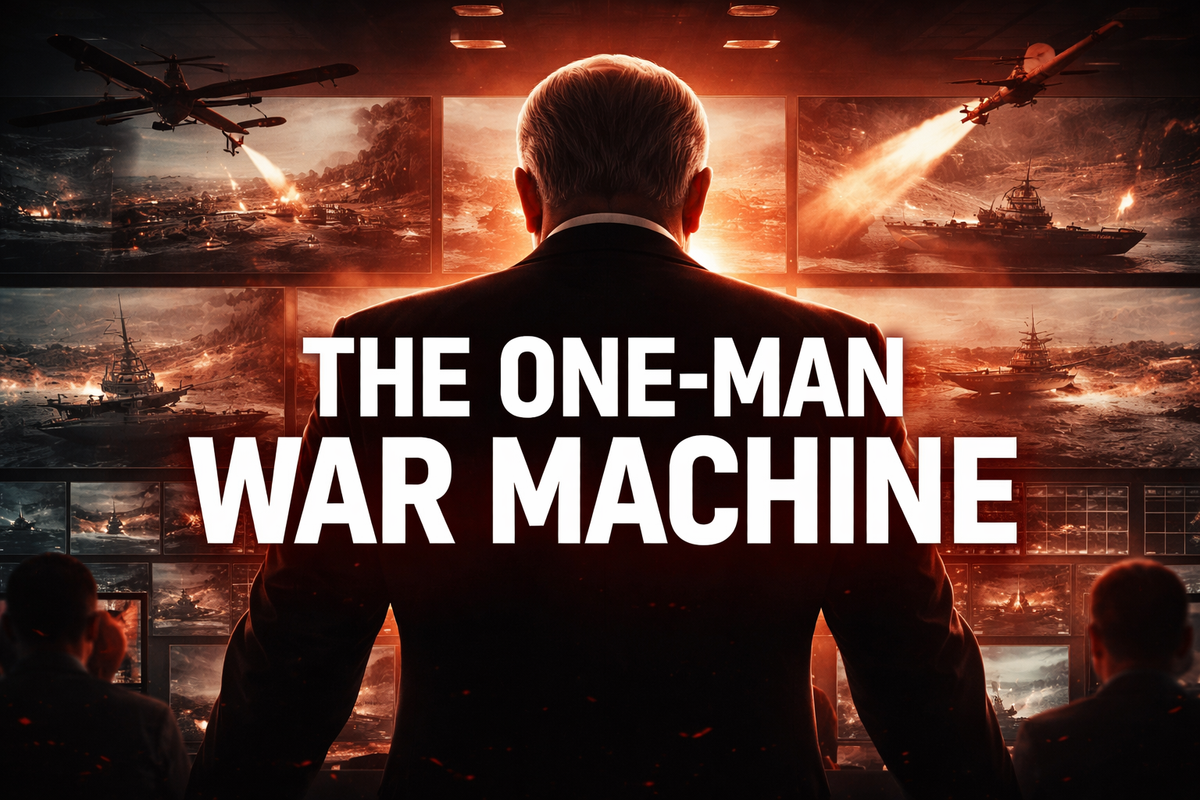
The One-Man War Machine

Efficiency used to mean something else. Factories. Supply chains. Cutting waste, not corners. Doing more with less without breaking the system that made it possible.
Now it means something simpler.
One man decides, and things explode. No committee, no delay, no vote that matters. Congress still exists, technically—like an old switch left on the wall after the wiring’s been rerouted behind it. You can flip it if you want. Nothing happens.
The system has been optimized. The one-man war machine is efficient.
So the machine keeps running—not because it’s hidden, but because it’s allowed.
Orders move faster than arguments, faster than law, faster than the slow machinery designed to slow exactly this kind of speed. By the time anyone asks a question, the answer is already smoke somewhere else. You can see it if you stop listening to the speeches and follow the trail—Iran, Yemen, Somalia, Syria, Iraq, Venezuela, Nigeria—not as headlines, as actions.
Iran. Direct strikes. Not proxies, not pressure—impact. Naval assets hit, infrastructure damaged, bodies on both sides. The justification comes after. The order comes first.
Yemen. Ports, supply lines, anything tied to the Houthis. Shipping lanes must stay open. That’s the language. Civilian deaths folded into the margin. Necessary. Regrettable. Move on.
Somalia. Drones over places most people couldn’t find on a map. Leaders removed, replaced, removed again. A loop that looks like progress from a distance.
Syria. The edges of a war that never ended. Strikes against militias, responses to responses. Geography reduced to coordinates.
Iraq. Militias, bases, retaliation cycles. Sovereignty discussed briefly, then set aside. Security fills the gap.
Venezuela. Sudden, sharp, half-seen. Official reasons. Bodies. Silence after the noise fades.
Nigeria. Another theater. Another justification. Another place where something breaks and the report smooths it over.
Different countries. Different reasons. Same motion—outward, faster each time.
And underneath it—the part that makes the speed possible—has barely changed in two decades. Congress authorized force once after 9/11, and again for Iraq. Those authorizations are still here.
The Authorization for Use of Military Force of 2001.
The Authorization for Use of Military Force Against Iraq Resolution of 2002.
They were meant for something specific. They became something else.
Where they stretch, they stretch. Where they don’t, something else fills the gap—presidential power. Immediate. Unilateral. Framed as defense, deterrence, necessity. Iran. Yemen. Venezuela. No new vote. No new mandate.
There is a law that was supposed to slow this—the War Powers Resolution of 1973. Notify Congress. Limit the timeline. Force a decision.
It doesn’t stop anything.
So the machine keeps running.
Language keeps it clean. Targets. Facilities. Capabilities. Words built for speed, words that don’t stick. You can read them and feel nothing, which is the point. At sea, ships go under—steel splits, water closes, men disappear into a line item. The report is filed. The cycle continues.
And while it runs, something else runs with it.
Noise.
A scandal resurfaces—Epstein, again. The story that never closes, never resolves, always just unfinished enough to demand another look. It pulls attention the way spectacle always does—personal, immediate, impossible to ignore.
And while attention is fixed there, everything else moves.
Orders are signed. Strikes are carried out. Authority expands in practice if not in law. None of it hidden. All of it visible. Just not centered.
War becomes background. A constant presence, low and persistent, easy to scroll past. And once something becomes background, it stops being questioned—not because it’s secret, but because it’s familiar.
That’s the shift. Not secrecy. Normalization.
The one-man war machine doesn’t need to hide. It just needs to outpace attention—move faster than scrutiny, faster than debate, faster than the structures designed to contain it.
So it continues. Orders. Strikes. Expansion. No declaration. No endpoint. Just motion that sustains itself.
Efficiency isn’t neutral. It removes friction, and friction is where judgment lives—where doubt forms, where someone might have said wait. Take that away, and what’s left isn’t just speed.
It’s permission.
The one-man war machine is efficient.
Congress authorized a war in 2001.
The machine is still spending it.