
They Want the Power

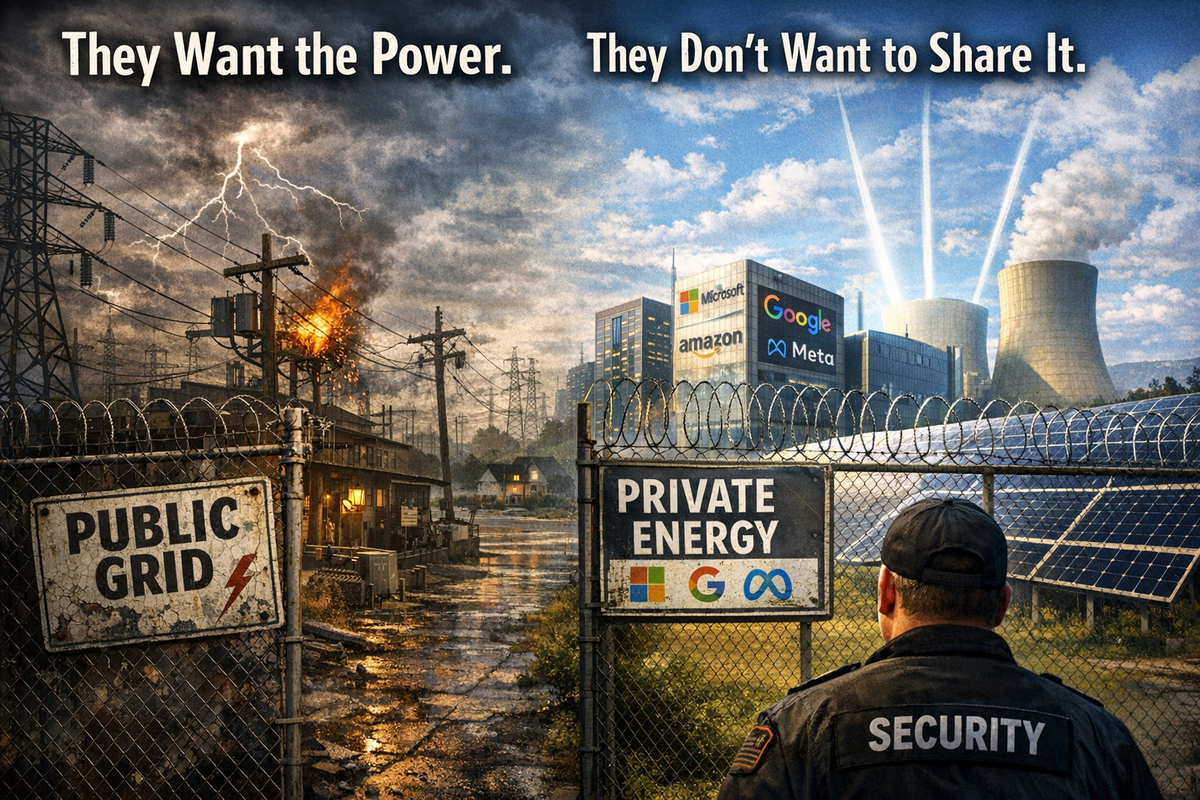
They Don't Want to Share It
Missed Tuesday. Sick, miserable, and horizontal for the last few days. Still not entirely upright but close enough to write again. Back to work now. More coming.
The data centers, Microsoft, Google, Amazon, Meta, are consuming electricity that would stress a national grid. AI does that. Training a single large model burns through enough power to light a city block for weeks. Running it at scale multiplies that by millions of queries a day.
The grid, the one your house plugs into, the one your hospital runs on, the one that kept your neighborhood alive during the last ice storm, cannot keep up. It is old. It is underfunded. It has been neglected for decades by the same political class that handed out tax breaks to the people who now need the most electricity.
Their solution is to build their own.
Microsoft is contracting nuclear reactors. Amazon is buying up solar farms the size of counties. Google is funding private generation capacity so it never has to depend on the public grid at all. They frame this as innovation. They frame it as green energy leadership. They frame it as necessity.
It is none of those things. It is enclosure.
England did it to its peasants starting in the 1500s. Took the common land, the land everyone used, everyone needed, everyone had some claim to, and fenced it off for private use. The people who had farmed it for generations were told to find somewhere else to exist. The owners called it efficiency. It was theft wearing a different coat.
What the data centers are doing is not identical, but the logic is the same. The electrical grid is common infrastructure. It was built with public money, public labor, public sacrifice. It belongs, in the only meaningful sense of the word, to everyone who depends on it. And right now it is crumbling. Transformers are failing. Substations are aging out. Rural lines snap in moderate wind. Climate events that used to be once-in-a-decade are happening twice a year and the grid takes longer and longer to recover.
The corporations know this. They have engineers. They can read the same Department of Energy reports anyone can pull up. They know the grid is in trouble.
Their response is to abandon it.
Not to fix it. Not to invest in it. To leave it, and everyone still dependent on it, behind. To build private generation capacity that guarantees their uptime, their margin, their quarterly projections. To extract maximum benefit from the communities where they plant their server farms, the roads, the water systems, the emergency services, the tax base, while building a wall around the one resource they actually need most.
That is not innovation. That is the oldest move in the oligarch playbook. Privatize the benefit. Socialize the cost.
Every dollar Microsoft commits to a private reactor is a dollar withheld from grid modernization. Every solar installation Google fences off for its own consumption is capacity stripped from a public network that serves farms and schools and small businesses that cannot afford to go dark. The technology exists. The capital exists. The obligation is the one thing they will not accept.
They will tell you there is no mandate. That they are private companies spending private money. That nobody can tell them where to build their plants.
That is technically true the way a lot of terrible things are technically true.
What is also true is that they did not build those data centers in a vacuum. They built them in communities with zoned land and permitted construction and trained workforces and fire departments. They used public roads to move the equipment. They negotiated tax abatements from local governments desperate for any economic activity at all. They took everything the commons had to offer and now, when it is time to give something back, they are drawing a fence around their power supply and calling it progress.
In the summer of 2023, extreme heat killed more than a hundred people across the United States. The grid held in most places, barely. In others it didn't. The people who died were not running data centers. They were old, or poor, or both. They were in apartments without backup generation, on oxygen concentrators and dialysis machines tied to infrastructure that had been underfunded for thirty years while the money that could have fixed it was sitting in capital allocation budgets deciding where to build the next private reactor.
That is not a metaphor. That is what it costs.
The grid needs hundreds of billions of dollars in investment. The utilities cannot fund it alone. The federal government moves at a speed that makes geology look urgent. The money exists. They just never considered it their problem.
That was always the point.