They're Coming for the Librarians

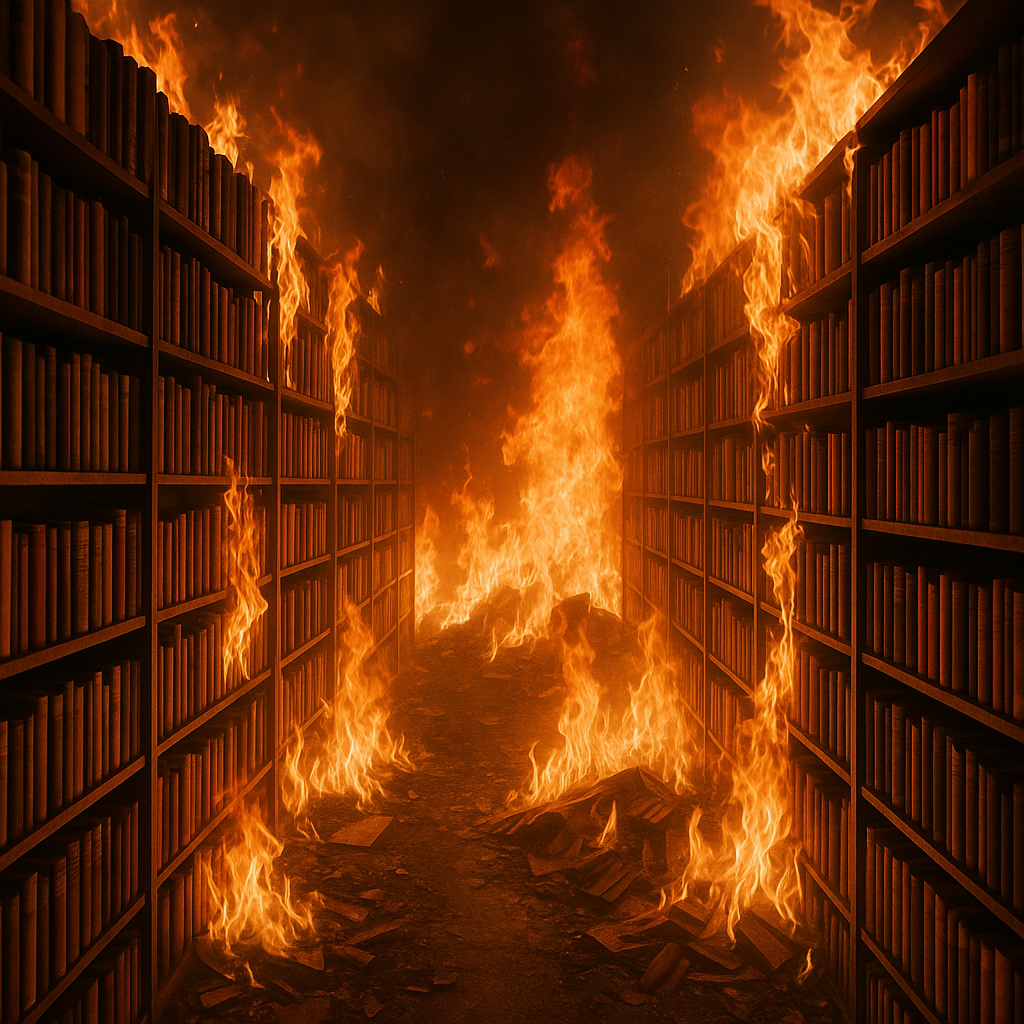
Summary: The United States is experiencing an unprecedented wave of book banning—nearly 23,000 since 2021, with Florida and Iowa leading. The targets: books about race, gender, sexuality, and inconvenient history. Groups like Moms for Liberty, designated extremist by the SPLC, harass librarians and teachers into silence while legislators criminalize "harmful" materials with deliberately vague laws. The irony runs thick: 1984, Fahrenheit 451, and even Ban This Book have all been banned. Meanwhile, actual threats—school shootings, medical debt, digital addiction—go unaddressed. Kids are fighting back with banned-book clubs and digital access. The bans will fail. Truth always leaks.
They always hide the knife behind a smile. “Concerned parents,” they say, as if this is a bake sale gone sideways instead of a slow-motion purge. A teacher pulls a book from her shelf. A librarian keeps pepper spray in her desk. A school board caves because a few adults found a sentence that cracked open something they spent decades burying.
Call it a culture war if you want. That’s the polite lie. This is a country sawing off its own future because the present terrifies it. Every banned book is a little confession: we don’t trust our kids, and we sure as hell don’t trust the truth.
The numbers tell the story plainly enough. PEN America documented nearly 23,000 book bans in public schools since 2021. In the 2023-2024 school year alone, more than 10,000 books were pulled from shelves—a 200 percent increase from the year before. Florida and Iowa led the charge, accounting for more than 8,000 bans between them, driven by state laws that turned vague words like “age-appropriate” into weapons. Forty-three percent of those banned books weren’t just restricted or moved behind a counter. They were removed entirely, made inaccessible, erased from the catalog as if they had never existed.
The targets are predictable. Books about race. Books about gender. Books about sexuality. Books that acknowledge history happened the way it happened rather than the way some adults wish it had. Ruby Bridges’ autobiography—the story of a six-year-old girl walking into a New Orleans school in 1960 while grown men screamed at her—was challenged in Tennessee for promoting “anti-American” and “anti-White” instruction. A book about Martin Luther King Jr. and the March on Washington was flagged because it included a photograph of segregated water fountains. The sin wasn’t what the books said. The sin was that they showed children what their country actually did.
The irony, when it surfaces, is so thick you could choke on it. George Orwell’s 1984—a novel warning against totalitarian censorship—has been banned in American schools over the decades for being “pro-communist” and for containing “explicit sexual content.” Fahrenheit 451, Ray Bradbury’s entire book about banning and burning books, was pulled from a Mississippi school in 1998 because it contained the words “god damn.” A Colorado school district in 2024 required parental permission for students to read 1984, Fahrenheit 451, Brave New World, and Anne Frank’s diary—all in the same sweep. Anne Frank’s diary was challenged in Alabama for being “a real downer.” In California, a school district banned the Merriam-Webster dictionary after a parent complained that a child had looked up “oral sex.” And in Florida, a children’s book called Ban This Book—about a fourth-grader who fights back against book banning—was banned by the Indian River County school board in 2024. The board objected because the book, in the words of one member, teaches children how to “overtly subvert school board authority.” The author, Alan Gratz, noted dryly: “Now irony is dead.”
The United States once bragged about leading the world. Now it jumps at shadows on a page. Governors picking fights with cartoon mice. Legislatures writing laws like jealous lovers policing who children are allowed to hear from. Moms for Liberty—branding worthy of a cigarette company—tour the country demanding purity through subtraction. It plays well on Facebook. It dies hard in real life.
Founded in Florida in 2021 by former school board members, Moms for Liberty grew from two chapters to more than 300 in four years, spreading to 48 states. The Southern Poverty Law Center designated the organization an extremist group in 2023, noting its ties to the Proud Boys and its campaigns to target teachers, librarians, and school officials. One Indiana chapter ran a newsletter that quoted Adolf Hitler on its cover: “He alone, who OWNS the youth, GAINS the future.” They later claimed it was meant as a warning. It read like a mission statement.
The harassment campaigns are not incidental. They are the point. Amanda Jones, a school librarian in Louisiana, spoke at a public library meeting in 2022 against proposed book bans. Within days, she was labeled a pedophile and groomer on social media. Death threats followed. Hair loss, panic attacks, hives. She went on medical leave but kept fighting, eventually filing a defamation lawsuit. “These people, by singling me out, did what they wanted,” Jones said. “They got everybody silent. It worked.”
Librarians across the country report similar treatment. They’ve been called before school boards, accused of corrupting children, threatened with prosecution under laws written so vaguely that providing a young adult novel could theoretically land someone in prison. Several states have passed legislation criminalizing the distribution of “obscene” or “harmful” material to minors, with penalties that include years behind bars. The definition of what qualifies keeps expanding. The chilling effect is the goal.
Meanwhile the actual threats walk right past them. Bullets in classrooms. Medical bills that read like ransom notes. A digital world engineered to keep young brains frantic and malleable. But none of that makes for a clean campaign slogan, so they take the cheap route: declare librarians the enemy and light the torches.