
Yeah, this is too long.
I’m late, I know. This took longer than expected. Lanying says, “This is really a long one!” Yes, it is. I worked hard, and it’s free, a midterm election gift for my readers. However, it is long. Please set aside some time or read it in sections. The midterms got me a little excited, and I may have overdone it.
For many years I’ve believed that one source of our devisiveness has been our lack of understanding. So, here it is naked in front of you.
My research resulted in the creation of an additional essay, meaning I now had two essays to work on instead of just one. The second one concerns the similarities of our current political situation to those of 1850. It’s strangely reassuring as we survived 1850, barely, at the cost of 700,000 lives. But we survived and sought to be better.
This one hurts to write.
I have been a liberal for 60 years. I marched against Vietnam. I stood in Selma in 1965 and read the sign on the bathroom door. It said WHITE ONLY. I believe the vote is the only honest tool a citizen has, and I have spent my life wanting more people to have it. So understand what it costs me to say this.
The founders did not trust the people to govern. They built the United States on that assumption. And the last 10 years proved them right.
I am not asking for fewer voters, and the founders were wrong about something too. The part where they were right comes first, because nobody on my side will say it.
I did not want to believe it. I spent my adult life calling their distrust the great stain on the Constitution. Then I watched 63 million people vote for Donald Trump in 2016, watched them watch him try to overturn an election, and watched 77 million vote for him again in 2024 with the file open on the table. At that point you either change your mind or admit you no longer have one.
So let me tell you what the founders actually thought, in their own words, because the civics books lied to all of us.
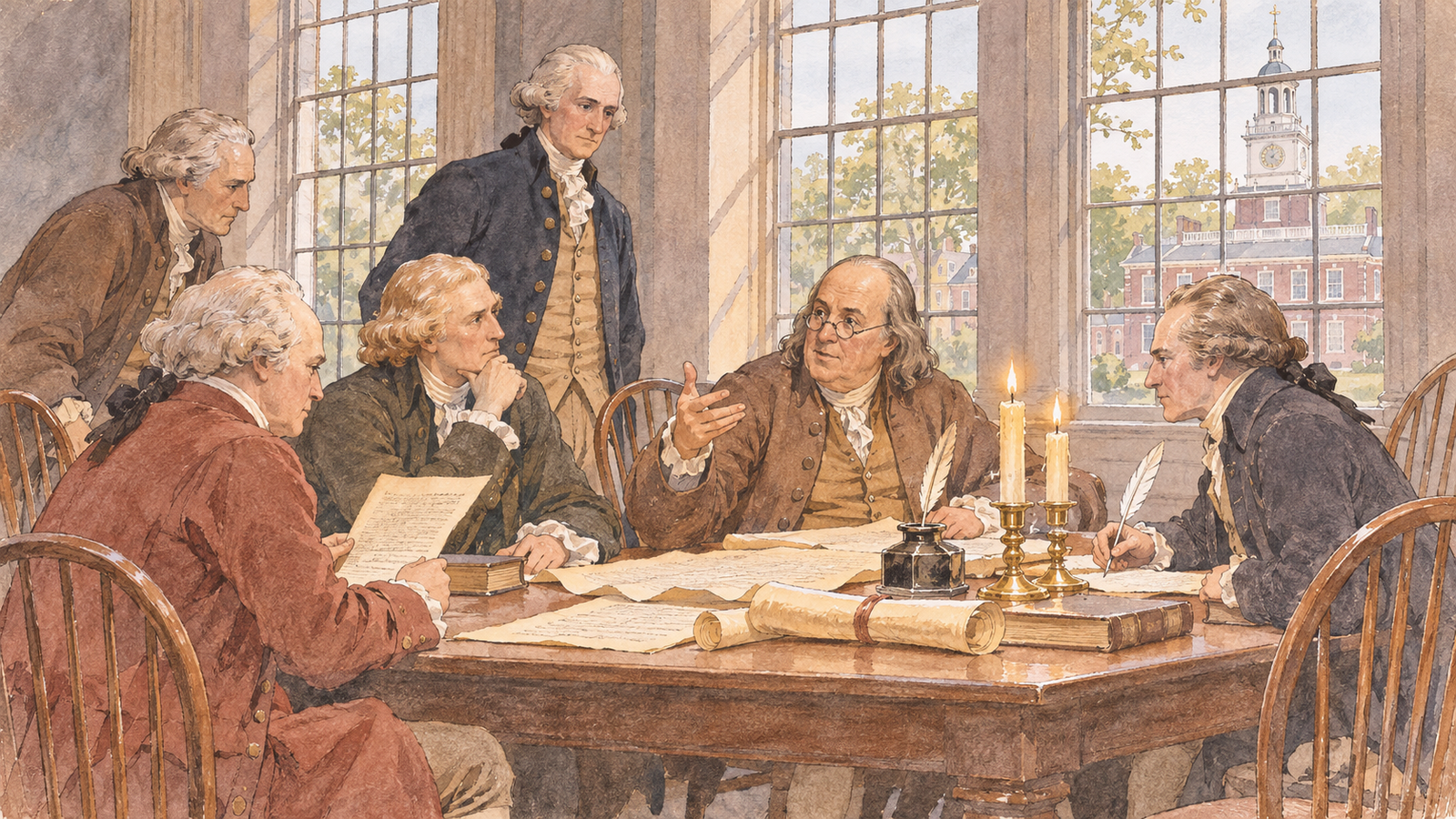
Start with how we know. In the summer of 1787, 55 delegates from 12 states met in Philadelphia, in the building we now call Independence Hall, to design a government. They bound themselves to secrecy and kept the windows shut through a Philadelphia summer so nobody on the street could listen. James Madison of Virginia took a seat at the front and wrote down what the delegates said, every day, for four months. He kept the notes out of print for the rest of his life. They came out in 1840, four years after he died, and by then every man who had sat in that room was dead. Robert Yates of New York kept notes of his own until he quit the convention in July. So, we have the debates, and they do not sound like the Fourth of July.
Philadelphia, May 31, 1787. The convention is not yet a week old, and the question on the floor is whether ordinary voters should elect even one house of Congress.
Roger Sherman of Connecticut, who started out as a shoemaker, says no. “The people,” Madison has him saying, “immediately should have as little to do as may be about the government. They want information and are constantly liable to be misled.” Two words have shifted since 1787. Immediately meant directly. Want meant lack. In plain English: give the people as little direct say as possible, because they do not know enough and anybody can fool them.
Elbridge Gerry of Massachusetts backs him. Gerry signed the Declaration of Independence, and the gerrymander carries his name. “The evils we experience flow from the excess of democracy,” he says. “The people do not want virtue but are the dupes of pretended patriots.” Same old meaning of want. "The people are not bad," Gerry is telling the room. They are easy.
Edmund Randolph, the governor of Virginia, says that when the delegates traced the country’s troubles to their origin, “every man had found it in the turbulence and follies of democracy.” Every man.
Now the other side, because the other side is the instructive part. George Mason, James Wilson, and Madison himself stand up for the voters. What they are defending is the people’s right to choose one house out of two, in one branch out of three. And Madison tells the room exactly where he draws the line. He is, in his own notes, “an advocate for the policy of refining the popular appointments by successive filtrations.” He wants the people to elect the House directly. Everything above the House, the Senate, the president, the judges, he wants strained. Successive filtrations. The filter in this essay is not my metaphor. It is his.
The voters’ side wins, six states to two with two divided, and the people get the House. It is the most they get all summer.
June 18. Alexander Hamilton of New York takes the floor and keeps it the rest of the day. He calls the British government “the best model the world ever produced,” less than four years after the treaty that ended the war against it. He proposes a president and a Senate that serve for life. His reason, as Yates took it down: “The voice of the people has been said to be the voice of god; and however generally this maxim has been quoted and believed, it is not true in fact. The people are turbulent and changing; they seldom judge or determine right.”
June 26. Madison argues for long terms in the Senate. Yates has him saying that landholders must have a share in the government, and then the blunt part: “They ought to be so constituted as to protect the minority of the opulent against the majority. The senate, therefore, ought to be this body.” "Opulent" means rich. Madison’s own notes of the same speech give his reasoning. The country will fill up. The people “who will labour under all the hardships of life and secretly sigh for a more equal distribution of its blessings” will one day outnumber the comfortable, and then, under equal voting, “the power will slide into the hands of the former.” The Senate was the wall against that day. The distrust had a wallet in it.
July 2. Gouverneur Morris of Pennsylvania has the floor. He gets around on a wooden leg, he talks more than any other delegate, and in September he will write the final text of the Constitution, including the words We the People. “We should remember that the people never act from reason alone,” he says. “The rich will take advantage of their passions and make these the instruments for oppressing them.”
Read Morris twice. He did not trust the rich either. “The rich will strive to establish their dominion and enslave the rest. They always did. They always will.” His answer was to seat them in a Senate of their own, for life, as “a separate interest,” where the rest of the government could watch them. Remember that. It comes back.
The convention finished in September, and then somebody had to sell the Constitution, one state at a time. New York was a hard sale. So, Hamilton, Madison, and John Jay wrote 85 newspaper essays under one pen name, Publius, and ran them in the New York papers starting in October 1787. We call them the Federalist Papers. Judges still cite them to settle what the Constitution means. Together they make up the owner’s manual, and two of the three authors helped build the machine. Notice what kind of manual it is. It is advertising. The authors wrote it for the voters to read, and the distrust is right there in it, listed as a feature.
Federalist 10 is Madison’s, published November 22, 1787, and it is the most famous of the 85. Its subject is faction. His definition: “a number of citizens, whether amounting to a majority or a minority of the whole, who are united and actuated by some common impulse of passion or of interest,” and turned against the rights of everyone else. A crowd that wants something at everybody else’s expense. Look at the words “a majority or a minority.” A majority can be a faction. That is the whole paper. Madison’s nightmare was not a coup. It was 51 percent.
A pure democracy, where the citizens assemble and decide everything themselves, has no defense against a faction, he writes. Such democracies have always been turbulent and contentious, incompatible with personal security and property rights, and generally short-lived and violent. And nobody can count on good men to sort it out. “Enlightened statesmen will not always be at the helm.”
His cure is a republic, and he says exactly what separates a republic from a democracy. In a republic the people do not decide. They elect a small number of men who decide. The point, in his words, is “to refine and enlarge the public views by passing them through the medium of a chosen body of citizens, whose wisdom may best discern the true interest of their country.” That is the filter again, in a newspaper this time.
Madison was honest enough to admit, in the same paragraph, that a filter can fail. “Men of factious tempers, of local prejudices, or of sinister designs, may, by intrigue, by corruption, or by other means, first obtain the suffrages, and then betray the interests, of the people.” Suffrages are votes. First win the votes. Then betray the voters. His hope was size. In a big country, he argued, it would be harder for “unworthy candidates to practice with success the vicious arts by which elections are too often carried.” He was counting on distance. He had not met the television set.
Federalist 55 is also Madison’s, from February 1788, and its subject sounds like bookkeeping: how many members the House of Representatives should have. The Constitution started the House at 65 members for a country of nearly four million people. The critics said 65 men were too few to trust with that much power. Madison answered that more is not safer. “Sixty or seventy men may be more properly trusted with a given degree of power than six or seven,” he wrote, but keep adding seats and the logic reverses, because past a certain size a body stops thinking. Then the two sentences everybody quotes: “In all very numerous assemblies, of whatever character composed, passion never fails to wrest the sceptre from reason. Had every Athenian citizen been a Socrates, every Athenian assembly would still have been a mob.”
Madison’s readers knew two things most of us have forgotten. Athens was the real article, a direct democracy with no representatives. Any citizen could walk up the hill, sit in the assembly, and vote on war, taxes, and exile. And in 399 B.C. a jury of several hundred of those citizens, chosen by lot, voted to put the real Socrates to death. Now read the sentence again. Madison is not calling the people stupid. He is saying brains would not help. Fill the assembly with the wisest men who ever lived, and it is still a mob, because the trouble is not the citizen. It is the crowd.
He closes the same paper by giving us our due, and he is careful about the amount. Human nature has enough good in it, he says, to “justify a certain portion of esteem and confidence,” and a republic depends on that good more than any other form of government does. A certain portion. He measured it.
John Adams missed the convention. He was in London as the United States minister to Britain. But he gets the last word. In December 1814, at 79, retired to his farm in Quincy, Massachusetts, and unrepentant, he answered John Taylor, a Virginia planter who had published a book attacking his ideas. “Remember, democracy never lasts long. It soon wastes, exhausts, and murders itself. There never was a democracy yet that did not commit suicide.” He was not excusing kings. In the same letter he says the people are no worse than monarchs or aristocrats and no better. Hand any of them power with nothing to check it, and the result is the same fraud, violence, and cruelty.
The founders were not hiding any of this. They were explaining it. And they built the machine to match.
The people got the House. That was it. Members faced the voters every two years, and the voters were whoever each state allowed, which in most states meant men with property. State legislatures picked the senators. Electors picked the president, and each state’s legislature decided how to choose its electors. In 1800 most of the legislatures were still choosing the electors themselves.
In March 1788, Hamilton explained the role of the electors in Federalist 68. The voters were not going to choose a president. They were going to choose the choosers. The choosing itself would fall, he wrote, to “men most capable of analyzing the qualities adapted to the station,” a small group picked for that one job, with time to deliberate and no crowd to please. He named what the electors were there to stop. One was the demagogue. “Talents for low intrigue, and the little arts of popularity, may alone suffice to elevate a man to the first honors in a single State,” he wrote, but never to the presidency. The other was the foreign plant. Foreign powers would want “to gain an improper ascendant in our councils. How could they better gratify this, than by raising a creature of their own to the chief magistracy of the Union?” The electors would stop that too. Hamilton called the result “a moral certainty, that the office of President will never fall to the lot of any man who is not in an eminent degree endowed with the requisite qualifications.”
A moral certainty. Hold on to that phrase.
The filtered president appointed the judges, and the filtered Senate confirmed them for life. The citizen touched one lever and the designers kept their hands on the other three.
I spent decades calling that elitism. It was. It was also engineering. I wrote software for 40 years, and I know what it means to build a system for a user who will do the wrong thing. You do not build for the user you wish you had. You build for the one who will click the wrong button. The founders built for that user. They had just watched him close the courthouses in Massachusetts with a musket because he owed money. They knew him.
He had a name. Daniel Shays was a farmer in western Massachusetts and a former captain in the Continental Army. In 1786 the creditors and the tax collectors wanted hard coin, the farmers had none, and the courts were seizing farms and filling the debtors’ jail. A good many of those farmers were veterans the country still owed for the war. So they stopped the courts. On August 29, 1786, about 1,500 of them surrounded the courthouse at Northampton, and the court did not sit. In January 1787, Shays led a march on the federal arsenal at Springfield. The militia answered with cannon and killed four men. An army paid for by the governor and 125 merchants scattered the rest in a snowstorm. Four months later the convention opened in Philadelphia. That is what Gerry meant by the excess of democracy, and Massachusetts was his state. Notice that the user who clicked the wrong button had a grievance. The founders built against him anyway.
We tell ourselves we are a democracy. It is not true, and it was never true. The United States is a republic with filters, built by men who had read enough history to be afraid of us. Every one of those filters was a deliberate act of distrust, and we have spent 200 years treating the distrust as a bug and sanding the filters off.
The electors went first. Hamilton’s electors had one job, which was to think. By 1800 they were party men who had promised their votes in advance, and that year the machinery jammed. Each elector cast two votes for president and none for vice president, so Thomas Jefferson and his own running mate, Aaron Burr, finished tied at 73. The House needed 36 ballots to settle it. The 12th Amendment, ratified in 1804, gave the electors separate ballots for president and vice president so they could vote a party ticket without another wreck. Read that as a confession. Sixteen years after Federalist 68, the Constitution itself treated the electors as messengers.
Then the legislatures let go of the electors. By 1832, voters had taken over the choice in every state except one, as Andrew Jackson occupied the White House and the vote spread to men without property. South Carolina’s legislature held on until the Civil War.
The Senate went in 1913. For 124 years the state legislatures had picked the senators, and they had made a mess of it. Between 1891 and 1905, legislatures deadlocked over Senate seats 46 times. Delaware left a seat empty for four years. In Montana a copper millionaire named William Clark bought the votes he needed, and a Senate committee said so in 1900. The 17th Amendment handed the choice to the voters. The reformers had a case. A filter you can buy is not a filter.
Wisconsin invented the primary. Before that, a convention of party men chose the party’s candidates. Robert La Follette wanted the party’s voters to choose them, the Wisconsin legislature put the question on the ballot, the voters said yes in 1904, and the first primary ran in 1906.
The last filter came off after 1968. That August, in Chicago, the Democrats nominated Hubert Humphrey, who had not entered a single primary. The party men handed it to him while the police fought demonstrators in the streets outside. Out of that wreck came a commission, chaired first by George McGovern, that rewrote the rules. Party leaders could no longer hand-pick the delegates. Primary voters would choose them, and the delegates would arrive at the convention already committed. The Republicans followed, because the state laws that created the primaries covered both parties.
Every one of those moves felt like progress. I cheered most of them. Each one put the citizen closer to the lever, and each one removed a man whose job was to ask whether the citizen should be pulling it.
For 140 years, the parties picked their candidates in rooms that voters could not enter. The newspapers called them smoke-filled rooms, after the Chicago hotel suite where Republican bosses settled on Warren Harding in 1920. Plenty of mediocrities came out of those rooms. Harding was one. But a man like Trump never came out of one, because the men inside knew what he was and did not need a primary to find out. That was filter working. It was ugly, it was undemocratic, and it worked. After 1972 the room was gone, and nothing stood between a demagogue and a nomination but the primary voter.
Then the test came, in four parts. We passed one.
In 2016, 14 million Republican primary voters, about four percent of the country, looked at Jeb Bush, Marco Rubio, John Kasich, and 13 others and chose the one Hamilton had described in 1788. Low intrigue. The little arts of popularity. That was not the people. That was Madison’s faction, a minority with a common passion, and it captured a party because we had removed, in the name of democracy, every man with the authority to tell it no.
In November the people chose the other candidate by nearly three million votes. The Electoral College installed Trump anyway. The filter the founders built to keep a demagogue out of the office put him in it. We had cut the deliberation out of it and left the shape, a screen door with the screen gone, and the shape was all it took.
A few electors tried to put the screen back. They called themselves Hamilton Electors, after Federalist 68, and in December 2016 they asked the rest of the Electoral College to do the one job Hamilton gave it. Washington State fined three of them $1,000 apiece for not voting as pledged. In 2020, the Supreme Court upheld the fines without dissent. So much for the moral certainty. The filter is still in the Constitution, and a state may fine the elector who uses it.
In 2020 the voters removed him, and on January 6, 2021, the actual mob, the one Gerry lay awake imagining, broke into the Capitol to keep him.
And in 2024, with all of it on the record, the fake electors, the Georgia phone call, 34 felony convictions in Manhattan, and Jack Smith’s indictment, the people put him back. Seventy-seven million votes and 49.8 percent of the total, the biggest share any Republican had won in 20 years. No small faction this time, and no filter. This is the one that truly matters. The citizen, given exactly the power he asked for and all the information he needed, did exactly what Madison said he would do.
I used to answer that argument with the civil rights record. The majority, when it finally got the vote, widened the vote. It asked for pensions and clean water and a weekend. The majority also elected Nixon twice, and the second time by 18 million votes, with the Watergate burglars already indicted. The majority is not wicked. It is distractable, frightened, flattered, and it votes its stomach. The founders knew that in 1787. I learned it in 2016 and refused to accept it until 2024.
And here is the part my conservative friends will not like, because it is their doing.
The founders’ plan had one more layer, and it was not the voters. It was the men inside the building whose job was to stop a demagogue after the voters let him in. Impeachment. The Senate trial. The courts. The oath. Morris’s chamber. The founders did not expect those men to be saints. Madison said so in Federalist 51: “If men were angels, no government would be necessary.” He expected them to be jealous. “Ambition must be made to counteract ambition.” A senator would defend the Senate’s power because it was his power. A congressman would guard the purse because holding it made him somebody. Whatever the mob did at the ballot box, enough gentlemen would remain inside to hold the line, out of vanity if nothing better.
The Republican Party has spent 10 years proving that assumption wrong too. The Senate acquitted Trump twice. The second time, in February 2021, Mitt Romney, Lisa Murkowski, Susan Collins, Ben Sasse, Pat Toomey, Richard Burr, and Bill Cassidy voted to convict, and Mitch McConnell led 42 others to acquit a man he had just called practically and morally responsible for the riot. The court McConnell built, Roberts, Alito, Thomas, Gorsuch, Kavanaugh, and Barrett, handed Trump immunity for official acts in July 2024, and on April 29 of this year, the same six gutted what was left of the Voting Rights Act. Mike Johnson and John Thune handed over Congress’s war power, its tariff power, and its spending power without a recorded fight. Ambition did not counteract ambition. It asked the president what he wanted. Kevin Roberts at Heritage wrote the manual and Russ Vought is running it from the budget office. The men whose job was to be the last filter took it off and called it loyalty.
Morris saw it coming. They always did, he said. They always will. Then he and the others handed the brake to the rich anyway, because they could not imagine anyone else holding it.
The people removed the outer filters in their pursuit of democracy, while the conservatives removed the inner filters to gain power, resulting in the complete loss of the design.
Look at what was left this year, with no filter on either side. A Fox weekend host, Pete Hegseth, running the Pentagon on a 51-50 vote. Kash Patel running the FBI. Robert Kennedy running public health. A war with Iran that cost six soldiers at Port Shuaiba and got their families the word "appropriate" from the Pentagon. Russian diesel bought from Putin under a sanctions exemption. An FBI raid on a sitting congresswoman. A Justice Department letter telling California ballot counters they could be prosecuted, a grand jury subpoenaing election workers, a lawsuit against Alaska over certification, and a $1 million bounty for fraud tips announced a week before the polls closed. Hamilton named two dangers in Federalist 68: the man of low intrigue and the creature of a foreign power. Read that list again and count. The faction nominated him, the filter installed him, the citizen rehired him, and the party kept him.
I raced motorcycles for a living and ran a school that taught it. Nobody at my school got on a race bike on the first day. You got a small one with a governor on the throttle, and you earned the rest. The founders put a governor on the republic. We took it off because it insulted us. Then we handed the throttle to a man who had never ridden, because he told us we were the best riders he had ever seen.
Now, Tuesday.
The town turned out. Democrats took the House and the Senate, and Hakeem Jeffries stands to be Speaker in January. James Talarico beat Ken Paxton in Texas, a state no Republican had lost statewide in 32 years. Troy Jackson beat Susan Collins in Maine. Roy Cooper took North Carolina, Sherrod Brown took Ohio back, and Gina Hinojosa beat Greg Abbott for governor of Texas. Three Florida districts that Tallahassee redrew to elect Republicans elected Democrats. Byron Donalds kept Florida for the Republicans, so Florida is still Florida, and I’m leaving. Exit polls put 60 percent of voters against Trump and 90 percent on the cost of living. He told Bret Baier he was a little bit surprised and would accept the results. Then he posted that if he had been on the ballot, he would have won in a landslide.
I am glad. I voted for it. And I am not fooled by it.
Ninety percent voted their grocery bill. They knew about the election he tried to overturn, the 1,500 pardons for the people who stormed the Capitol, the television host at the Pentagon, and the diesel from Putin. They knew all of it in 2024 and hired him, and they knew all of it Tuesday, and it still was not the reason. Gas prices were the reason, and he raised them himself with a war he picked. The same stomach voted both times. Prices went up under Biden, so the voter fired Harris. Prices went up under Trump, so the voter fired his House. If eggs had been cheap, he would have kept it. That is not the majority finding its conscience. That is the weather changing. Madison would have nodded and gone back to his notes.
A scant victory, then. Scant because inflation bought it, not judgment. Scant because the Senate is still two per state and a Wyoming voter still outweighs 67 Californians. Scant because the same six are still the court and will be for 30 years. Scant because the man who says he will accept the results has 61 days, Pam Bondi’s Justice Department, and a grand jury to change his mind with. And scant because nothing in it fixes the thing I finally understand: we took the filters off a machine that was built with filters for a reason, and the reason has not gone anywhere.
So, what do I do with this.
I do not want property tests. I do not want legislatures picking senators or electors deliberating over my head. I saw what the men in those legislatures do when no one is watching, in Selma in 1965 and Austin in 2025. The founders’ answer to the mob was to put rich men between the mob and the lever, and the rich men sold the lever.
But I am done pretending we are a democracy, and I am done with the argument I made for 60 years, that the cure for a failure of democracy is more of it. More primaries gave us Trump. More direct say gave us Trump twice. The citizen is not a Socrates, and Madison told us it would not matter if he were. He is a guy who votes on eggs, and I am one of him.
The question was never more democracy or less. The question is where you put the checks so nobody can buy them. I want them in rules. A court with terms, so no president gets 30 years out of one lucky funeral. A Senate in which 26 states holding less than a fifth of the country cannot govern the other four-fifths. A nomination process with a hand on the brake, which means a party willing to tell its own voters no. A Congress that takes back the war power, the tariff power, and the purse and uses them whoever sits in the White House, starting with the one that convenes January 3. Some of that is more democracy and some is less, and I have stopped caring which. I care whether it holds.
The founders were right that the people need checking. They were wrong about who should do it. They thought the answer was men like themselves. Ten years of men like themselves settled that.
We won Tuesday because eggs were expensive. Madison would call that luck, and he would be right. I will take the luck. Then I want the governor back on the throttle, and this time I want it bolted to something nobody can sell.