Treason Pays Better
Than Governing
This is an extra. Free. Posted this morning because Trump’s corruption didn’t cross the line—it erased it. Waiting would be dishonest. So it goes out now.
Paul Krugman used the word "treason" this morning. Not as a rhetorical flourish. As a description of what happened.
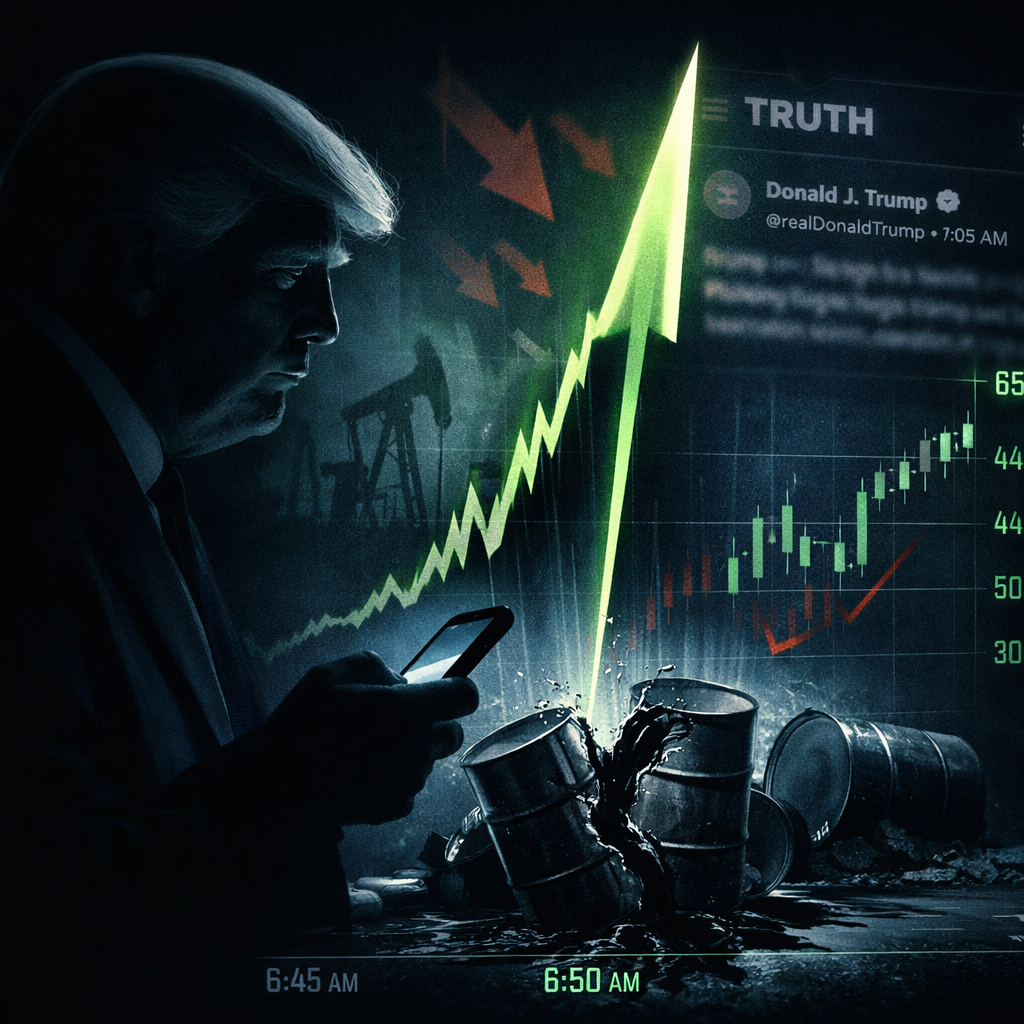
Here is what happened. At 6:50 AM Monday, the S&P 500 e-Mini futures on the CME recorded what CNBC called "a sharp and isolated jump in volume, breaking from an otherwise subdued premarket backdrop." Simultaneously, West Texas Intermediate oil futures spiked in the same way. Early-morning futures markets are thin. That kind of burst stands out like a gunshot in an empty room. There was no publicly available news at 6:50 AM to explain it. None.
Fifteen minutes later, at 7:05 AM, Trump posted on Truth Social that the U.S. and Iran had been talking and that he was halting planned strikes on Iranian power plants. S&P futures soared more than 2.5% before the opening bell. WTI crude dropped nearly 6%.
Whoever bought stock futures and shorted oil at 6:50 made a fortune in fifteen minutes. The SEC and the CME Group declined to comment. The Financial Times estimated the oil futures trades in that window at around $580 million. That doesn't count the equity side.
Here's the part that should be obvious but isn't getting said clearly enough: whoever placed those trades knew the content of that Truth Social post before it went live. Which means the list of suspects fits in a small room. Trump himself. Whoever drafted the post, if it wasn't him. Whoever he told about it before he hit send. That's the circle. The SEC could match the 6:50 account holders against White House staff and Trump's inner circle in a week if it wanted to. The CME has the records. It's not a hard investigation. It's just an inconvenient one.
This isn't the first time. In April 2025, Trump posted "THIS IS A GREAT TIME TO BUY!!!" on Truth Social — signed it with his initials, which also happen to be his company's stock ticker — and four hours later announced a 90-day tariff pause that sent the S&P up 9.5% in a single session. Eighteen minutes before that announcement, an unusual block of options on the S&P 500 changed hands. A $2.1 million position turned into more than $30 million before the day ended. Analysts said the odds of that happening by accident were virtually zero.
Before that, suspicious moves appeared in Polymarket ahead of the Venezuela and Iran military actions. This is a pattern. It has been a pattern for over a year.
Krugman lays out why this crosses from insider trading into something worse. When corporate insiders trade on non-public information, that's a federal crime. But when the non-public information is whether the United States is about to bomb a foreign country, the crime has a different name. The profits aren't just theft from other investors. They're cut from national security itself.
There's a second problem Krugman identifies that deserves more attention than it's getting: foreign adversaries no longer need spies. They need a futures account and a Bloomberg terminal. When the decision to stand down from a military strike shows up in the oil markets fifteen minutes before the president posts it, every intelligence service in the world is taking notes. You don't bribe a source. You watch the tape.
And then there's the question Krugman raises carefully, because it's the ugliest one: are policy decisions themselves being shaped to serve the trade? Not just — did someone profit from the decision? But — was the decision timed, or even made, because someone had already placed the bet? Did the bombing get called off when it did because the conditions were right, or because the short position needed the announcement to land on schedule?
The White House will deny it. Kevin Hassett — who also guaranteed with 100% certainty there would be no recession in 2025 — said after the tariff episode that "the proper authorities" would look into any suspicious trading. The SEC is run by a Trump appointee. The FBI is run by Kash Patel. Krugman made a joke about that. It wasn't really a joke.
What we are watching is a government that has learned to monetize the presidency in real time. The old graft was slow — defense contracts, revolving doors, post-service board seats. This is instant. You know what's coming. You or your friends place the bet. The announcement drops. You collect. The SEC declines to comment.
Krugman's closing is the part that should follow everyone to sleep: you cannot trust a corrupt government to protect national security. Not because corruption makes officials cowardly, though it does. Because a government that sells access to its own decisions has already decided the country is a commodity.
Nobody credible is going to investigate this right now. What we can do is say clearly what it is, so that when the reckoning comes — and it will come — the record is clean.
It's treason. The word fits.
Thanks for reading Burnt Ground! This post is public so feel free to share it. Log onto Paul Krugman below. I recommend it.