
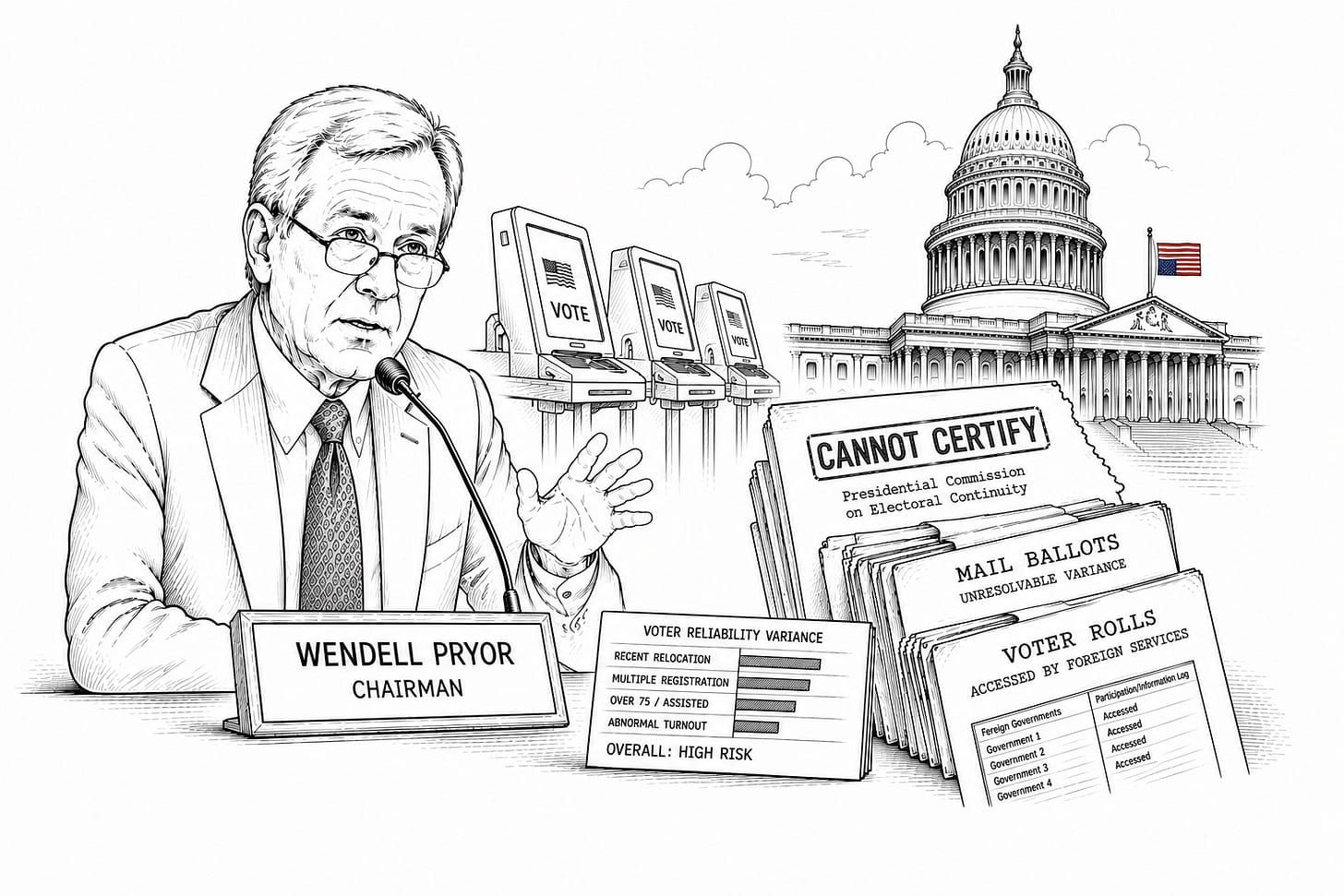
Prepared remarks of Wendell Pryor, Chairman of the Presidential Commission on Electoral Continuity, before the Joint Committee on Rules and Administration.
I did not seek this assignment. I want that on the record before anything else, because the coverage of our preliminary finding has suggested a hunger for authority that I do not have and have never had. I am a technician. I was asked. I said yes because the people who asked me could not find anyone else willing to look at the numbers and say what the numbers said.
What the numbers say is that we cannot certify the November result. Our elections run on software no citizen has inspected, maintained by vendors whose internal audits remain proprietary, administered across 10,000 county offices operating to 10,000 standards of practice. Foreign services have touched the voter rolls in every state. I am not at liberty to characterize the extent. I can tell you that our analysts describe the modeling as unambiguous, and that the finding troubled me personally more than anything in 30 years of public work. An election that cannot be verified cannot confer legitimacy. Holding it anyway does not protect the franchise. It launders doubt into power.
Our interim remedies are modest and I had thought them uncontroversial. Withdraw the machines. Suspend voting by mail, which introduces more unresolvable variance than every other vector combined. Count by hand, in daylight, in the presence of federal observers. Members have called this a restriction. It is the only condition under which a count means anything, and I would ask why the objection arrives loudest from the people who have spent six years telling us the result was rigged.
Senator Halloran asked last week who administers the government during a pause. I want to say plainly that this is a fair question and a serious one, and that it is downstream of the technical finding rather than part of it. Our mandate is verification. The question of continuity in the interim falls to other bodies, working from other authorities, on a timeline I am not positioned to describe. I understand the appetite for specificity. I would ask the committee to notice that the appetite arrived before the audit did.
I am told some members find our voter-reliability annex distasteful. I have not been told it is inaccurate. The annex (tab four) identifies the population segments that introduce the greatest variance into a contested count: voters who have relocated within 18 months, voters registered in more than one jurisdiction, voters over 75 in facilities where assistance is customary, and voters in precincts where turnout has recently departed from historical pattern. Nobody on our staff proposes excluding anyone. We propose that a pause allows these segments to be resolved rather than litigated. Resolution is a kindness. Litigation is what we are trying to spare them.
Which brings me to a point I did not expect to be making when I took this job, and which I make with some warmth, and I apologize to the committee for the warmth. The midterm is a measurement problem before it is anything else. A presidential year produces the largest sample this country is capable of generating. A midterm produces two-thirds of it, drawn unevenly, weighted toward the same segments our annex has already identified as the least resolvable. By the standard I have applied to the machines and to the mail, the midterm is the least certifiable election we hold. It has always been the least certifiable election we hold. Nobody has raised it, because nobody had run the numbers, and because nobody wanted to.
So I would ask the committee to follow its own objection to the end. If the November count cannot be verified, members say we are suspending an election. If a midterm can never be verified, and the arithmetic says it cannot, then this body has been certifying unverifiable results for two centuries and calling it a check on power. A president arrives through the broadest electorate this country produces. Twenty-four months later a smaller and less resolvable one is invited to overrule him. I have been asked whether I find that democratic. I find it imprecise. I have no view on the record of the past 18 months. I would observe only that it is not finished, and that a measurement taken at the midpoint of an unfinished thing measures the midpoint. The mandate was issued in the presidential year. Let the term run. Judge the whole of it in 2028, when the sample is complete.
On public trust I will be brief, because the committee has seen the polling. Confidence has collapsed in both parties; each side is now certain the other cheats. Whoever wins in November, half the country calls it theft and the litigation runs a year. Our recommendation is therefore that the pause continue until confidence has been restored to a level consistent with legitimate administration. Senator Halloran asked how that level would be measured, and by whom. The commission would measure it. That is the commission’s function. I recognize this has been characterized as circular. I would characterize it as the reason the commission exists.
I have been asked about 1864 more times than I can count, and I welcome it, because the precedent runs the other way from how it is usually deployed. Yes, the country voted in the middle of a war. What the record also shows is that in the August before that vote, Lincoln sat down and wrote out what he would do when he lost, which he expected to. Then he folded the page so the writing could not be seen and had every member of his cabinet sign the back of it without reading the front. He kept it in his desk until the thing was decided. That is the conduct the members opposite are praising when they invoke that autumn. A man who thought the moment through in advance, committed his intention to paper, sealed it, and told no one what it said. I keep his example close. I would ask the members who raise 1864 as a rebuke to consider that they may be making mine.
One further matter, and I raise it because I would rather this committee hear it from me than read it in a leak. Our analysts were asked to model whether the conditions we have identified will have resolved by 2028. They report that the trend lines do not support that assumption. Vendor concentration worsens. The attack surface grows. It is possible, and I want to be careful here, that 2028 arrives under conditions no more certifiable than the ones in front of us now, and that a country grown accustomed to pausing would find itself pausing again in circumstances less well understood and in a hurry. That is the outcome I fear most. It is why the commission’s final recommendation will propose a standing capability, resident in the executive, so that this determination need never again be improvised by men like me at short notice. Nobody wants a permanent commission. We want to make sure no one ever has to build one again in a panic.
The Twentieth Amendment has come up. Members are correct that congressional terms end at noon on January 3 whether or not an election has occurred, and that in the absence of a certified result the House would, as a technical matter, stand empty. Our counsel describes this as a transitional condition. It resolves itself the moment confidence is restored. Counsel is preparing a fuller memorandum on the mechanics and I will forward it to the committee when it is available.
I know what is said about men in my position. So last month I wrote out my own understanding of the duty I hold and sealed it in the drawer of my desk, where it will stay until this is finished. It says what I will do when the audit is complete and the moment is right. I do not compare myself to Lincoln. I only mean that a man who writes down his intentions in advance is a man who has thought about them. I am glad to take the committee’s questions.
Wendell Pryor is fictional, and so is his commission. The argument is not.
In January, Trump told Reuters his administration had accomplished so much that the country shouldn’t even have an election this year. The White House said he was speaking facetiously. It was at least the second time that month he had raised it, and he had already told Republican lawmakers he wouldn’t say the words cancel the election, because the press would report he wanted the election canceled. He has warned Democrats would find a reason to impeach him if they take the House. Two executive orders, March 2025 and March 2026, moved against voting by mail and against the machines. The second directs a federal citizenship list and tells the Postal Service to withhold ballots from anyone not on it. The voters most likely to fall off a list like that are service members overseas, naturalized citizens, people with disabilities, and the elderly in care. Twenty-three states and the District of Columbia sued. In June Judge Indira Talwani blocked the core of the second order for the November 3 election, writing that the Constitution “does not grant the President any specific powers over elections.” The First Circuit upheld her last weekend. On Monday the Solicitor General asked the Supreme Court to let the order take effect anyway, arguing it has to be in place by the middle of August to matter in November. The states’ response is due Monday.
No president can cancel a federal election. Congress sets the rules, 10,000 county offices run them, and those offices say they intend to keep running them. The men who built it that way did not trust a president with elections, and said so out loud in Philadelphia. That was never the danger. The danger is a plausible man with an audit.