
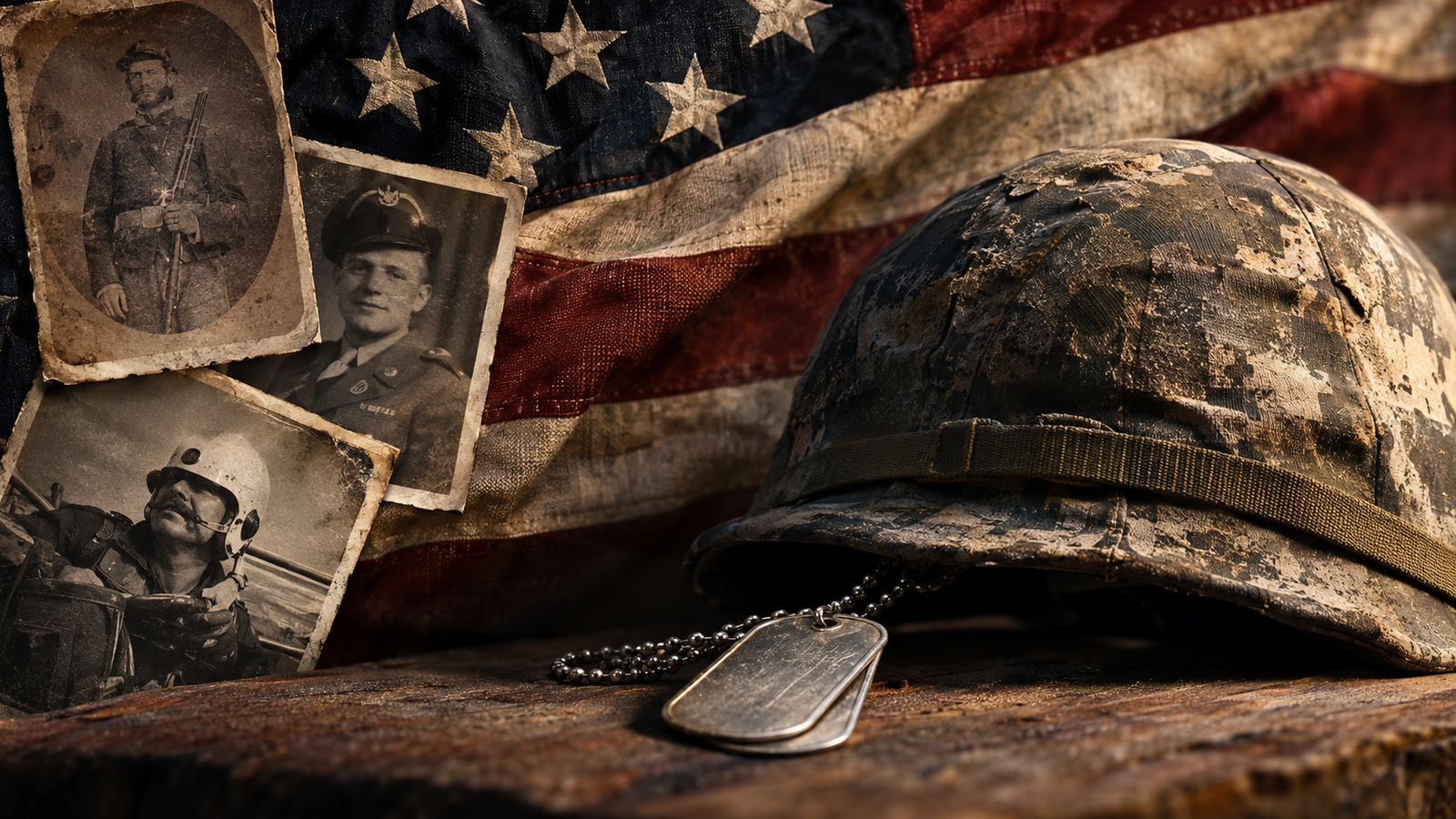
Veterans Day, from a family that has been at it since 1860.
Joe Zeigler | Burnt Ground | November 11, 2026
Today, the United States thanks its veterans. Mattress stores thank them at 40 percent off. Restaurants thank them with a free appetizer. Congressmen thank them from a podium. Most never served. Some go back to work and vote against their care.
I want to thank them too. I want to do it honestly, which takes longer.
My family has worn a uniform since 1860. We started on the losing side. My predecessors owned plantations and people, and when the war came, they fought to keep both. Call them brave if you like. Bravery in a bad cause is still a bad cause, and it still leaves a widow. I don’t get to skip that part. A family that claims its soldiers has to claim all of them, including the ones who fought for the wrong thing and lost.
After that, the uniform changed color, and the family kept putting it on. Two cousins died in World War II. Other relatives died in most of the wars that followed. My father his brother were Navy officers and a pilots I was born in Selma and raised on bases, in military housing, and in military schools.
Then I flew for the Coast Guard, the service the country forgets until the boat starts to sink. Its business is going out in weather that sensible people avoid and bringing strangers back.
So, I know what service looks like from inside the fence. It is not a parade. It is a family that moves when ordered and waits when told. It is a job where the worst day at the office ends with a folded flag.
That history doesn’t make the uniform sacred. It makes it heavy.
I have spent years writing that war is the oldest thing we do. We were killing each other in groups before we had an alphabet to brag about it. I believe that. I also believe the people who fight a war are almost never the people who chose it. Old men with maps choose. Young men with rifles pay. Any honest thanks starts by keeping those two groups separate.
Some wars had to be fought. My two cousins died in one of those. The necessary wars do not excuse the cheap ones. They make them worse.
I marched against Vietnam. I did not march against the men who went. Friends of mine and relatives went and did not come back. The men who sent them died in bed, with libraries named after them.
The day itself tells the story. It began as Armistice Day, marking the hour the guns stopped in 1918. It celebrated the end of a war. In 1954, Congress renamed it, and the country has celebrated the warriors ever since. Celebrating warriors is easier than ending wars. It also polls better.
Fewer than one in 100 of us serves now. The rest of the country outsourced it. The United States hires its wars done the way it hires the lawn done, and it tips once a year in November. The recruiter does not set up his table at the country club. He sets it up where the jobs left, and he offers a kid the only college fund in town.
I have been hard in these pages on the man who served a year and wore the hat for the next 50. I served, so I get to say it, and I stand by it. I will also say this for him: he went. Somebody put a form in front of him at 18, and he signed it. Most of the country never saw the form.
The oath I took did not name a president. Neither did my father’s. Both named the Constitution. That detail matters more now than it has in my lifetime. Trump got out of Vietnam on a doctor’s note about his feet, and he commands the military. Pete Hegseth, a weekend television host, runs the department and fires the officers who know the job. PrumpTutin wants a military loyal to a person. Every veteran alive swore to something else, and most of us remember it.
In March, an Iranian drone killed six soldiers at Port Shuaiba. The wounded say they had to fight the Army for treatment. The Pentagon called the care “appropriate.” I keep reading that word. A man uses it when he means the minimum.
Honor costs money. That is how you tell it from the appetizer. The bill for a war runs 50 years past the last shot. Hospitals. Prosthetics. Pensions. The nightmares that medicine can name and cannot cure. The people who profited from the war never pay that bill. The contractor books the revenue, the rich book the tax cut, and the veteran waits on hold.
Honoring a veteran means three things, and none of them fits on a bumper sticker. Do not spend soldiers cheaply. Pay for every one you break, for as long as he stays broken. Tell the truth about why you sent him. The United States is bad at the first and late on the second, and it has not tried the third.
“Thank you for your service” runs five words and costs nothing, which explains its popularity.
My family has been sending people to war since 1860. I would like mine to be the generation that asks what for before the funeral instead of after.
To everyone who went: you kept your end. The country still owes you its half.
Further Reading
U.S. Army, “History of Veterans Day”
Pew Research Center, “The changing face of America’s veteran population”