Putin's War, Trump's Bombs

The war started on a Saturday morning, the way the worst ones usually do. Trump announced it on Truth Social — a platform he owns a controlling stake in, worth about $1.2 billion — not in a televised address to the nation, not before Congress, but as a digital dispatch on his personal money machine. An 8-minute video. Posted like a product announcement.
There’s something else worth saying about that choice. Democrats and liberals don’t read Truth Social. They’re not on it. It was built for the base, to feed the base, and the base already wanted this war. So the people most likely to object, most likely to ask hard questions, most likely to remember what Iraq cost — they found out the same way they find out everything from this administration. Late. Secondhand. After the bombs were already falling.
February 28, 2026. The United States and Israel launched coordinated strikes on Iran. They called it Operation Epic Fury. That’s not satire. That’s the name they actually chose. Supreme Leader Ayatollah Ali Khamenei was killed in the opening hours. By Day 10, more than 1,200 people had been killed in Iran and 570 in Lebanon — and the count was still moving. The Strait of Hormuz went quiet. Oil surged past $100 a barrel. Trump held a press conference at his golf club and said it was “a military success the likes of which people haven’t seen.”
He also said it would be over “very soon.”
Eleven days in, it wasn’t.
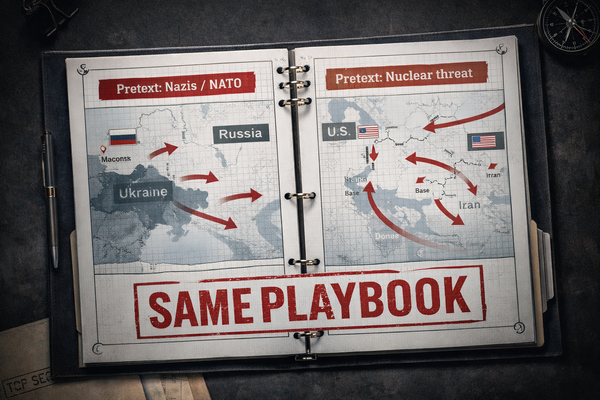
The stated reasons for the war shifted from the beginning. Nuclear weapons were invoked. Missile threats that American intelligence said were unfounded were invoked. Protesters were invoked. The reasons changed daily, sometimes hourly, because the reasons were never really the point. The point was the war.
Now look at who’s winning.
Not Iran. Not the United States, which is now burning through military resources, watching oil prices crater domestic budgets, and watching alliances fray in real time. Spain denied use of its military bases for US flights connected to the offensive, and Trump threatened economic retaliation. France opened its bases while calling for restraint. Canada said it “can’t rule out participation.” This is what coalition warfare looks like when the coalition doesn’t believe the cause.
The winner is Vladimir Putin. Watch the geometry.
Russia gains new resources to finance its war against Ukraine as energy prices rise. It profits from the diversion of military capabilities. That’s the European Council president speaking, not a critic on the fringe. The discount Russia trades its oil at to compensate for sanction risk has been shrinking since the crisis started. More money. For the Ukraine war. As a direct consequence of Trump’s Iran adventure.
And then there’s the phone call.
Trump spoke with Putin on Monday, their first call since the beginning of the war. Putin presented Trump with several proposals for ending the conflict. Afterward, Trump told reporters that Putin “was very impressed with what he saw” the United States do in Iran. Trump sounded like a student waiting to hear what his teacher thought of the book report.
Then Trump hung up and announced he was lifting oil sanctions on “some countries” — he wouldn’t say which ones. He didn’t have to. The Treasury’s general license named them. Russian oil companies. Russian shadow fleet vessels. Even ships tied to Iran’s Revolutionary Guard. Trump kept Russia off his lips. The paperwork didn’t.
He didn’t notify Congress, which is required by law. Senate Democrats called it “a sweeping general license” and noted — citing public reporting — that Russia was actively helping Iran target American forces in the Middle East. Trump was asked about Americans paying record gas prices because of his war. His answer: “I don’t have any concern about it.”
PrumpTutin is not a metaphor. It’s a mechanism. Putin doesn’t need to give Trump orders. He needs Trump to need his approval. Hanna Notte, Director for Eurasia at the James Martin Center for Nonproliferation Studies, put it plainly: by offering to play a constructive role, Putin flatters Trump and stays on his good side — which is exactly what Russian objectives in Ukraine require. Every phone call, every compliment, every “proposal” is a deposit. The war with Iran is a withdrawal. The sanctions are a withdrawal. Trump is spending American credibility and lives, and Putin is cashing every check.
The Russian regime built its strategy on Trump being distinct from his predecessors. That bet is still paying. The Ukraine war grinds on. Western attention is elsewhere. Oil revenues are climbing. And somewhere in all of it, a phone call happened, a general license got signed, and the name Russia never crossed the president’s lips.
He knew what he was doing. He just couldn’t say it out loud.
If this landed, send it to one person who needs to read it.