
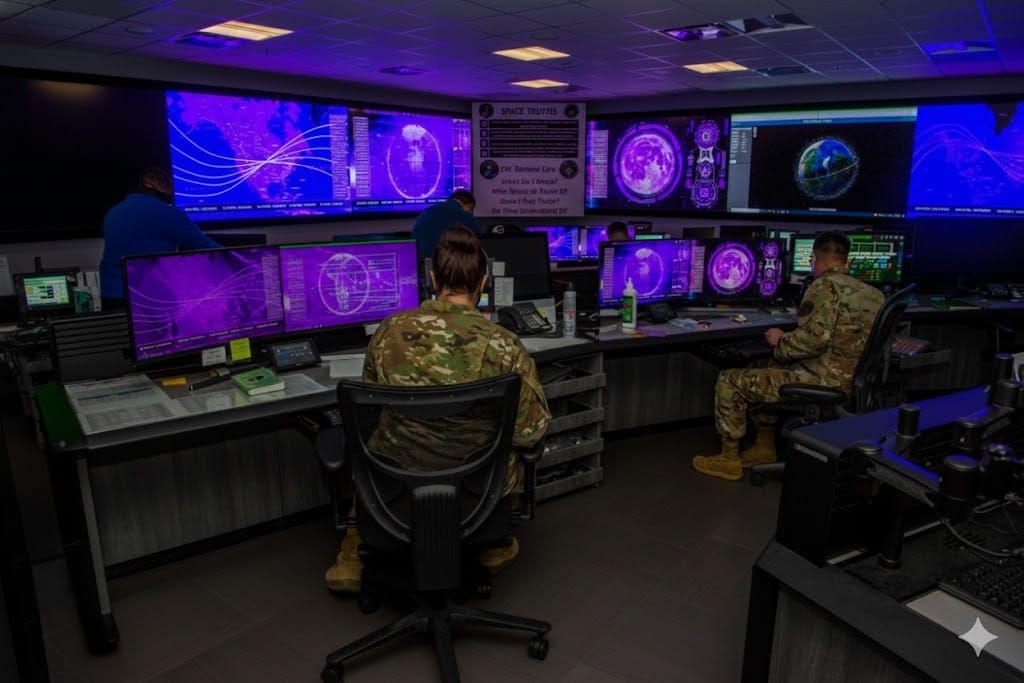
War used to move at the speed of people.
Analysts stared at photographs. Intelligence officers argued over reports. Lawyers reviewed targets. Commanders debated what might happen if the bomb hit the wrong building.
Days passed. Sometimes weeks.
War was slow because humans were slow.
That era is ending.
This week we learned that the United States military has been using Claude, built by Anthropic, inside the battlefield intelligence system known as Maven Smart System.
Maven was built by Palantir Technologies, a company that has spent years convincing the military that software can win wars faster than generals.
The system swallows data by the oceanful. Satellite imagery. Drone feeds. Signals intercepts. Reconnaissance reports. Logistics chatter. The raw material of modern warfare.
Then the machine begins sorting.
Targets appear.
Coordinates.
Priority lists.
Strike suggestions.
Damage estimates after the bombs fall.
In the opening hours of the U.S. and Israeli campaign against Iran, the system reportedly helped generate roughly one thousand targets in the first twenty-four hours.
One thousand.
That is not human speed.
That is machine speed.
And here is the part that reads like satire.
Hours before the bombing began, Donald Trump announced that federal agencies would ban Anthropic’s technology. Six months to phase it out.
The argument was about control. Anthropic wanted limits on how its models could be used — particularly around autonomous weapons and domestic surveillance. The administration wanted fewer guardrails.
So the government banned the system.
Then the military used it anyway.
Not because anyone changed their mind. Because they couldn’t stop.
Too much of the battlefield now runs through Maven. Commanders plan with it. Intelligence officers query it. Targeting teams rely on it to process intelligence streams that no group of humans could keep up with.
Turning it off would mean slowing the war back down to human speed.
No military does that voluntarily.
The deeper story here is not a contract dispute between Washington and an AI company. The deeper story is that warfare has crossed a technological threshold.
For centuries, the pace of conflict was limited by the human brain.
Artificial intelligence removes that limit.
A system like Maven can ingest hundreds of intelligence feeds simultaneously and produce targeting packages in minutes. The result is a battlefield that moves faster than the people supervising it.
The phrase you will hear from officials is reassuring.
Humans remain in the loop.
Perhaps.
But loops get very small when the machine is moving faster than the humans checking its work.
Anyone who has used a large language model understands the problem. AI gets things wrong. It hallucinates. It fills gaps in the data with confident nonsense.
When that happens in a chatbot summary, the worst outcome is embarrassment.
When it happens in a targeting system, the outcome is measured in craters.
The fight between Anthropic and the United States government is really a fight about guardrails. Technology companies want limits on how their systems are used. Governments see strategic advantage and prefer fewer limits.
History suggests which side wins those arguments.
If Anthropic ultimately pulls Claude out of Pentagon systems, the military will not slow down. It will simply replace it. OpenAI, xAI, and a growing ecosystem of defense startups are already lining up to provide the next model.
The trajectory is obvious.
Artificial intelligence is sliding quietly into the targeting loop of modern war. It is not pulling the trigger — at least not yet — but it is increasingly deciding where the trigger points.
Which makes one line in the reporting worth lingering over.
Officials suggested that even if Anthropic attempted to cut off access, the government could use its authority to retain the technology until a replacement is ready.
Translation is simple.
The AI may belong to a private company.
But once it enters the machinery of war, it stops being theirs.
It belongs to the war now.