
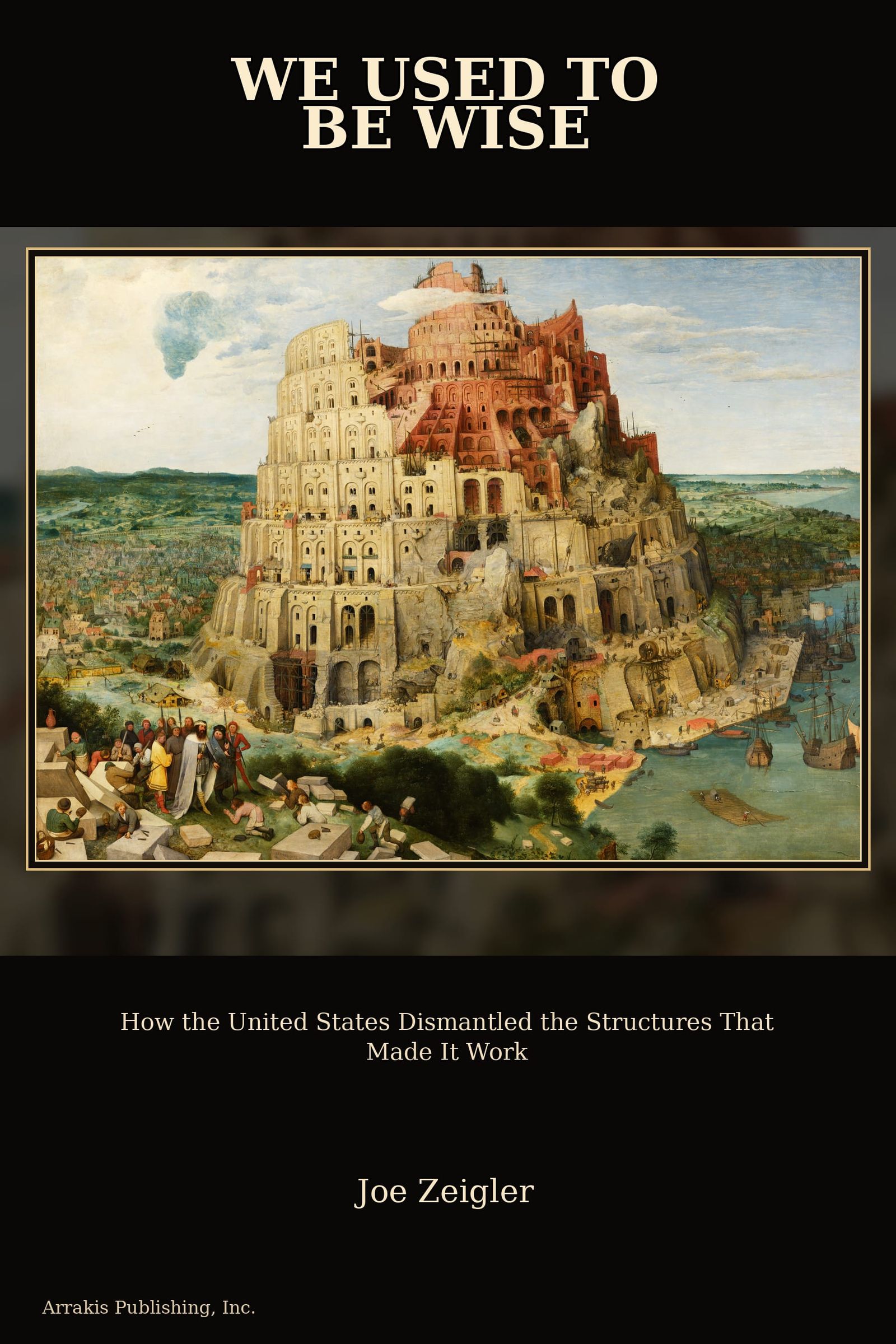
We Used to Be Wise is the accounting Zeigler has been threatening to write for years. Nineteen chapters, one indictment. The premise is simple and the evidence is overwhelming: in August 1971, Lewis Powell wrote a memo to the U.S. Chamber of Commerce that read like a battle plan. Concentrated private wealth was losing the postwar political settlement, and Powell told it how to fight back — patiently, across decades, on every front simultaneously. Universities. Courts. Media. Legislatures. Funded through tax-deductible foundations and trade associations so the cost was borne by everyone, including the people it was being deployed against.
The book traces what happened next. Heritage Foundation, 1973. ALEC, 1973. Cato, 1977. The Federalist Society, 1982, eventually staffing the federal judiciary up to and including Gorsuch, Kavanaugh, Barrett. Fox News, 1996, with Roger Ailes — who attended a Powell Memo Task Force meeting in 1973 — finally building the television operation he had drafted for Nixon in 1970. By 1980 there were 2,445 corporate offices in Washington, up from 176 in 1971. By 2024, the Koch network alone was spending over half a billion dollars per cycle.
Each chapter takes one structure and shows how it was taken apart. The Wagner Act. Glass-Steagall. The Fairness Doctrine. The progressive tax structure. NATO commitments. The Voting Rights Act. The peaceful transfer of power. The IRS’s enforcement capacity. The regulatory state. None of these failures was accidental. Each was lobbied for, litigated, and ultimately legislated by people who knew exactly what the structure had been preventing and decided the prevention was worse than the catastrophe.
The numbers do not flatter the dismantlers. Productivity grew 60 percent between 1979 and 2019. Wages for nonsupervisory workers grew 11 percent. Private-sector union density fell from 35 percent to 6 percent. CEO pay went from 20 times worker pay to 350 times. The top one percent’s share of national income roughly doubled. The national debt grew from $1 trillion to over $35 trillion, most of it added during Republican tax-cutting administrations whose theory was that the cuts would pay for themselves. The theory failed every time it was tested. It kept being deployed anyway, because the people benefiting had bought the political infrastructure to keep deploying it.
The book is honest about what was always wrong with the postwar achievement. Black veterans were systematically denied GI Bill benefits. Redlining was federal policy. The unions were segregated. The structures worked, and they distributed their benefits along racial lines that compounded inequality rather than closing it. Rebuilding cannot mean restoration. It has to mean building something better than what existed.
The conclusion lands hard. Powell’s method — patient, coordinated, institutional, decades-long — was the right method. His purpose was the wrong purpose. The response requires the same method in service of the opposite goal: a democracy that actually governs in the interests of the people who live in it.
We used to be wiser. We learned. We let it be unlearned.
We Used to Be Wise is available on Amazon and at arrakispublishing.com.