
The Road Under the Road
Summary for the Time-Constrained Reader
Route 66 got a birthday and a death certificate. The federal board numbered it on November 11, 1926. The Federal Highway Administration struck it off on June 27, 1985. In between, the road did three jobs, and only one of them shows up on the t-shirts.
It sold. A Tulsa businessman named Cyrus Avery bent the Chicago-to-Los Angeles route south through Oklahoma, lost the number he wanted, took 66 instead, and spent the rest of his life selling two digits like patent medicine. Everything that grew along the shoulder, the concrete teepees and the caged mountain lions and the eighty-foot arrows and the two-headed calf, existed to make a driver's foot come off the accelerator. Main Street was the highway. That was the whole business.
It killed. Sixteen feet of crowned pavement carried the industrial weight of a moving nation. Bias-ply tires that ran hot by design let go all at once at seventy. Drum brakes faded on the second hard application. Passing meant pulling into the oncoming lane and doing arithmetic with your life. County coroners counted the bodies for three decades and small-town papers printed the numbers. The local press along the corridor did not use the promotional nickname. They called it Blood Alley.
And it sorted. In February 1936 the Los Angeles police chief sent a hundred and twenty-five of his own officers hundreds of miles outside his jurisdiction to sit at the state line and turn back anyone without money. California then made it a crime to bring a poor person into the state, and the Supreme Court did not strike that law down until 1941. The same year the blockade started, Victor Hugo Green began publishing a guide telling Black drivers which towns would sell them gas and which county lines to be across before dark. White families remember the road as freedom. They are not lying. It was never open to everybody.
Two findings sit under the nostalgia.
The first is that nobody fixed the road for the dead. The casualty figures were public the whole time and no Congress built a highway system because of them. The money moved when a lieutenant colonel who spent sixty-two days crossing his own country in 1919 became a president who had driven Hitler's roads in 1945. The Interstate Highway Act was engineered to standards written by soldiers: divided lanes, controlled access, no cross traffic, no stoplights, no towns. No towns was the specification, not the side effect. The towns died on a schedule, one bypass at a time, Glenrio in 1975, Seligman in 1978, Williams last in 1984. Eisenhower saved those lives sideways, while solving a problem about moving divisions.
The second is that the same four hundred miles of highway monetized the same people three separate ways. The Atomic Energy Commission bought uranium out of Grants as the only legal buyer in the country, and the Public Health Service put in writing that the miners would not be told what radon does to a lung, on the reasoning that men who knew would quit and production could not afford the interruption. Ninety miles west at Holbrook, Chester Lewis rented a fake Indian village at two dollars a night. At Two Guns, a huckster sold bones with the postcards. Three men, one arrangement, and none of them had to leave the pavement to find it.
One man fought the bypass and won. Angel Delgadillo, a barber in Seligman, got the business owners into a room in 1987 and asked the state for a sign. That is the only mechanism that has ever worked at the local level. Not a plan. Not a budget. Somebody who will not let it go.
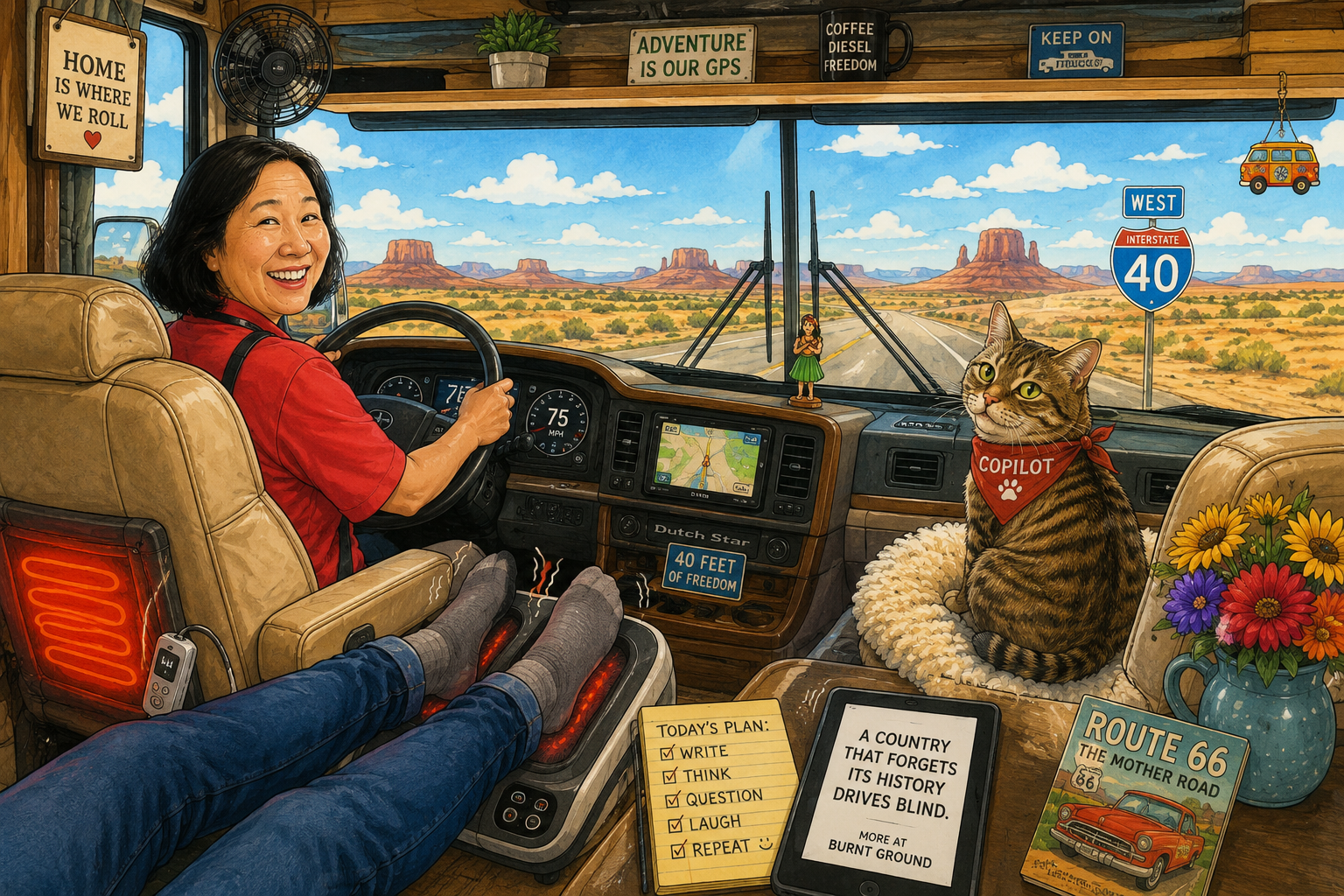
The rest is a man of eighty driving over the graves at seventy-five, twelve tire monitors reporting to a screen, complaining about a date code, on pavement the government bought with other men's lungs.
That is the argument. Paid readers get the drive.
The governor who lost an election and spent his last thirty-one days in office cutting a road across sixty-nine miles of nothing to punish the city that knifed him. The engineer who sank a fortune into the crater at Winslow for twenty-six years and died broke on the rim, right about what made the hole and wrong about everything else. The tiger cage in the alkali dust at Two Guns, and the children feeding peanuts through the mesh while their fathers checked the radiator. The trooper outside Needles, forty miles from water with no cutting tools, and what the man pinned in the burning frame asked him to do.
Also, the barber who got his town back and the ten Cadillacs buried nose-down in a wheat field at the angle of the Great Pyramid.
Four hundred miles of it, with the old grade running parallel the whole way.