
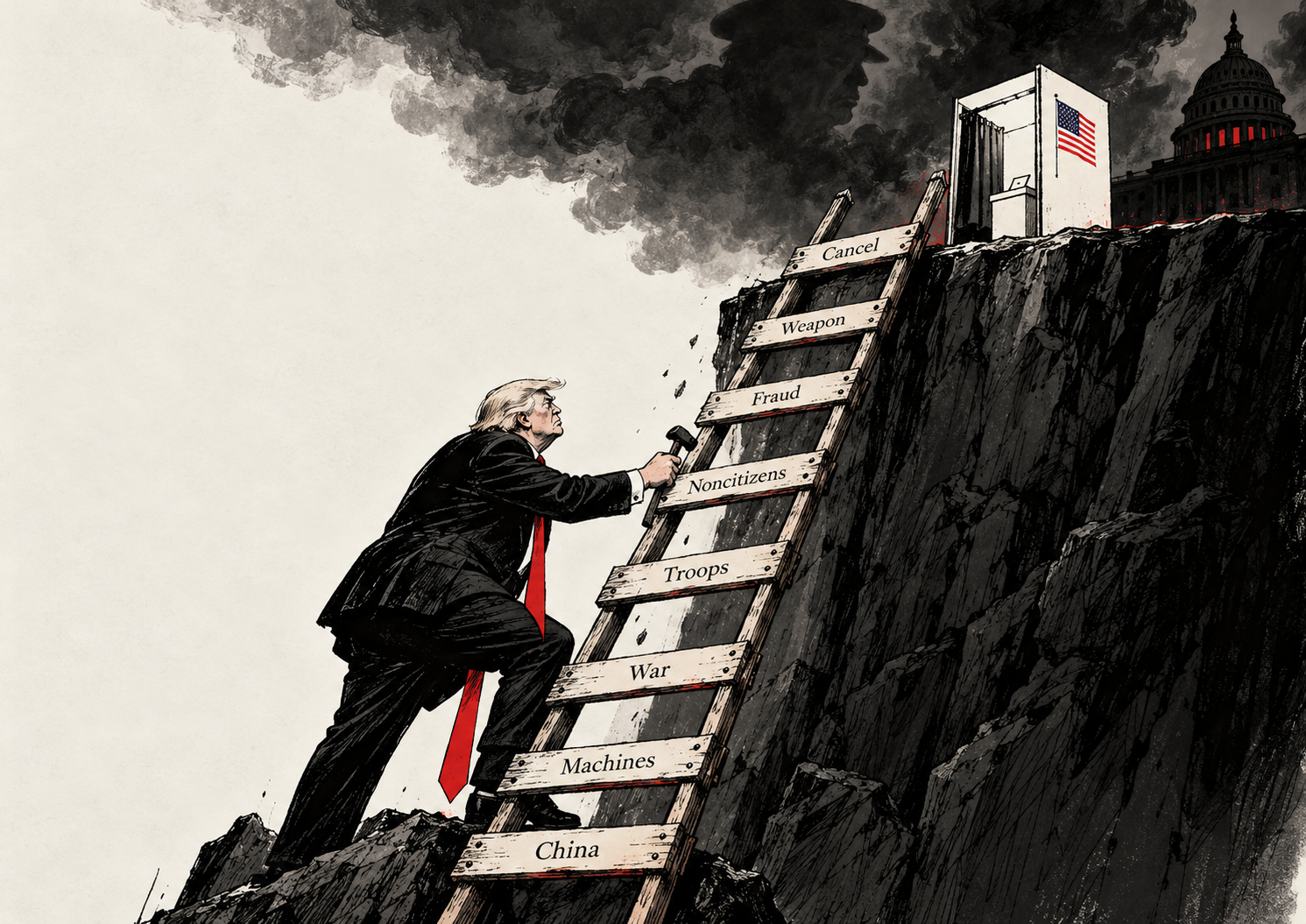
Seven excuses, one destination, 37 days to go.
Read these in order.
The Chinese are rigging the election. The voting machines can't be trusted. We can't have an election while at war. There's civil unrest with troops in the streets. Noncitizens and illegal immigrants are voting. Election fraud. The election is a weapon aimed at him, not a vote by citizens. The election must be canceled until further notice.
Some of these lines are already on the record. In January Trump told House Republicans "they should cancel the election." Then he told Reuters "we shouldn't even have an election" while worrying out loud about his party losing seats. His press secretary, Karoline Leavitt, called it a joke. On September 10, at his party's midterm convention in Dallas, he had the crowd raise their right hands and repeat an oath: "I don't care if I'm registered or not, I'm going to try and cheat like hell like they do." Another joke, apparently. The other rungs he has said in pieces, or Wayne Allyn Root and Peter Ticktin have said for him, or nobody has said yet. He doesn't need to say every line. The order says them for him. Scattered across a year, they sound like grievances. Stacked in a column, they look like a ladder, and every ladder leads somewhere.
I wrote code for most of my working life. I know a script when I read one. A script has an order, and every line in it exists to set up the one after. You don't call the shutdown routine first. You call it last, after you've closed every file that might object.
Start with a foreign enemy, because a foreign enemy makes doubt patriotic. Foreign interference is real, which makes this rung sturdy. It also makes his record on it easy to read. A Senate Intelligence Committee run by Republicans documented Russia's operation in 2016, and he called the finding a hoax. In 2020 his own Cybersecurity and Infrastructure Security Agency joined election officials in calling that election the most secure in the nation's history. He fired its director, Chris Krebs, by tweet. Interference is a hoax when it helps him and a crisis when it doesn't. The man who checked the locks lost his job for reporting they held.
Then the machines. A network doesn't pay $787.5 million to settle a lawsuit unless the trial would cost more. In 2023 Fox News paid Dominion exactly that rather than put its hosts on a witness stand.
Then war. Lincoln stood for reelection in 1864 with Confederate armies still in the field. In August he wrote a private memo, folded it shut, and had his cabinet sign the back without reading it. He expected to lose, and he pledged in writing to help the man who beat him. Franklin Roosevelt ran in 1944, five months after D-Day. The country voted in 1812 with British troops on its soil. The United States has never skipped a federal election for a war. It has never needed to.
Then disorder. Troops in the streets. Ask who put them there. In 2025 Trump sent the National Guard into Los Angeles and Washington and tried for Chicago and Portland until the courts, the Supreme Court among them, stopped him. On New Year's Eve he pulled back and promised the troops would return "in a much different and stronger form." He has called his crackdown a winning issue for the midterms. I started fighting fires at 16. The first question at a suspicious fire is who called it in. Sometimes the answer is the man holding the gas can.
Then the invaders at the ballot box. In 2024 Georgia's Republican secretary of state, Brad Raffensperger, audited 8.2 million registrations. His office found 20 noncitizens. Nine had ever voted, most of them before 2012, when Georgia began checking citizenship against driver's license records. His office opened case files on 156 more. Remember the name. On January 2, 2021, Trump called Raffensperger and asked him to find 11,780 votes, one more than Biden's margin in Georgia. Raffensperger refused. Trump has climbed this ladder before, and Raffensperger is the man who wouldn't hold it steady.
Those nine ballots are real, and they carry the strongest objection to this essay. Noncitizens do slip onto rolls. Machines do need audits. Georgia shows what serious people do about it: check the rolls, refer the cases to prosecutors, open files on the doubtful ones, publish the numbers. Proportion is the tell. A man worried about nine ballots orders an audit. A man worried about losing orders a cancellation.
Fraud. No noun attached. By this rung nobody needs evidence. The word does the work alone. Fraud stops being a claim and becomes weather: always out there, never pinned down. He can blame it for any loss he likes.
Then the only honest line on the list. The election is a weapon aimed at him. Yes. By design. The framers gave House members two-year terms on purpose, and Madison argued in Federalist 52 only frequent elections keep representatives dependent on the people. The midterm enforces it on schedule, two years into every presidency. A president who calls it persecution has told you he considers accountability a crime committed against him.
Then the top rung. Canceled until further notice. "Further notice" carries the whole sentence. Who gives the notice? He does.
Here's the ceiling. The president holds no power to cancel the midterms. The Constitution hands the times, places and manner of congressional elections to state legislatures and Congress, federal law fixes the date on the first Tuesday after the first Monday in November, which this year falls on November 3, the 20th Amendment ends every House term at noon on January 3 whether anyone voted or not, and of the more than 120 statutory emergency powers a president can reach for, not one touches the calendar. An emergency declaration, as Elizabeth Goitein of the Brennan Center puts it, "is not a blank check." Federal judges have now blocked key parts of both his elections executive orders, the one from March 2025 and the one he signed this March 31. Judge Indira Talwani, blocking the second one in 23 states and the District of Columbia, wrote the sentence he keeps trying to forget: "The Constitution does not grant the President any specific powers over elections." States run elections. Presidents don't. Only Congress can move Election Day, and even Congress can't cancel it. So watch Congress. In June, Senator Elissa Slotkin asked the Senate Armed Services Committee to bar the Pentagon from spending money to seize ballots or voting machines, and to require notice to Congress before troops went to any polling place. Every Republican on the committee voted no, behind closed doors, twice. Federal law already keeps troops away from the polls. The committee's Republicans declined to say so in writing.
His own government says as much, in careful language. A Justice Department spokesperson told The Atlantic the department has no plan to declare certified voting equipment unusable without verified evidence. Dan Caine, chairman of the Joint Chiefs, put it in a letter to the same Slotkin: no plans to send troops or federalized Guard to polling places, no plans to seize ballots or voting machines. Then the Homeland Security secretary, Markwayne Mullin, opened a side door. On September 1 he said ICE officers could go to polling places "if there is a threat to that polling place or we're serving a warrant on someone that we have been actively tracking down." His department later said it isn't planning operations aimed at polling places. Denver sued anyway, joined by LULAC, UnidosUS and Common Cause, arguing federal law bars armed officers at the polls. Mullin's own word for the exception is a "specific threat." Remember that phrase. A specific threat is whatever the man at the top of the ladder says it is.
So why build the ladder at all? Because a ladder doesn't have to reach the top to work. It only has to get people climbing. The goal isn't a canceled election. The goal is an election Trump has taught his voters to disbelieve before anyone counts a single ballot. If his side wins, the machines worked fine. If his side loses, rung six was right all along. Heads I win, tails you cheated.
Want to see who's climbing? Earlier this month election deniers packed an off-Strip hotel in Las Vegas for something called the Storm Summit. The crowd told reporters from The Atlantic they expect the midterms canceled, suspended, or stuck without certified winners. Nobody had to carry them up. Peter Ticktin, who went to military school with Trump, gave the president two choices if Democrats win: "Either martial law, or step aside." Asked about riots, he said, "Believe me, our armed forces are a lot bigger than they are." Our armed forces.
Wayne Allyn Root wants Trump to declare a national-security emergency and texts his columns to the president. When Root pitched it on air in August, Trump said, "stranger things have happened." Later that month Trump posted Root's column under a headline calling the plan foolproof. The third headliner, Tina Peters, went to prison for giving an unauthorized person access to the voting equipment she controlled as a Colorado county clerk. Trump called her a political prisoner, issued a federal pardon that couldn't touch her state convictions, and leaned on Colorado's Democratic governor for more than a year. In May the governor cut her sentence in half, after she admitted in writing she misled the secretary of state about the access. She now maintains she did nothing wrong, The Atlantic reports. The only person on that stage convicted of breaching voting equipment confessed to get out of prison, took it back once she was free, and came to warn the crowd about election tampering. His own White House and Cabinet advisers have spent months trying to steer him away from theories like theirs, The Atlantic reports. The outsiders keep handing him rungs, and he keeps taking them.
Vladimir Putin holds elections and never cancels one. He doesn't need to. He jails the opponents, owns the counters, and lets the ritual run on schedule. PrumpTutin was never two men with one idea. It was one idea with two addresses. The idea isn't how to stop a vote. It's how to hold one that doesn't count.
Thirty-seven days remain, and the ladder is standing. Lincoln expected to lose in 1864 and signed a promise to hand over power. The man on this ladder expects to lose too, and after 2020 he already tried once to keep what he lost. He built a ladder instead of signing a promise. But a ladder is lumber until someone climbs it. A Senate committee left the bottom rungs in place. A hotel crowd in Las Vegas cheered for the top one. Every voter who has already decided the count will be crooked is standing on a rung, and the man at the top is counting on them to hold still.
More from Burnt Ground
Lincoln Twenty-eight years old at the Springfield Lyceum, warning where the danger would come from.
Until Confidence Is Restored Testimony before Congress from the Presidential Commission on Electoral Continuity.
Watch the Hands The purge of the military, and where to look while it happens.
35% The floor Trump stands on was poured before he arrived.
The Mechanics of the Panic How a message that lands in the dark becomes a fact by morning.
Books
PrumpTutin: How Trump Sold the West One organism, two capitals.
The Art of the Lie The documented record.
We Used to Be Wise Nineteen chapters on the fifty-year capture.
1776: A Novel The founding, told by a man who was inside it.
The full catalog: fiction and nonfiction.
Further Reading
The Supporters Urging Trump to Declare Martial Law for the Midterms, by Yvonne Wingett Sanchez and Michael Scherer (The Atlantic, September 23, 2026)
Why Trump can’t cancel the 2026 midterm elections (Votebeat)
Frequently asked questions about the 2026 midterm elections (Protect Democracy)
No, Trump can’t cancel the midterms. He’s doing this instead (CNN)
Georgia citizenship audit finds few noncitizens on voter rolls (AP)
Denver, advocacy groups sue to bar ICE agents at voting sites (UPI)
Colorado Gov. Jared Polis grants clemency to Tina Peters (Colorado Springs Gazette)
The Trump-Raffensperger call, full audio and transcript (Washington Post, January 2021)