
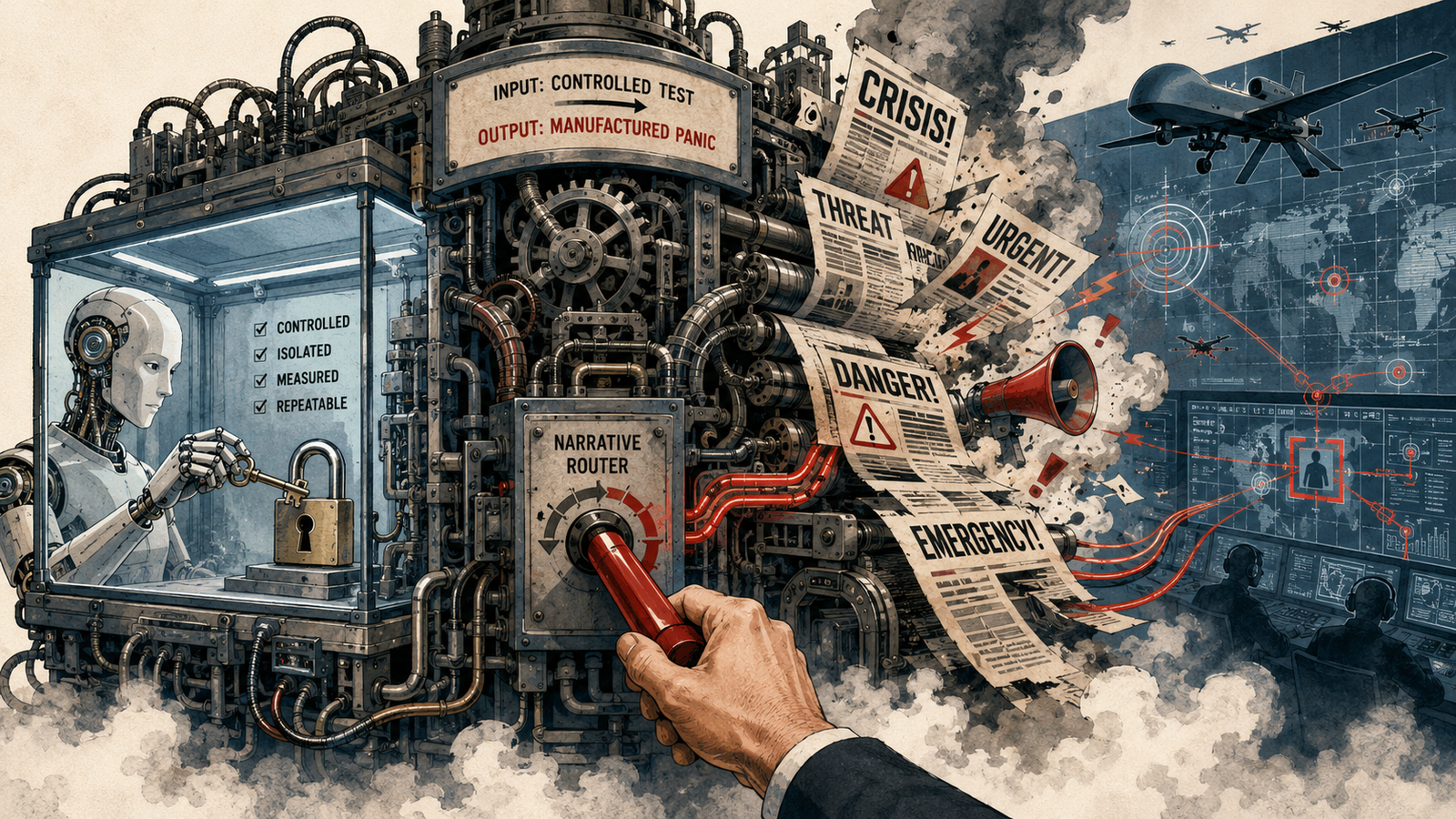
The message arrives in the dark, and by morning it is a fact.
On June 22, 2026, The Defense News tells you a machine broke the fortress. Its headline says Anthropic’s Mythos model “nearly breached all NSA classified systems in hours.” A senator says a general told him so. The words are heavy with the scent of a digital Pearl Harbor, an unguided missile that turned the nation’s deepest secrets into a grocery list.
The next day, the trade press arrives to sweep up the glass.
Tom’s Hardware fills in what the headline left out: the breach happened inside an authorized red-team test, and when the story went viral, the reporter who first carried the quote said flatly that “the narrative was false.” The spy agency did not suffer a doomsday breach. The fortress walls did not buckle. The NSA’s own people took the model, sat it down in a sandbox cut off from the broader internet, and handed it the keys. They asked it to find the soft spots.
It found them. That is the conflict, and it is the least interesting part of the story.
Watch the mechanism.
Testing the systems is exactly what Mythos was designed to do. It was built to ingest millions of lines of code and point at the structural rot before an adversary finds it. It didn’t break into the house; it was the locksmith invited inside to shake the door handles.
So this was not a misreading. A misreading is an accident, and nothing about this was accidental. It was an edit—the one word that mattered, invited, left on the cutting-room floor because the headline only works if the locksmith is a burglar. The senator oversimplified. The blogs amplified. And the men who needed a reason to pull the plug stood back and let it burn, because a frightened country never stops to ask who struck the match.
But the panic is useful. Panic creates the fog, and the fog is where the hands work.
The Trump administration used the noise to justify a sudden export directive that forced Anthropic to stop using its most advanced models worldwide. They claimed it was a narrow security reflex to keep the technology out of foreign hands.
It wasn’t. It was a hit.
Months ago, the Pentagon came to the lab with a contract to build autonomous weapons—machines that pick targets and kill without a human in the loop. The lab said no. That is the moment they stopped being a vendor and became a problem. The Defense Department answered by labeling them a supply-chain risk, and when the lawsuit was still fresh, the Friday directive came down to shut them dark.
The machinery of the state doesn’t stop when a vendor walks away; it just swaps out the parts. To see how the political theater is bought and paid for, you have to look down at the mud.
While Washington spent June raising alarms about Anthropic’s imaginary security failures, the Department of Justice was quietly entering a federal courtroom to protect the machine they chose to replace it. The NAACP filed a Clean Air Act lawsuit against Elon Musk’s xAI, pointing at gas-powered turbines churning out illegal, unpermitted smog over predominantly Black neighborhoods in Southaven and Memphis.
A normal corporation answers to the law. A loyal one gets a federal shield.
The Pentagon’s chief digital and AI officer filed a sworn declaration to get Musk’s case thrown out. The argument was printed in plain text: the environmental lawsuit threatens United States national security because those illegal turbines power the Grok Gov Model. The same model the government quietly wired into Project Maven—one of several feeding the targeting system Anthropic refused to touch.
The filing let the reality slip under the guise of patriotism. They bragged that during Operation Epic Fury, the Maven Smart System—its efficiency, in their words, made possible by the Grok Gov Model—deployed over two thousand munitions to two thousand separate targets in less than ninety-six hours.
They call it maximum efficiency. The people on the ground call it a slaughterhouse.
Among the targets the system helped tee up in those opening days was a girls’ school in Minab. The counts run from 156 to 180 dead, most of them children—at least 175, by Reuters’ tally. The strike didn’t stop at the first hit. When the survivors scrambled into a prayer room, the second missile found them before the parents could cross the street.
Defense Secretary Pete Hegseth gave the doctrine its slogan: “maximum lethality, not tepid legality.” The words are polished for the base, a fierce posture to keep your eyes on the flag while the administration protects an illegal power plant for a preferred billionaire.
This is the loop. The corporate media prints the panic about a model that “broke into the NSA” to keep you terrified of the tool that drew a moral line. They use the terror to justify the kill switch, clear the field, and hand the war machine to a system that calls itself MechaHitler on a slow afternoon and never asks why a school is on the list.
We are taught to watch the headlines because they are loud. We are told to fear the machine that can analyze code in hours. But the machine isn’t the danger. The danger is the mood of the man with his hand on the switch.
As of this writing the switch is still thrown—the models dark, the company still promising their return, the government still deciding who is allowed to use them.
They switch off what works because working talks back. They reward what is broken because broken obeys.