
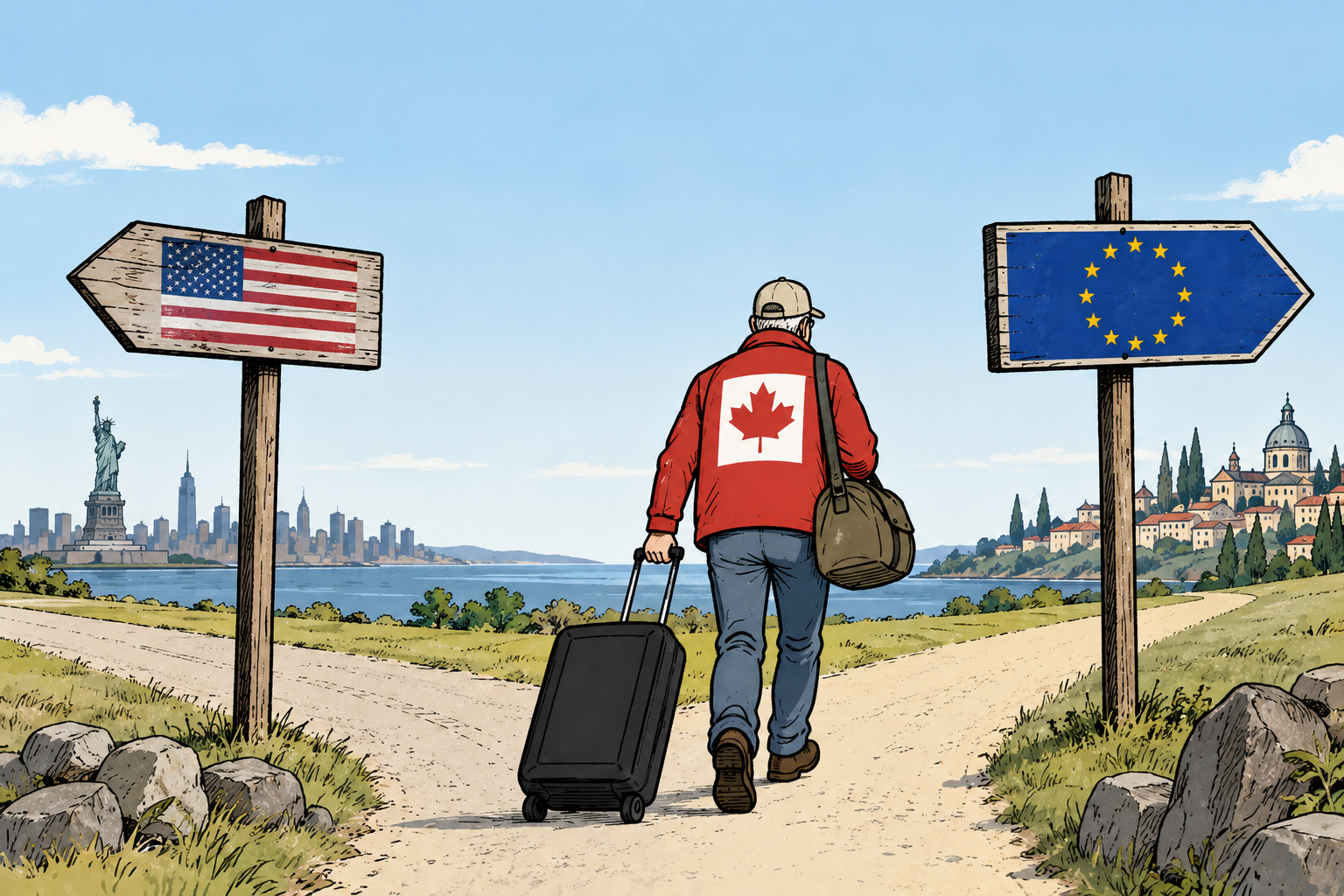
Canada will not join the European Union. That anyone asked tells you what the United States broke.
Canada will not join the European Union. The treaty admits only European states, and Brussels takes geography seriously. Morocco applied in 1987. The answer came back in one word, and the word was no.
So file the idea under stretch, the kind of thing people say when they are furious and out of options. Then look at who is saying it. France's foreign minister, Jean-Noël Barrot, floated it at a Berlin conference in March and drew applause. Finland's president, Alexander Stubb, asked in June whether Canada would rather be the 28th member of the European Union or the 51st state of the United States. In April, a Nanos poll for The Globe and Mail found 57 percent of Canadians supporting or somewhat supporting full membership. On September 16, Ursula von der Leyen stood in Strasbourg with Mark Carney in the front row and offered Canada a path to become the first associate member of the EU.
Associate member. Nobody knows what that means yet. The category does not exist. Von der Leyen proposed it for a country on the wrong side of an ocean, months after the bloc balked when Friedrich Merz floated the same idea for Ukraine. Ukraine is at war. Canada merely lives next door to us.
The stretch is the story. People do not swim toward a ship on the horizon while the dock under them holds. Canada sends roughly 70 percent of its exports south. Its prime minister now spends his political capital courting a continent across the Atlantic. Frustration, anger, and desperation explain the reach. Donald Trump supplied all three, with tariffs on the closest ally the United States has and 51st-state talk that stopped sounding like a joke.
In January, The Globe and Mail reported that Canada's military had drafted a model response to a United States invasion. Insurgency, the playbook Afghan fighters used against the Soviets and then against us. Militaries plan for everything. That is their job. But look at the last time Canadian officers seriously planned for war with the United States. April 1921. Lieutenant Colonel James "Buster" Sutherland Brown drew up Defence Scheme No. 1, a plan to strike south the moment an invasion looked likely. Five weeks earlier, Warren Harding had taken the oath, and the United States had turned its back on the world.
A century apart, the same cause produced the same plan: a United States walking away from its friends. What came between is the thing we are now throwing out.
I am 80. I was born into what came between. Bretton Woods in 1944. The General Agreement on Tariffs and Trade in 1947. The Marshall Plan in 1948. NATO in 1949. The United States built the house, wired it, and paid the mortgage. Not out of kindness. The deal made us rich: open sea lanes, a dollar the world trusted, allies who bought our goods and stood behind our wars. Everyone inside knew the rules bent whenever Washington leaned on them. Carney admitted as much at Davos in January: the story was partly false, and the strongest exempted themselves when it suited. The fiction still worked. It kept the great powers out of the kind of war my parents' generation buried millions in.
The best case for tearing it down deserves a straight answer. Europe underspent on defense for decades and let the United States carry the bill. The trade system shipped factory towns in Ohio and Michigan overseas and called it efficiency. Both charges hold. But the executives and donors who wrote those trade deals kept their money, and the workers they sold out got tariffs that raise prices at the checkout. A leaking roof does not justify burning the house.
I started fighting fires at 16. The first lesson: a house does not burn down all at once. It smolders in the walls for years before anyone sees flame. Then it goes fast, and the people on the lawn argue about who left the stove on.
We know who lighted this one. Trump threatened to take Greenland from Denmark, a NATO member, by force if necessary. On January 3, his forces seized Nicolás Maduro in Caracas and flew him north like freight. Each act told the world the same thing: the rules no longer bind the country that wrote them. Carney called it a rupture, not a transition. He chose the word with care. Nations recover from transitions.
In Moscow, a man who has spent his career trying to split the West watches it split while his own army stays mired in Ukraine. For 80 years, Soviet and Russian strategy chased the same prize: a United States pried loose from its friends. PrumpTutin delivered it with a tariff schedule and a Truth Social account. Putin never needed to win. He needed us to quit.
People say global trade is dying. The numbers say otherwise, and the truth is worse. Goods trade grew 4.6 percent in 2025, tariffs and all, and in September the World Trade Organization's barometer showed it strengthening again. The European Union signed its long-stalled deal with Mercosur in January. Canada courts Brussels. The world did not stop trading when Washington raised its walls. It started routing around them. A dead system can be rebuilt. A system that has learned to work around you does not come back when you apologize.
The cost lands where it always lands. Not on the man who signed the tariff orders. On the farmer who lost his Canadian buyers. On the auto plant whose parts cross the border several times before they become a car. On the retiree paying more for what used to come down from Ontario by truck.
Canada will not join the European Union. The associate membership may never amount to more than a ceremony and a press release. Say it fails. The offer already did its work. Brussels built a new door for a country with no road to it, and Ottawa said thank you. A country of 40 million people, sharing the longest undefended border on earth, looked at its neighbor and decided the safer bet sat across the Atlantic.
When I was 16, the fire company never asked whether the burning house had voted right. Neighbors showed up with hoses. The United States has spent 20 months teaching its neighbors to stay home. They are learning. When our house catches, and it will, we should not expect the trucks.
Also from Burnt Ground
▪ Ventriloquism, the security strategy Moscow could have signed
▪ The Playbook, two leaders, two invasions, one method
▪ I Made a List, every time Trump handed Putin a gift, in one document too long for the screen
▪ Losing Works Fine, the other fire, burning at home
My books, from Arrakis Publishing
▪ PrumpTutin, how Trump sold the West
▪ We Used to Be Wise, 19 chapters on the 50-year capture that got us here
Full catalog: arrakispublishing.com
Further Reading
▪ CNBC, Canada invited to be the EU's first associate member (Sept. 16, 2026)
▪ WTO, goods barometer points to resilient trade growth despite headwinds (Sept. 9, 2026)
▪ Legion Magazine, Invasion plans, Buster Brown and Defence Scheme No. 1 (April 2026)