
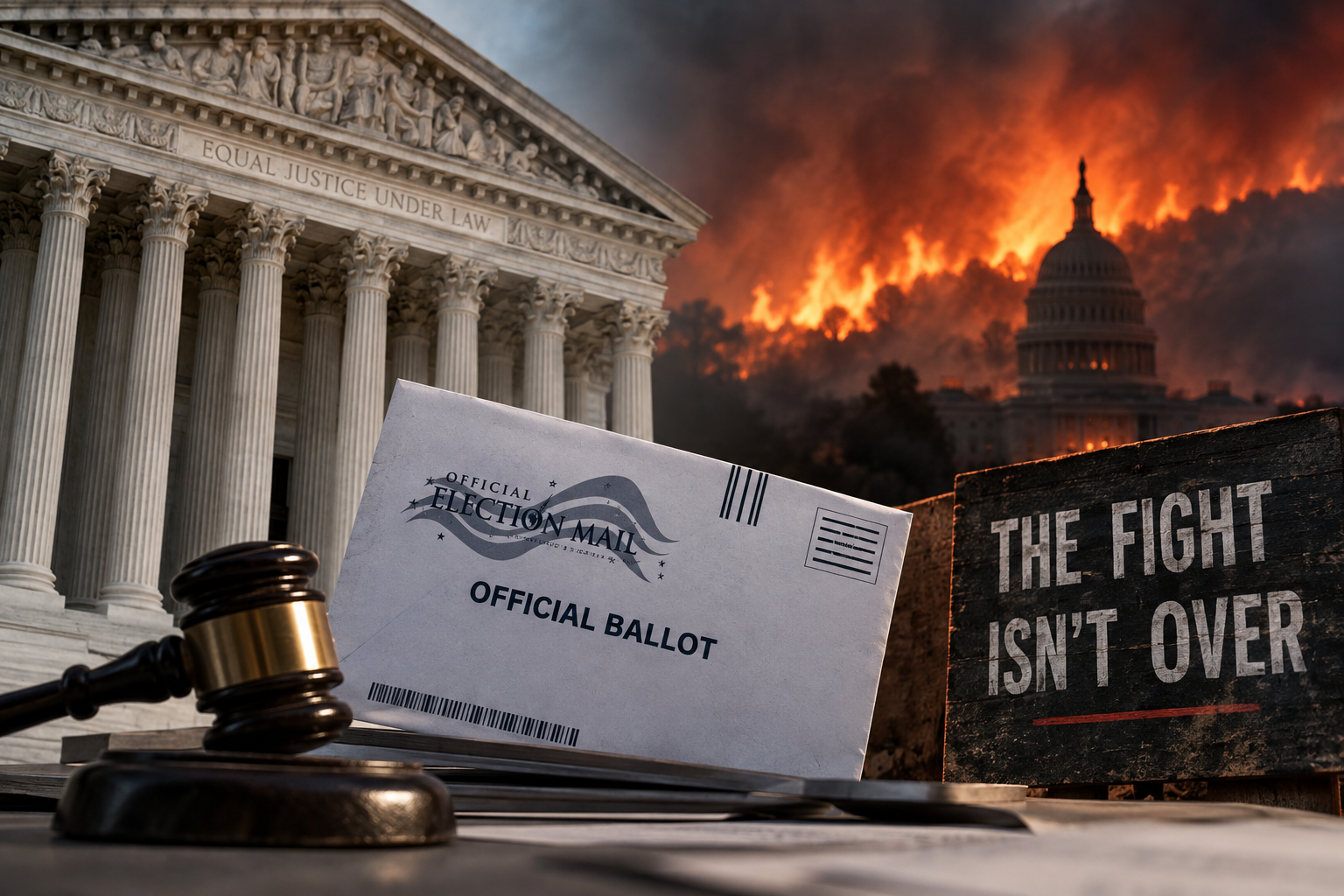
A fire has two flanks. The Supreme Court knocked down one of them, and the head is still running.
Joe Zeigler, Burnt Ground
The Supreme Court told Donald Trump no on Monday night, September 14. Only Samuel Alito and Clarence Thomas voted to let his mail ballot rule run this November.
The rule would have let the Postal Service check your ballot against a federal list and ship it back if your name flunked. One bad envelope in a random sample would bounce the whole mailing. An anonymous Postal Service whistleblower described the system to Votebeat in early September, said the agency never tested it properly, and warned it could stop millions of ballots from reaching voters. One smudged barcode, and a county goes silent. The court killed the plan for 2026. Celebrate for a minute. Then count what the ruling never touched.
I left home at 16 to live and work at a firehouse in Burke, Virginia. Firefighters learn fast: a fire has two flanks, and knocking one down means nothing while the head keeps running and the embers land behind you. The court knocked down one flank. Everything else is still burning: the rules, the voter rolls, the maps, the badges, the numbers, the calendar, and the count itself. No single one of them has to win. They only have to keep burning.
Start with the rules, because Trump started there. His March 2025 executive order demanded documentary proof of citizenship to register, told states to toss mail ballots arriving after Election Day, and pushed the Election Assistance Commission toward decertifying the voting machines most of the country runs on. The Brennan Center found no machine on the market could pass his new test. A standard nothing can meet is not a standard. It is a padlock. Federal judges took the order apart, and one permanently enjoined it in June. Trump lost the order and kept the talking point.
So he wrote another one, the March 31, 2026, order behind Monday's ruling. Judge Indira Talwani, of the federal district court in Massachusetts, blocked its key provisions in June. The Supreme Court lifted her injunction in late August on procedural grounds, holding she had ruled before the Postal Service issued its final rules. The Postal Service issued them days later, 95 pages of them, Talwani froze the plan again, and Monday the Court left her freeze standing. Read Brett Kavanaugh's concurrence slowly. He wrote that the rule might fall within the Postal Service's statutory authority, and that state and local officials lacked sufficient time to implement it before the elections. That is not a wall. That is a scheduling note.
When the orders failed, Trump leaned on Congress. The House passed the SAVE America Act on February 11 by 218 to 213. It would force Americans to show documentary proof of citizenship in person to register or update a registration, and a photo ID to cast a ballot. More than 140 million citizens have no passport. Trump demanded Republicans break the filibuster to pass it, and John Thune ruled out the maneuver his own members wanted. In his State of the Union in February, Trump asked Congress to pass it and told the country that cheating in elections is rampant.
The second fire runs through your personal data. Harmeet Dhillon, who runs the Justice Department's Civil Rights Division, the office built to protect voters, demanded unredacted state voter rolls, driver's licenses and partial Social Security numbers included. States refused. The department filed 30 lawsuits against 29 states and the District of Columbia, and it has lost every district court ruling that reached a decision, 23 of them. Thomas Johnston, a judge George W. Bush appointed, dismissed the West Virginia case in July and wrote that one is left to wonder what the real purpose was. The department has appealed 20 of the losses. Attorney General Todd Blanche says the Supreme Court is a possibility and the department will not stop. Its emergency motions warned judges the government had “no other process to ensure a fair election” without the data. The Justice Department wrote its excuse for doubting November into federal court filings in March.
The third is the map. In July 2025 Trump pushed Texas Republicans to redraw their congressional districts in the middle of the decade and hand him five more seats. Missouri and North Carolina fell in line. California Democrats answered with a gerrymander of their own, proof both parties can draw a crooked line. Only one party took the order from the White House. Trump did the math out loud: a mail ballot ban plus new maps could “pick up 100 more seats.” A man confident in his voters does not need 100 seats of help.
Then on April 29 the Supreme Court decided Louisiana v. Callais, 6 to 3, and gutted Section 2 of the Voting Rights Act, the provision Black voters in the South used for decades to win seats in Congress. Samuel Alito wrote it. Elena Kagan, dissenting, wrote that the decision renders Section 2 all but a dead letter and called it the last chapter in the majority's demolition of the Voting Rights Act. Republican legislators in Alabama, Mississippi, Tennessee, and South Carolina went after minority-held districts within weeks. Louisiana did not wait for the funeral. It canceled a primary already underway and started over with a map carrying less minority representation. Florida passed its own gerrymander within hours, despite a state constitution banning partisan maps.
The fourth wears a badge. In January 2026 FBI agents searched the Fulton County elections office in Georgia and hauled out hundreds of boxes of 2020 ballots, ballot images, and voter rolls. Tulsi Gabbard, then the director of national intelligence, stood there too, and later testified Trump personally sent her. She resigned effective June 30. An internal memo, obtained in July by the Associated Press and the New York Times, surged 260 investigative analysts to Fulton County as a priority of FBI Director Kash Patel, each one assigned roughly 708 records checks. A former official told the Times a typical surge runs five to 10 analysts. The warrant behind the raid leaned on debunked ballot claims revived inside the White House by Kurt Olsen, an election denier on the federal payroll. The same month Trump announced people “will soon be prosecuted” for the 2020 election. Every county clerk in the United States heard it.
In July 2026 Dhillon sent letters to election officials in all 50 states threatening prosecution if they facilitate noncitizen voting. Utah's lieutenant governor, Deidre Henderson, called it “truly bizarre behavior.” Henderson is a Republican.
Now sit in a county clerk's chair. A federal grand jury subpoena pried hard drives and servers out of the Arizona Senate. Agents searched a voter registration nonprofit in Ohio. The Justice Department mailed your state's top election official a letter with the word “prosecution” in it. ProPublica counted at least 75 career election security officials fired, reassigned, or pushed out. The White House fired both Democrats on the Election Assistance Commission. The help Washington used to send is gone. Nobody has to arrest a clerk. The clerk can read.
Then came Markwayne Mullin, the Oklahoma senator and former cage fighter Trump installed as secretary of Homeland Security. He has threatened to jail election officials. He has threatened to cut federal money to any state ignoring his demands, put hundreds of agents on the hunt for noncitizen voters, and floated ICE officers chasing a suspect into a polling place on Election Day. His department took the ICE line back. Guess which sentence a voter remembers.
Steve Bannon, Trump's former strategist, promised ICE would “surround the polls.” Asked to rule out troops at polling places, Pete Hegseth, who runs the Pentagon, sidestepped. Trump told the New York Times he regretted not sending the National Guard to seize voting machines after 2020. In Minneapolis, an ICE officer shot Renee Nicole Good, a United States citizen, through her car window on January 7, minutes after she dropped her six-year-old son at school. She had no record beyond a traffic ticket. Seventeen days later a Border Patrol agent killed another citizen in the same city. Nobody there needs a lawyer to explain an armed agent near a polling place.
The fifth is the number. In a prime-time address on July 16, Trump told the country elections could be “rigged and stolen” and cited 278,000 noncitizens on voter rolls. The Washington Post reported the figure did not hold up. In July the Homeland Security department claimed 250,000 potential noncitizens on the rolls nationwide, roughly 15,000 of them in Pennsylvania, and then walked the numbers back. Nevada's share fell from 16,000 to 185. This month Texas and federal officials charged seven people with crimes tied to noncitizen voting and referred 117 more for investigation. The same state flagged nearly 600 other voters as suspects, then confirmed every one of them a citizen.
Prosecuting a noncitizen who votes is the law doing its job. Sending hundreds of federal agents after a problem the government's own corrected numbers shrink to a rounding error is something else. Mullin made the accusation at the White House complex. The New York Times dug out the Nevada correction weeks later. A retraction walks. An accusation flies first class.
The sixth is the calendar. In January 2026 Trump told an audience, “They should cancel the election.” The White House called it a joke. A week later he told Reuters, “We shouldn't even have an election.” Funny how the joke keeps coming back. In February the Washington Post reported election deniers had handed the White House a draft order declaring a national emergency over foreign interference, banning most mail ballots, and forcing every voter to reregister in person. Trump denied considering it. I ran the suspension itself as a thought experiment in Until Confidence Is Restored, written as testimony from a commission that does not exist yet. In August a friendly talk show host urged him to declare the emergency anyway. Trump answered, “Stranger things have happened.” A president with no such plan says no. This one let the sentence hang.
The last one is the count. At least 30 local officials in eight states have refused to certify results since 2020. Article I, Section 5 of the Constitution makes each chamber the judge of the elections and returns of its own members, and the Heritage Foundation reads that as license for Congress to refuse members it decides won improperly. Nobody has to steal a result on election night if a friendly majority can decline to swear the winner in on January 3. That mechanism, and the man who can trigger it before noon that day, gets its own essay.
A fair reader will stop me here and say the system worked. Courts ruled against Trump on voter data and mail ballots almost every time. A Republican Senate has not broken the filibuster for his voting bill. Arrests stayed few. Much of the alarm comes from Democrats and progressive groups like the Center for American Progress, which bring their own politics to the count.
All true, and the courts deserve the credit. Now ask what the campaign was built to win. Justin Levitt, an election law scholar at Loyola who worked on voting rights in the Biden White House, argues Trump's real leverage lies in the perception he might seize ballots or send troops, not in doing either. Take the credential for what it is worth and then read Johnston again, a Bush appointee wondering from the bench what the filings were actually for. Every lost lawsuit still bought a headline, every threat still reached the clerk, and every excuse still sits in the court record waiting for November. Losing works fine.
When Trump reaches for an emergency, he reaches for foreign interference. He blamed China in his July address, and the draft emergency order leaned on foreign meddling. Meanwhile, his administration dismantled the offices built to catch foreign enemies. It disbanded the FBI's Foreign Influence Task Force. It shut the Office of the Director of National Intelligence's Foreign Malign Influence Center. It proposed killing the election security program at the Cybersecurity and Infrastructure Security Agency, which Congress created after Russia attacked the 2016 election.
And the mail ballot crusade did not start in a county clerk's office. It started in Anchorage. On August 15, 2025, Trump walked out of nearly three hours with Vladimir Putin and told Fox News, “Vladimir Putin, smart guy, said you can't have an honest election with mail-in voting.” By Trump's account, Putin also told him the 2020 election was rigged. Three days later Trump vowed to “lead a movement” against mail ballots and voting machines. United States intelligence agencies assessed Putin tried to tilt the last three presidential elections toward Trump. Putin won his own last election with 87 percent of the vote. His best-known critic, Alexei Navalny, died in an Arctic penal colony. The listening devices got their own history in The World’s Most Luxurious Bug.
The president who warns foreign enemies threaten the ballot ripped out the smoke detectors and took his fire safety advice from the arsonist.
I was a conservative most of my life. I know what a party sounds like when it believes it can win the argument. This one quit trying. I took apart the floor holding it up in 35%, and in Herbert I let a Trump voter answer for himself. PrumpTutin runs the Kremlin play: you never have to steal an election if you can scare enough people home and convince the rest the count was crooked.
Which leaves the one accomplice every suppression campaign needs and no judge can enjoin: the eligible voter who decides not to bother. The naturalized citizen in Houston who sees nearly 600 fellow Texans land on a suspect list and decides a ballot is not worth a conversation with a federal agent. The retiree in Phoenix who hears “ICE” and “polling place” in the same breath and stays home. The Black voter in Alabama whose district Republican legislators set out to dismantle, wondering what his vote still elects.
The court told Trump no on September 14. The next no belongs to those voters and to everyone like them who will hear every threat and never see a correction. Trump does not need to take it from them. He needs them to hand it over.
2379 words
Also from Burnt Ground
▪ Yes, There Is a Conspiracy, on what happens to a word once laughing at it becomes the defense
▪ Watch the Hands, the same misdirection, aimed at the Pentagon
▪ In Search of Mediocrity, firing the competent and calling it discipline
▪ Forty Trillion Dollars and Nobody Did It, numbers as an emergency only when the other guy holds the pen
My books, from Arrakis Publishing
▪ PrumpTutin, how Trump sold the West
▪ The Art of the Lie, the method, book length
Full catalog: arrakispublishing.com
Further Reading
▪ Bloomberg Law, the Justice Department's losing streak in the voter roll cases (July 17, 2026)
▪ Democracy Docket, 0 for 23 in district court and still appealing
▪ Associated Press, the FBI memo surging 260 analysts to Fulton County (July 2, 2026)
▪ Votebeat, from MMA fighter to Homeland Security secretary (September 14, 2026)
▪ Federal Register, the Postal Service's 95-page ballot mail rule (August 26, 2026)
▪ Stateline, the Justice Department's voter data campaign (March 13, 2026)
▪ CBS News, 31 lawsuits seeking states' voter data
▪ CNN, the Putin mail-voting remark (August 19, 2025)
▪ What is known about Renee Nicole Good, the citizen killed in the January 7 raid
▪ NAACP Legal Defense Fund, Louisiana v. Callais and Kagan's dissent