
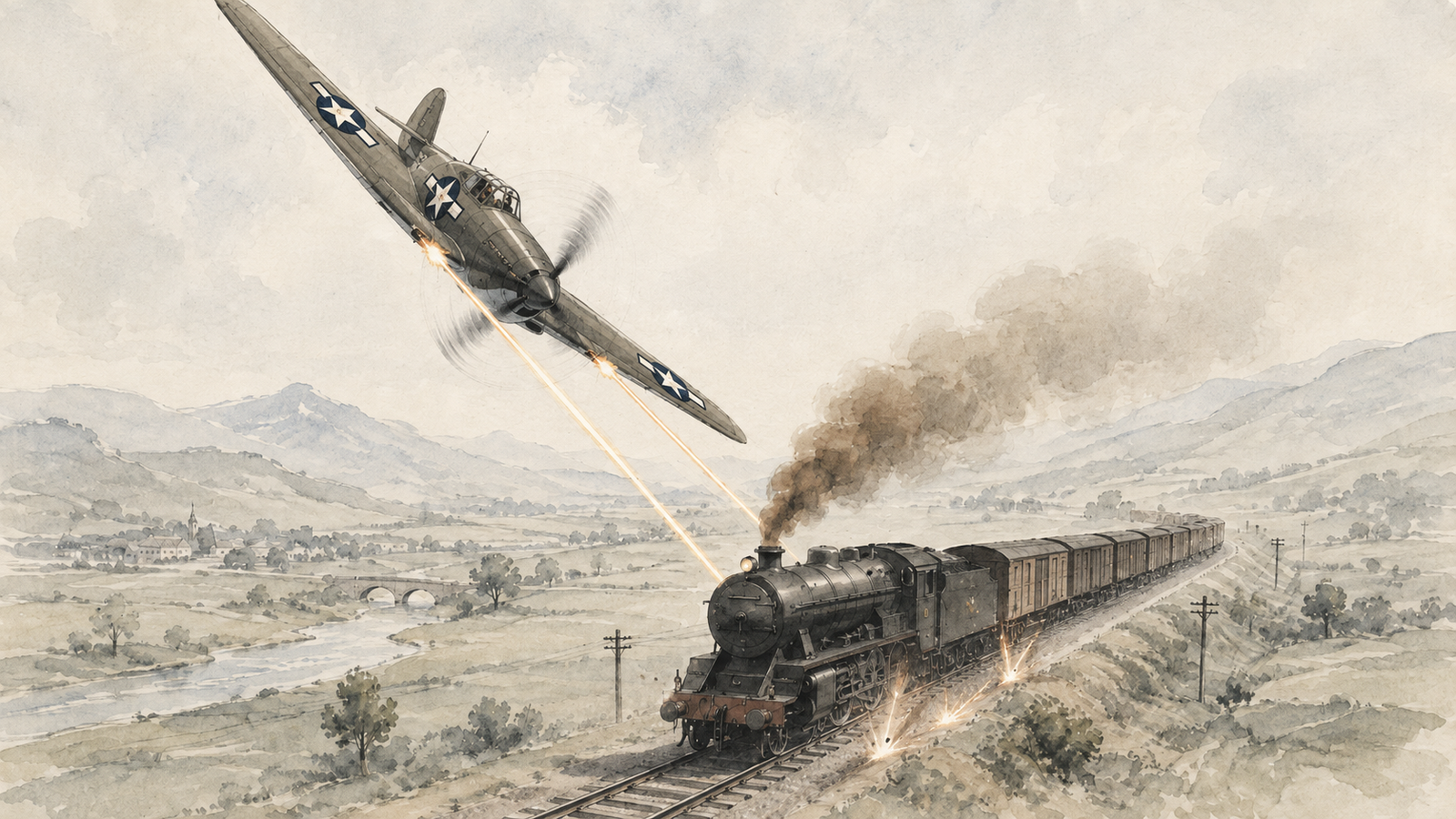
You Go Where You Look
Old flight instructors had a blunt way of teaching target fixation. You go where you look.
A pilot rolls in on a locomotive. He holds the gunsight half a second past the moment he should have come back on the stick. Nothing exotic happens to him. He is not suicidal. He is not badly trained. The boxcar fills the windscreen, and his hands go on flying the airplane toward the only thing left in the world.
The report afterward does not need poetry. He flew into what he was shooting at.
My cousin died strafing a locomotive in the Second World War. I do not know whether fixation did it or a gunner did. The Germans put flak wherever the trains ran, and a man at 400 feet did not get much time to sort out which thing was killing him. The family got the telegram either way. The image has never been theoretical in my house.
I have been reading Hayek again. The Road to Serfdom, a book quoted far more often than it is finished.
I read it the first time when I was young enough to assume a famous man with a serious book had settled the question. Age is useful for a few things. One of them is discovering how many settled questions were never settled.
He got a large piece of it right, and I want to say so before I start taking the rest apart. He dedicated the book to the socialists of all parties, which tells you he meant it as an argument.
He wrote in 1944, when governments had spent five years directing steel, rubber, rail schedules, factory floors, and the working hours of whole populations. The direction worked well enough to flatten Germany and Japan. Sensible people looked at the performance and asked an obvious question. If the state can run an economy to fight a war, why not run one to build a country?
Hayek's answer was that nobody at the top can know enough. On that point I have no quarrel with him, and I have receipts.
A price is a fact somebody paid for. It says one person wants the thing, another has it, and the two of them settled on a number. The number moves by town, by season, by shortage, by fashion, and sometimes because a truck went off the road outside Toledo. No ministry gathers all those small facts before they change again.
I learned the retail edition of this running six computer stores, one of them the first computer discount warehouse in the country. I knew the products cold. I knew the distributors, the margins, and the customers by their first names. I still guessed wrong all the time.
Monday morning I would stand looking at a pallet of printers every man in the trade had sworn would clear the floor by Christmas. There they sat. Nobody convened a committee to inform me of my error. My bank account handled the notification, and it arrived on a Friday, in the exact amount of payroll, which is a kind of feedback nobody has to call a meeting to deliver.
Now take my mistake and spread it across a country. Then remove the Friday. The official who ordered too many tractors writes a memorandum explaining why the tractor quota, viewed properly, was a triumph. My pallet never offered me that comfort. The difference is a market tends to expose mistakes while a bureaucracy can bury them, defend them, and promote the man who made them.
I watched the same failure inside a private company, and it cost more than my printers ever did. I consulted for Digital Equipment when Digital was one of the great firms in the United States and Ken Olsen ran it out of an old woolen mill in Maynard, Massachusetts, freight elevators, wooden floors, the whole thing. Olsen was a good man and I never heard anybody call him a crook. In 1977 he stood up in front of a convention audience and said he could see no reason why anybody would want a computer in his home.
Customers were carrying machines out of my stores in their arms that same year.
I said so. Others said so. It made no difference. Digital had a plan, and the plan had no room for a thing already happening in my parking lot on Saturday morning. Compaq bought the wreck in 1998, Hewlett-Packard bought Compaq four years after that, and the name ended up on the list of things men my age remember and nobody else does.
The knowledge problem belongs to bigness. It turns up wherever a plan grows large enough to outrank the evidence sitting in front of it, and a corporation can reach that size without asking anybody's permission or standing for election.
He was onto something real, too, in the chapter he called Why the Worst Get on Top. A system built to deliver one grand plan eventually meets people who will not go along, and somebody has to make them. The man with scruples becomes an obstacle. The man who signs the order becomes an asset.
I sat in boardrooms and committees for 30 years. The gavel always went to whoever wanted it, and the man who wanted it was never the man I would have handed it to. Government arms an appetite that was already loose in the room before anyone drew up a plan.
Then Hayek keeps flying.
The warning hardens into a road with one destination. More planning brings more coercion. More coercion brings less freedom. Stay on the road long enough and you arrive at the camps.
It is a powerful argument. It is also too neat.
Britain founded a national health service in 1948, broke and still rationing food. Britain then spent 70 years throwing out one government and installing another, arguing about the health service at every election. Sweden taxed at levels that would cause fainting spells in Florida, built a welfare state to match, and went on voting the Social Democrats in and out. Denmark, France, West Germany and the Netherlands built the same machinery. Some of those programs bloated and some of those rules were plain stupid.
The political sequence Hayek promised never arrived, and 70 years is a long run for a prophecy to sit there waiting on the weather.
The dictatorships of the last century did not grow out of pension plans either. Every one I can name came out of ruin. A lost war, a wrecked currency, a hungry country with nothing left to lose and one man promising to hand it all back. Germany had street fighting and a worthless mark long before it had Hitler. Not one of those regimes arrived because a parliament voted for old-age insurance.
That matters, because the United States has produced a Hayek considerably simpler than the man who wrote the book. In the political version any intervention is the first step onto the road. Health insurance, clean water rules, overtime pay, mine inspections. Put a toe on the pavement and the jackboots are waiting around the bend.
Hayek was not that simple. He allowed a floor under everybody, below which nobody in a wealthy country ought to fall. He allowed social insurance against sickness and accident because private insurance handles some risks badly. He allowed rules against a factory dumping its costs on the neighbors. He could tell the difference between a state keeping a man from starving and a state telling the man what job he will hold and what town he will hold it in.
The people who quote him at me find the distinction inconvenient.
My real argument with him is somewhere else. He spent a lifetime staring at government power and never turned his head far enough to see private power standing next to it.
His market runs on a customer who can say no. Take away the no and the price stops carrying information and starts carrying leverage. The question worth asking about any bargain has nothing to do with whether a government is in the room. Who here can walk away?
Take the old company town. One mill. The mill hires nearly everybody. The mill owns the houses and the store, and in the worst years it paid in scrip good at one counter. The worker is free in the strict legal sense. He can quit.
Fine. Quit and go where?
That question does an enormous amount of work. When one company buys nearly all the labor in a valley, calling the contract voluntary puts nothing in the worker's hand. He can refuse the offer in the same sense a man crawling across the desert can refuse the fellow with the water.
The modern edition is tidier. No scrip, no shack by the gate. Health insurance attached to the job does the same job.
A woman has run the same machine for 30 years. Her husband is sick. Her card covers them both. She is entirely free to tell the plant manager where to go tomorrow morning, provided she is prepared to bet the house on the next hospital bill. Nobody in Washington assigned her to that plant. Nobody had to. The exit costs more than she has.
I have seen the other end of that, and so has nearly everyone I know. You do not negotiate from a gurney. Nobody calls three emergency rooms to ask which one is running a special on internal bleeding. You get treated, the numbers show up weeks later, and some of them come from people you never saw in the room and cannot identify now.
On paper that is a private transaction between consenting parties. It bears no resemblance to the free exchange Hayek described.
I went into my first burning building at 16, out of a firehouse in Burke, Virginia. Nobody in that neighborhood compared quotes at two in the morning with the kitchen going. The United States gave up on competing private fire companies for a good reason. Rival crews used to reach the same hydrant and brawl over the right to put the fire out while the house burned to the sills behind them. A few services do not survive contact with a market, and every man learns which ones the night he needs one.
Here his disciples turn strangely incurious. Government coercion gets the microscope. Private coercion gets called a contract.
The strongest objection to all of this deserves a hearing, because it is not stupid. No corporation can conscript your son. No mill owner can jail you or send a man with a badge to the door. The state holds a monopoly on legal force, and Hayek was right to treat that monopoly as a thing of its own kind.
Fair enough. Then look at what the objection concedes. It measures freedom by whether somebody can put you in a cell, and by that measure the woman with the insurance card is free as a bird. She is also not going anywhere. Power that never touches the law can still decide where a person spends the next 30 years. And when private power has wanted a badge, it has usually managed to rent one. The coal operators in West Virginia hired Baldwin-Felts detectives and had them sworn in as deputies. The men shooting into the tent camps carried the authority of the state in their pockets.
Over the years the argument drifted into something Hayek did not write. A sensible warning against piling too much power into one government became a permission slip for dismantling anything that might restrain concentrated private power. Antitrust. Unions. Bank examiners. Public insurance. Each one can be labeled interference, and the corporation itself gets treated as weather.
I bought a lot of it once.
I had built companies. FirePrograms was mine. I had sat across from regulators who could make a ridiculous decision on Tuesday and never pay a dollar for it, while I spent Friday wondering whether the mail would bring enough checks to cover payroll. When Hayek told me the builder knows things the planner cannot, I had the evidence stacked around me in cardboard.
A second reason took me 20 years to say out loud.
It flattered me.
In that story the man who knew things was the man who built things, and the man who did not know sat behind a desk in a building with a flag out front. I happened to be the builder. Any philosophy that hands you a medal on the first page is worth checking for an invoice on the last.
Which brings me back to the pilot.
Hayek saw one danger clearly and held his eyes on it for the whole run. State power, and officials deciding what other people will do with their lives. The danger is real, and I have no interest in pretending otherwise. A fair share of what he warned about has shown up in my lifetime, right on schedule.
But you go where you look. Stare long enough at a single source of power and the others go soft at the edges. A government can trap a man. So can a boss holding the insurance card.
Keep watching government. Then look up once in a while and see who else is standing over you while you aim. The exits are what matter. A man who cannot leave is not free, and it makes very little difference to him whether the door is held by a ministry or a mill.
My cousin's squadron lost airplanes to flak and lost airplanes to fixation, and the telegrams read about the same either way. Nobody in the family ever found out which kind he got. The locomotive was a real target. Whoever wrote up the loss had a form for it.
Related from Burnt Ground
Essays: Socialism | The United States Is Not Polarized. It Is Stratified. | A Merry-Go-Round: Medicine and Money | Stagflation | Capitalism Doesn't Work
Books: How to Fly | The Art of the Lie | PrumpTutin | All books