Nice People Everywhere
We spent a month in California and pulled out last Saturday.
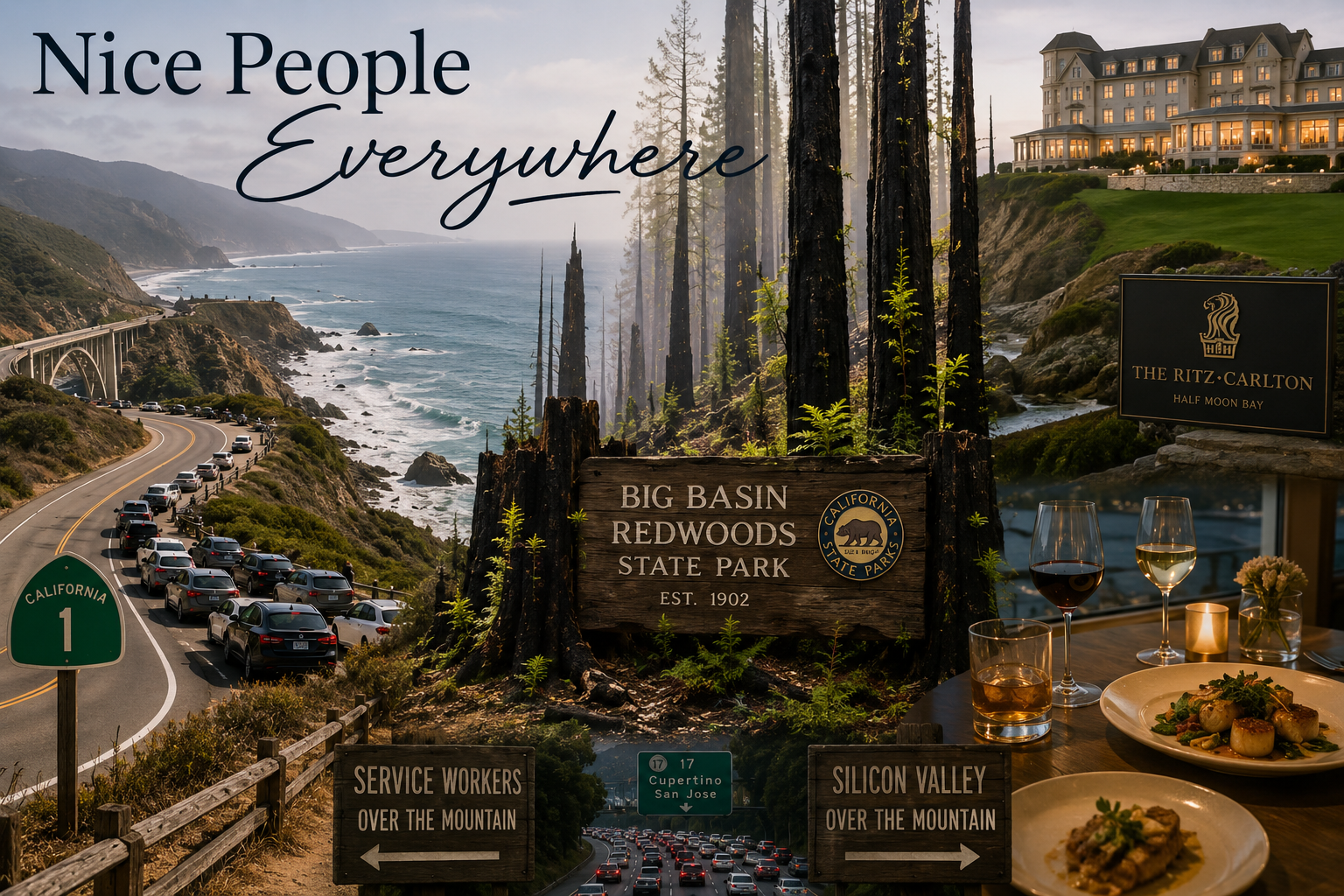
One of the days we drove Route One, a winding two-lane highway along California's rocky, terrifying, spectacular coast. It runs across WPA bridges built by men who needed the work, past one state park beach after another. There's rock on one shoulder and a drop on the other, and the guardrail is a formality. The turnouts are all full.
We detoured into Big Basin Redwoods State Park, the oldest state park in California. This area exists because, in 1902, a small group of individuals purchased six square miles of forest, preventing the lumber companies from cutting it down. In 2020 a dry lightning storm burned 97 percent of it anyway. Most of the old redwoods came through and are pushing new growth straight out of black trunks. The Douglas firs did not. Of eighty-five miles of trail, about six were open when we walked in.
It's beautiful here, and the weather is perfect. There are also too many people. There are nice people everywhere, filling every corner.
Route 17 over the mountain to Silicon Valley terrifies me, and I raced motorcycles for a living, so I've had time to work out what does and doesn't frighten me.
It's twenty-six miles from Santa Cruz to San Jose. It opened in 1940, and it shows. Four lanes, most of it split by a concrete barrier about knee-high, climbing to eighteen hundred feet at Patchen Pass and dropping down the other side. The redwoods stand right at the pavement edge and hold the road in shade, so the wet stays wet. There is no shoulder worth the name. A flat tire doesn't put you off the road. It puts you in a live lane with your hazards on, praying.
The posted limit is fifty. Nobody does fifty. The curves arrive in sequence—Big Moody, Laurel, and Vine Hill—and some of them tighten after you've already committed. On a bike, that's a calculation. In traffic at seventy with a car eight feet off your bumper, it's a coin toss you didn't ask to flip.
The locals have a name for what happens next. The Valley Surprise. You come around a blind bend at speed, and the whole road is stopped dead in front of you. Sixty thousand cars a day on a highway built for a smaller world.
Drivers are way too late to get where they're going and seem to universally have a death wish. I constantly fear being hit from behind. Not sideswiped. Not run off. Hit from behind by someone who is late.
Because that's what's moving on 17. People in Santa Cruz use it to commute to their well-paying jobs in Cupertino, while service workers from over the hill come the other way, hell-bent, to cook the food and clean the rooms in Santa Cruz. Two streams of people crossing the same mountain twice a day in opposite directions, neither one able to afford to live where they work.
California is expensive beyond comprehension. The median house in the state sold for $904,640 in June. Roughly 18 percent of California households earn enough to buy one. In Santa Cruz County the median runs between $1.3 and $1.45 million, which is the cheap side of the mountain; in Los Gatos the typical house is worth $2.65 million. Gas has been sitting near six dollars a gallon. Average rent is $2,537.
California is losing doctors who cannot make enough to repay their student loans and pay living expenses. Strangely, a doctor here makes too much money to live over the mountain. The state has 661 federally designated primary care shortage areas, more than any other state in the country. Arizona is second with 284. Almost seven million Californians live inside one, and about half the need in those areas gets met. The average medical school graduate owes more than $210,000. A private medical school runs past $390,000. As of July 1 of this year, federal borrowing for a professional degree caps at $50,000 a year and $257,000 for a lifetime, and Grad PLUS loans are gone, so the rest comes from private lenders. The people trying to recruit these doctors name housing costs as the reason nobody comes.
On the Route One day, we passed the Ritz-Carlton at Half Moon Bay, where a room runs $1,890 a night. We had lunch there, at The Conservatory. That's the casual room, the one where guests eat breakfast; the fine dining is upstairs at Navio. Two entrées, an appetizer, and a couple of drinks. Two hundred and twenty dollars with the tax and the tip.
The food is excellent everywhere. I've never had a bad meal here other than the ones I cooked myself. We went into town on Friday and had breakfast at the Walnut Avenue Cafe. The eggs Benedict was very, very good. Then we walked down the street and shopped at the Cookie Factory. Wonderful. That night Lanying and I had an appetizer, bourbon for me, and a glass of wine for her. It came to $110.00.
There is excellence here, as there often is in an area of wealthy people. It's costly excellence.
The K economy is in full bloom. The poor are very poor and the rich, very rich. Both use the same sidewalk, and neither one looks up.
After taking a piss in my daughter's bathroom in a small, 2.7 million dollar house, I mentioned that I could see straight into the neighbor's bathroom five feet away.
"That's why we have shades," she said.
People like my daughter live in a bubble. So do the people I've lived among in Florida for forty years. Both sides are equally deluded, holding opposing views on every political question that matters, and each group knows only people like themselves. Full disclosure: I share the beliefs of the Californians.
Wells worked this out in 1895. In The Time Machine, the Eloi live above ground, gentle and beautiful and childlike, with nothing much to do. The Morlocks live underground, operate the machinery, and emerge at night. One species stopped mixing and kept going in opposite directions until neither could recognize the other as kin. The Eloi looked like the privileged class. The Morlocks were raising them for meat.
We climbed over the mountains and dropped into the desert, into Trump country, aimed at Bakersfield, where it is forty degrees hotter and nobody seems to mind. Past Avenal, the land goes flat and blond and dead. Hot, desolate, dry. The kind of country that tells you plainly what it is.
Then a green line on the horizon.
Almonds. Rows of them, marching off into the haze, drinking. It takes about 560 gallons of water to put one pound of almonds in a bag — better than two tons of water, for a pound of nuts, in a place that has neither. Out here it comes from a ground that stopped being generous a long time ago. The wells go deeper every year. The valley floor is sinking. While the trees continued to receive their water, entire towns have gone dry.
And the growers are perplexed. Genuinely baffled. Where did all the water go?
It went into the trees they planted. Almond acreage in California has more than doubled since 2004, from 640,000 acres to better than 1.6 million. The crop didn't get thirstier. It got bigger, on ground that was already borrowing against an account nobody was auditing.
Three-quarters of it leaves the country. Which means the desert isn't really selling almonds. It's selling water it doesn't have to people who don't live here and is calling it agriculture.
The Floridians are all Trumpers and aggressive. The Californians are compliant. That scares me. It scares me a lot, and it’s why I write Burnt Ground.
Joe Zeigler's books are available at Arrakis Publishing. This essay's argument gets the long treatment in We Used to Be Wise — read the summary.