
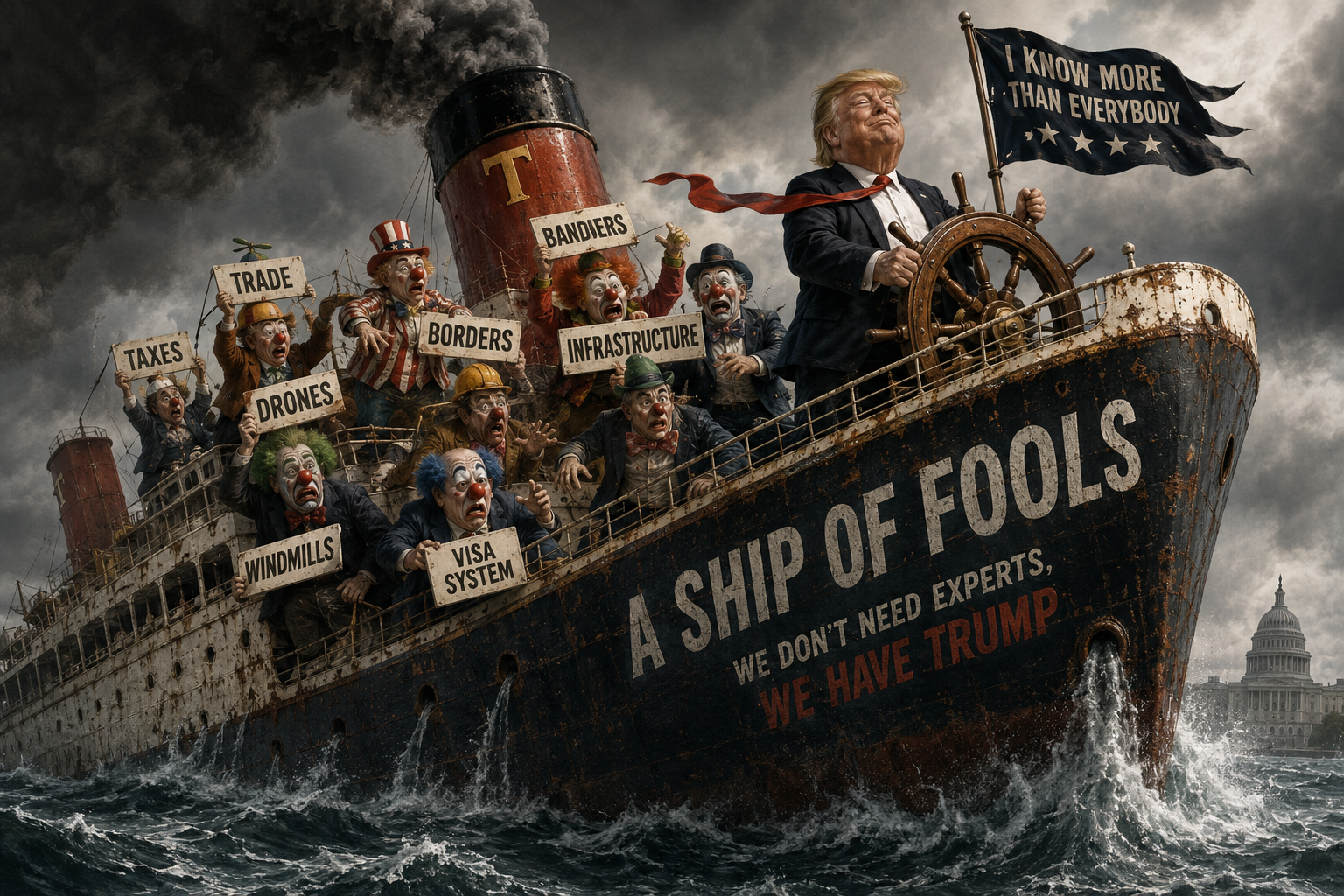
He knows more about ISIS than the generals. More about taxes than accountants, more about drones than pilots, more about trade than economists. More about infrastructure, borders, banking, windmills, and the visa system than the people who spent their whole working lives inside them. He has the best words. By his own accounting, he is the ranking authority on nearly everything a government touches, and he got there without reading anything longer than a menu.
A man who knows everything needs nobody. Which makes him easy to point at.
We laugh. We have been laughing for ten years.
The laugh is the product.
Because the arithmetic stops working eventually. Fools lose. That is what makes them fools. They trip on the stairs, say the quiet part into a live microphone, lose the room, then the money, then the case. What fools do not do is take apart a functioning republic on a schedule, in sequence, hitting every load-bearing wall on the way through.
Ten years ago the United States was a democracy with allies. Treaties that meant something. Trade that ran on rules instead of moods. A civil service that mostly showed up and did the work. Courts that mostly meant it. A press that was free and sometimes brave. We were not good. We were better than we had been and still climbing, still hauling misogyny up the slope behind us, and we made every inch of that progress against our conservative friends rather than with them. Every step forward was taken into resistance. We took it anyway.
Then, on a Friday night in January of 2025, seventeen inspectors general opened an email from the White House personnel office. Changing priorities. Effective immediately. There was no thirty-day notice to Congress, as required by law, and no one even attempted to provide one. Grassley complained about the paperwork and went back to work. A month later Hegseth cleared out the chairman of the Joint Chiefs, the chief of naval operations, and the vice chief of the Air Force in one evening, along with the judge advocates general of the Army, the Navy, and the Air Force. Those last three are the lawyers whose entire job is telling a president that an order is illegal. Nobody in the building missed the point.
The allies write contingency plans now for a partner who may not show. Trade runs as a hostage negotiation. Agencies got hollowed out and restaffed with loyalty, the only credential still being issued. Institutions that took a century to build were emptied in a season and nobody had to storm anything.
A fool leaves a mess. This is a demolition, and demolition takes a plan, a crew, and somebody who knows which wall holds the roof.
So there are two possibilities.
The first is that he is not a fool. The ignorance is a costume, and he has worn it for ten years while the people who think of themselves as the smart ones kept explaining why he was finished this time.
The second is that he is exactly what he looks like and somebody else has the wheel. A fool at the wheel can be pulled off it. A fool who is the wheel is not an accident in the machine. He was installed.
Moscow worked this out ahead of us. It never took an agent. A vanity large enough to aim does the same job and costs less, and a man who knows everything needs nobody to check him. PrumpTutin is one organism with a single appetite and two mouths, and only one of them talks.
Which possibility is true matters less than we keep hoping it does. Both roads run through the same rubble, and on both of them the hand on the wheel belongs to someone who can count.
We don’t need experts. We have Trump. Indictments slide off a clown. Nobody organizes against a clown. And nobody, right up until the end, believes a clown can steer.
We are on a sinking ship of fools. The captain is not one of them.
I have been keeping the ledger on this for a while. The Art of the Lie is eight years of it in one place. We Used to Be Wise is the longer account—nineteen chapters, one indictment. The rest of the shelf is here.