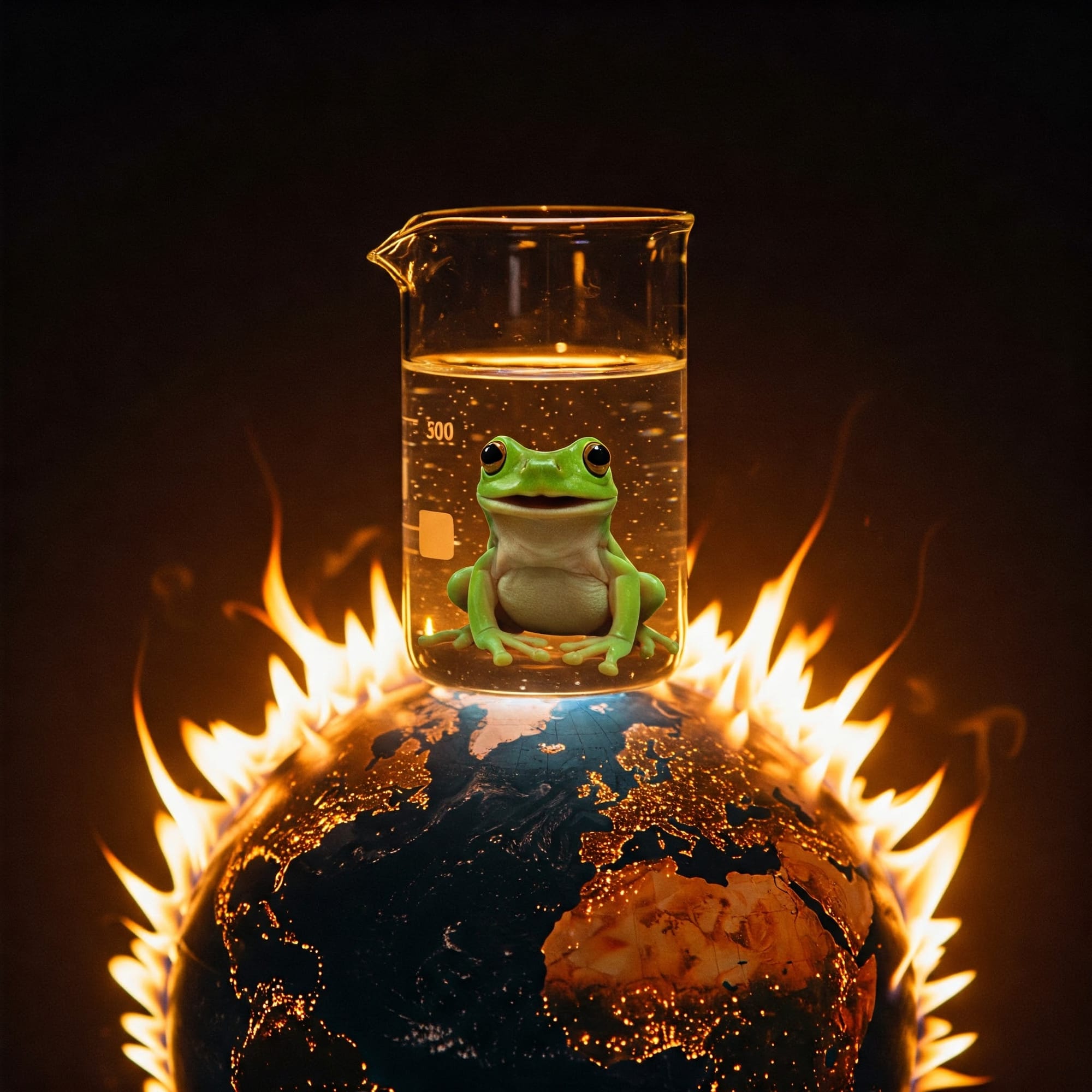
Note: Yes, I'm late today. Sorry, to much fun.
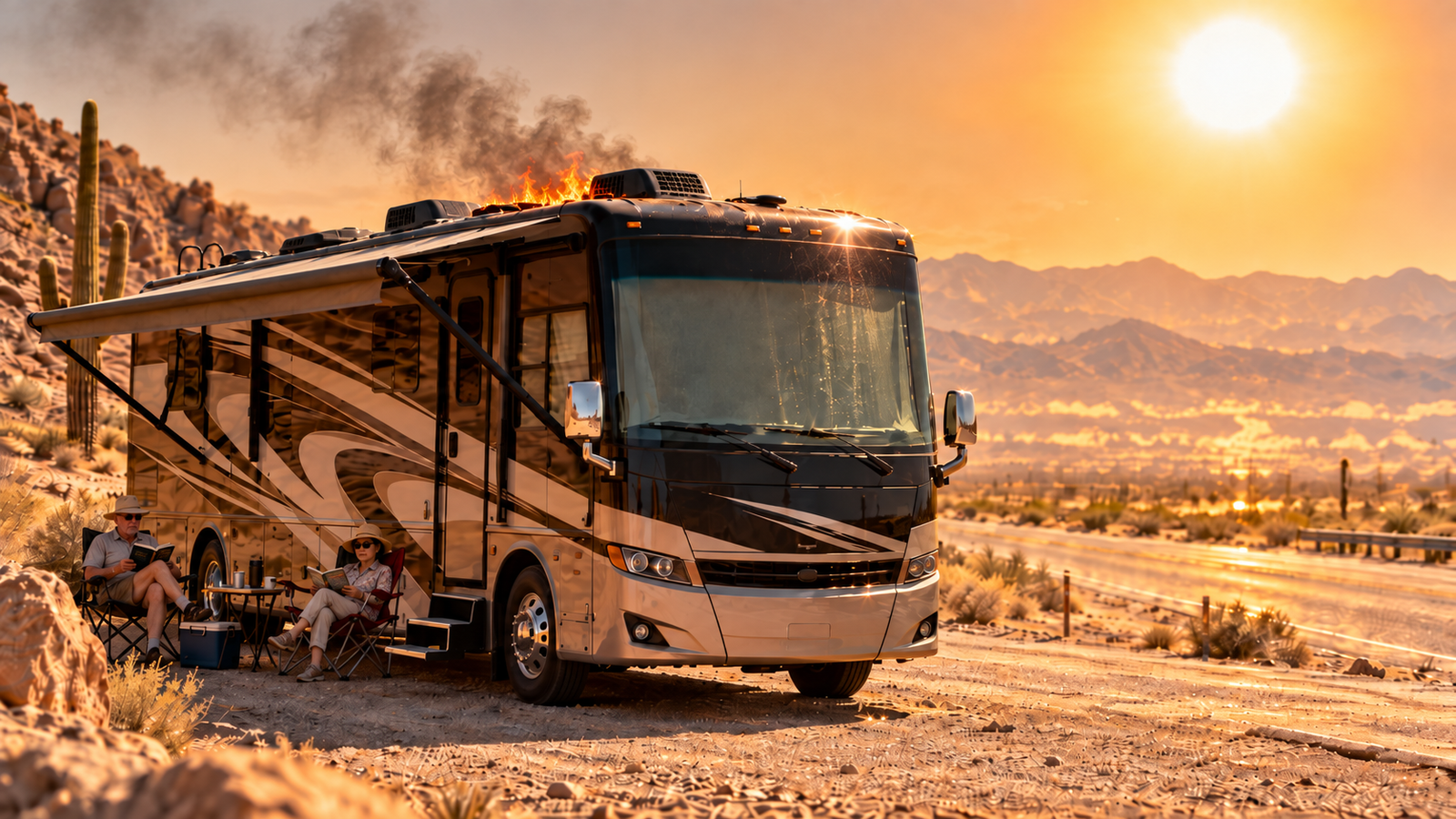
The air conditioner in my motorhome no longer keeps up. Nothing is broken. It runs. It cycles. It pulls its amps. The inside of the coach still sits ten degrees above whatever the thermostat asks for. The machine does exactly what its engineers built it to do. The climate they built it for has gone.
These came off my dash. Needles, 115. Bakersfield, 116. Kingman, 106. Phoenix, 120. Santa Fe, 92. Crystal River, 93. The machine keeps up with the last two.
August 2026 tied July 2023 as the hottest month ever measured on this planet. July 2026 broke every heat record the contiguous United States has kept since 1895, including the furnace summer of 1936. On July 12 Miles City, Montana hit 115 and broke its own daily record by 12 degrees. Records of that kind fall by tenths. Outside Pueblo, Colorado, one fire took 35,000 acres and more than 100 structures. That was before the Fourth of July.
The heat is not the story. The story is this: it was avoidable, and other people avoided it.
In 1856 Eunice Newton Foote set glass cylinders of different gases in the sun and watched the one holding carbon dioxide climb hotter and hold its heat longest. An atmosphere carrying more of that gas, she wrote, would give our earth a higher temperature. Three years later John Tyndall measured it properly in a London laboratory. In 1896 Svante Arrhenius did the arithmetic and figured the world's coal furnaces would need about 3,000 years to double the carbon dioxide. He expected the result to be pleasant, a longer growing season for Sweden. We did it in 130 years. A Swede with a pencil got the physics right and underestimated only our appetite.
In 1938, Guy Callendar showed that warming had already started. In 1965 Lyndon Johnson's science advisers handed him a report on carbon dioxide, and he told Congress this generation had altered the composition of the atmosphere. Exxon's own scientists ran projections from 1977 through 2003 and put the figure at two tenths of a degree Celsius per decade. Researchers later checked that work against what happened. Exxon was right. Its models ran as well as anything the universities or the government produced. Exxon knew. Then Exxon spent decades funding people whose job was to say the number could not be known.
I was born 50 years after Arrhenius published. I watched the back half myself.
Ten countries today generate more electricity from wind, water, and sun than their own grids consume. Paraguay makes 152% of its demand and sells off the rest. Norway makes 115%. Iceland runs an entire country on falling water and volcanic steam. These are not pledges for 2050. These are grids running a surplus this year.
Those places got lucky. Paraguay sits on a river the size of a small sea. Iceland sits on a volcano. Add all ten of those grids together, and they come to barely more than half of what Texas alone burns in a year. Nobody runs a continental economy of 347 million people on somebody else's geography.
So, look at ours. In the twelve months ending this June, South Dakota generated 127% of its electricity demand from wind, water, and sun and exported the surplus. Iowa hit 74%. Kansas 72%. Texas produces more wind power than any other state. Not one of those is a liberal state. Ranchers signed the leases and cashed the checks. County commissions approved the transmission. The turbines went up across the reddest ground in the country, while the party those counties vote for called the science a hoax.
Wind was the second road. France took the first one. After the 1973 oil embargo, France decided to build its way out. In roughly 15 years it put up 56 reactors. France has run on about two-thirds nuclear ever since, one of the cleanest grids in the industrial world, built with 1970s engineering. The United States started down that same road, reached 112 reactors, and quit.
Three Mile Island gets the credit and has earned some of it. So have the cost overruns, Chernobyl, and Fukushima. Fear and arithmetic did real damage. But fear did not write the letters.
In 1963 the president of the National Coal Policy Conference put it on paper: continued investment in commercial nuclear power risked destroying the coal industry. Half a century later, when Pennsylvania and Ohio moved to keep their reactors running, the American Petroleum Institute ran a campaign called No Nuclear Bailouts, and Lachlan Markay of the Daily Beast got hold of the internal playbook. Social media buys. Mail pieces. Legislator intercepts. Front groups that looked local and were not. The coalition fighting the Pennsylvania rescue included the Marcellus Shale Coalition. That is the state's gas trade group. Utilities shut five reactors in five years. Gas took the load.
Cheap fracked gas was already beating nuclear on price. The gas industry did not need to invent the problem. It needed to stand in the doorway when somebody tried to fix it, and it paid good money to stand there.
In 1997 the Senate voted 95 to nothing against any climate treaty that might put a cost on the United States. Every Democrat, every Republican. The whole chamber agreeing that the atmosphere could wait. Trump did not invent the refusal. He inherited it, and he gave it a word.
On February 12, 2026, Trump and his EPA administrator, Lee Zeldin, stood in the Roosevelt Room and revoked the endangerment finding, the 2009 determination that carbon dioxide and five other gases threaten public health. That finding was the legal floor under every federal limit on greenhouse gases: cars, trucks, power plants, and refineries. Zeldin called it the largest deregulatory action in the history of this country and called the science under it a religion. Asked about the evidence, Trump called the whole thing a giant scam.
Removing the rules was the cheap part. The administration canceled $7.6 billion in grants across roughly 300 energy projects, then told a federal court the criterion was the political identity of the recipient's state. Sixteen states, all of which voted the wrong way in 2024. After that it started paying. Close to $3 billion pledged to cancel offshore wind, including a March payout to kill projects off New York, New Jersey, and North Carolina. Equinor had Empire Wind fully permitted and under construction when Interior ordered the work stopped. The government spent public money to stop work the public had already paid for.
The courts have mostly said no, and a record 79.7 gigawatts of clean power should arrive this year anyway. Hold the applause. In a single quarter, planned gas capacity climbed from 44.8 gigawatts to 65.5, better than four times the combined growth of solar, storage, and onshore wind. Fossil's share of everything planned has gone from nine percent to 27 since 2022. The obstruction is losing in court and winning in the pipeline.
Fake climate change. Fake heat.
Watch what that word does. It does not argue. It offers no measurement, no rival curve. It calls the thermometer a liar and walks off. It costs the speaker nothing. Call a thing fake and you never have to fund it, regulate it, or explain it to your shareholders.
Denial is not a belief. It is an accounting method.
The air outside my coach has not heard. It sits in a Needles parking lot, indifferent to the Roosevelt Room, pressing on a coil sized for a cooler century.
Failure is not the galling part. Hard problems get failed. This one had three solutions. We watched other people use all of them. Paraguay took a river. France took fission and 15 years of political will. South Dakota needed nothing but wind and a bank loan. We had the rivers, the wind, the uranium, the engineers, and more money than all of them combined. We built a lobbying industry instead.
Eliot had the ending 101 years ago, 29 years after Arrhenius handed us the number.
This is the way the world ends
Not with a bang but a whimper.
No bang. An air conditioner is running at full capacity and losing efficiency, a dammed river is visible outside the window, and a man on television is calling the temperature fake.
Eliot missed one thing. The men who bought the delay have air conditioning that works.
More from Burnt Ground
The Fire. Arco, Idaho, July 1955, and the fire the United States walked away from.
The Ledger. Alec Smith was twenty-six and three hundred dollars short of his insulin. A confession in numbers.
Ignorance. Destroying the country's access to information. Not by accident. As policy.
The End of the Beginning. Of all the institutions that folded, the energy sector was the most obedient.
The United States Is Not Polarized. It Is Stratified.. The divide is not horizontal. Owners and workers. Insured and exposed.
Forty Trillion Dollars and Nobody Did It. The bill arrives and not one of them will tell you he wrote it.
Books
We Used to Be Wise. How the United States dismantled the structures that made it work, and the fifty-year campaign that did it. Nineteen chapters, one indictment. Arrakis Publishing, 2026.
The full shelf. Novels, the Bot Series, the Bible retellings, and the political nonfiction, at Arrakis Publishing.