Lincoln was 28 when he said it out loud. January 27, 1838, Springfield, Illinois, a room of young men at the Lyceum, under a title dull enough to hide anything: "The Perpetuation of Our Political Institutions."
He opened by praising the enemy and then taking him away. All the armies of Europe, Asia and Africa combined, with a Bonaparte for a commander, could not by force take a drink from the Ohio or make a track on the Blue Ridge in a thousand years. Nobody was coming for us. That was the point of the compliment. It closed the only exit. If destruction be our lot, we must ourselves be its author and finisher. As a nation of freemen, we must live through all time, or die by suicide.
He had his reasons. In Mississippi the hangings ran from gamblers to slaves suspected of insurrection, then to white men supposed to be helping them, then to strangers passing through on business, until Lincoln could describe bodies hanging along the roadsides thick enough to rival the moss. In St. Louis a mob seized a man named McIntosh off the street, chained him to a tree and burned him alive inside an hour. No jury ever tried anyone for it. Less than three months before Lincoln spoke, a mob in Alton, Illinois shot the editor Elijah Lovejoy dead and threw his press in the river. Lincoln never said Lovejoy’s name. He did not have to. His catalog of what a mob does includes throwing printing presses into rivers and shooting editors.
His point was mechanical, and he was careful about it. The dead were the small evil. The danger sat in the example. A mob that works teaches. Men who were lawless in spirit become lawless in practice, and men who love order, seeing their families insulted and their government offering no protection, get tired of it and stop objecting to a change. The law drops from a wall to a suggestion. Call it weather. Something spreading, with no one to bill for it.
Then comes the part nobody quotes. Lincoln said the ambitious men who could be satisfied by a seat in Congress, a governor’s chair or the presidency itself do not belong to the family of the lion or the tribe of the eagle. The one who does will find all three too small. He will want distinction, and he will take it at whatever price the market offers, at the expense of emancipating slaves or enslaving freemen, the direction irrelevant to him, only the scale.
Lincoln proposed reverence for the law as the cure. Taught in schools, written into primers, preached from the pulpit, made into the political religion of the nation. He offered a hope and called it a defense. He got 23 years before Fort Sumter, spent his presidency proving his own thesis, and a man of towering ambition with one very small stage finished the argument for him in a theater. Notice what that cost. Booth had to break in. Every villain Lincoln could imagine had to break in.
On January 6, 2021, a mob went into the Capitol after the certificate of the vote and chanted for the Vice President by name. A man named Albuquerque Head dragged Officer Michael Fanone into the crowd and yelled that he had gotten one. Another man tased him. Fanone had a heart attack and a traumatic brain injury and left the force.
On January 20, 2025, within hours of taking the oath, Trump pardoned roughly 1,500 of them and commuted the sentences of 14 more, all Proud Boys and Oath Keepers, 10 of whom a jury had convicted of seditious conspiracy. The Justice Department had charged some 608 people with assaulting, resisting or impeding officers, roughly 174 of those with a weapon or with causing serious injury. The pardons covered them. The men who took Fanone are free.
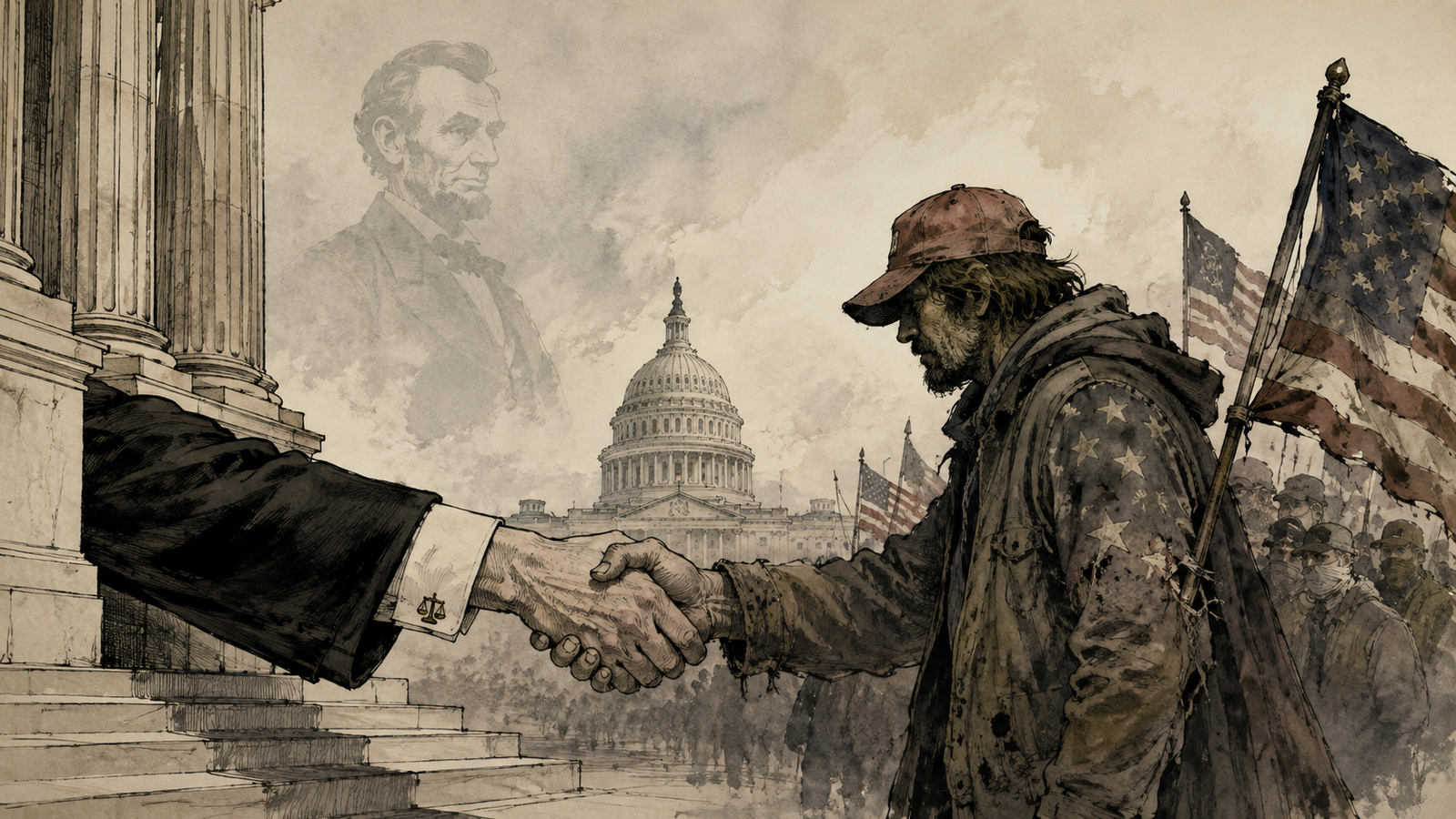
Lincoln feared a mob strong enough to overpower the law. He did not imagine this. The mob did not defeat the law. The law came out and shook its hand. Six months before that, the Supreme Court had supplied the other half, ruling on July 1, 2024 that a president answers to no prosecutor for the official acts of his office. Booth had to shoot his way in. This one got handed the keys, twice, by people who had already watched him try the door.
The obvious objection runs the other way and it has history behind it. Every generation buries the republic, and the republic keeps turning up at its own funeral. Wilson jailed his critics. McCarthy owned the Senate. Nixon put burglars on the payroll. All of it passed. It passed because each time a piece of the man’s own side turned on him. Republican senators walked down to the White House and told Nixon he was finished. An Army lawyer asked McCarthy whether he had any decency left, and the room decided he did not. The correction never arrived from the opposition. It arrived from inside the coalition. Name the person inside this one who will do it. I have looked. The lawyers whose job was to say no went out the door in the spring of 2025, and nobody in the building missed the point.
Roughly 77.3 million people saw the pardons, the immunity ruling and the open admiration for Putin, and voted for more of it. That came to 49.8 percent, not a majority, and the distinction is the worse news rather than the better. A country does not require a nation of fanatics. It requires a committed plurality and a tired remainder that will not cross the street to stop them. PrumpTutin is not something that happened to the United States. He is something the United States ordered, paid for, and asked to be delivered early.
Lincoln could call it weather. Nobody had signed for those mobs, nobody claimed them, and they arrived from everywhere at once. We have no such excuse. We have the returns, county by county, and we have the proclamation with a date on it. I am 80 years old. I have watched this country do filthy things and then, late and grudging and never enough, turn around. That turn is what I no longer expect. Repair requires people who believe the law binds their own side, and I cannot tell you where those people are.
And here we are.
Related from Burnt Ground
Until Confidence Is Restored | A Ship of Fools | Orders and Oaths | The Man Who Would Cancel November | I’m Tired
Further Reading
Abraham Lincoln, "The Perpetuation of Our Political Institutions," January 27, 1838. https://www.abrahamlincolnonline.org/lincoln/speeches/lyceum.htm
Tom Joscelyn, "Trump’s January 6 Pardons and Assaults on Law Enforcement Officers By The Numbers," Just Security. https://www.justsecurity.org/106689/january-6-pardons-statistics/
Trump v. United States, No. 23-939, slip opinion, decided July 1, 2024. https://www.supremecourt.gov/opinions/23pdf/23-939_e2pg.pdf
Cook Political Report, National Popular Vote Tracker, 2024. https://www.cookpolitical.com/analysis/national/national-politics/key-takeaways-2024-national-popular-vote-tracker