
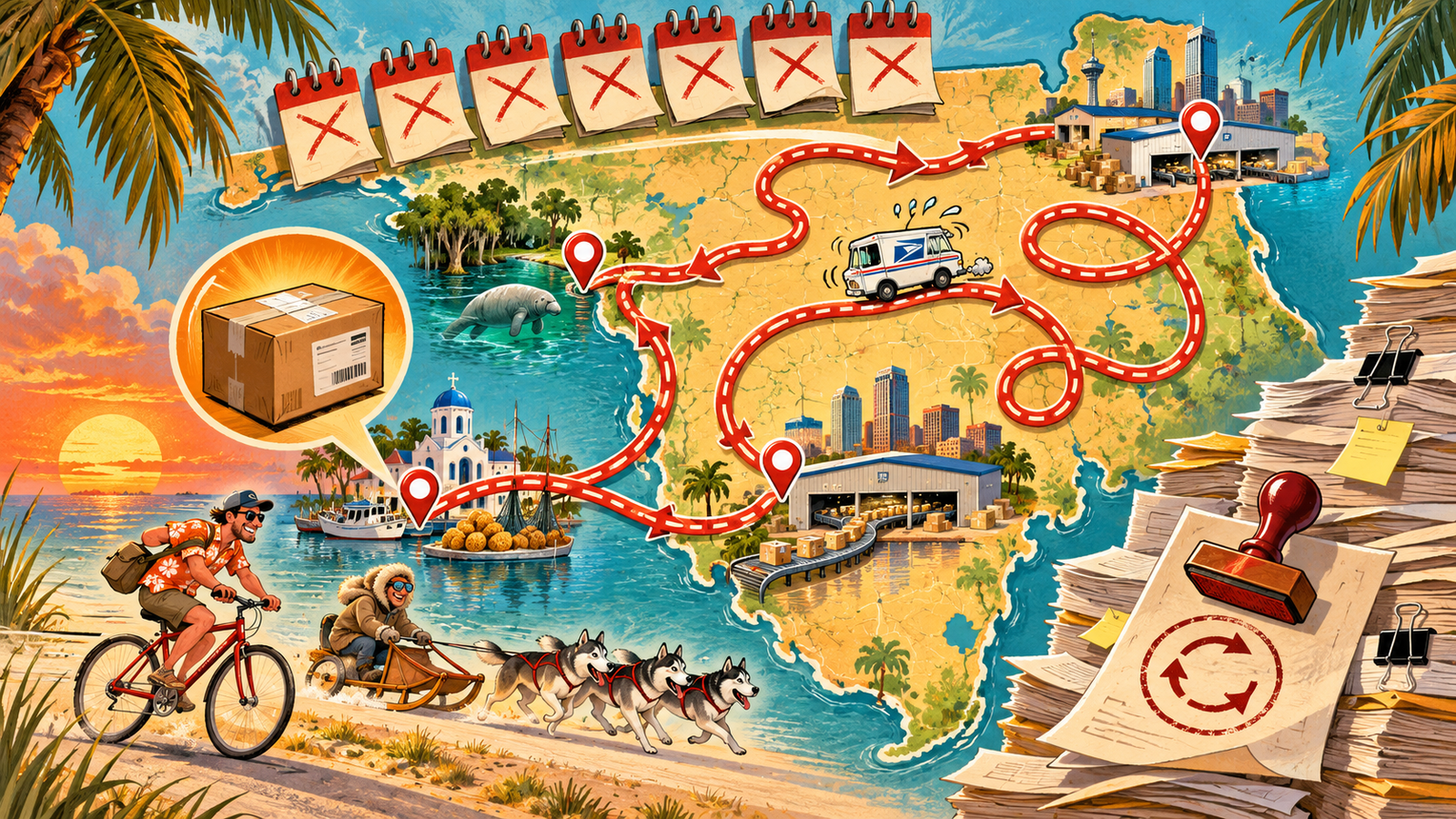
I ordered a package last week. It is coming from Tarpon Springs, Florida, to Crystal River, Florida.
According to the delivery estimate, it will take a week to get here.
Thanksgiving falls inside that week, and so does a Sunday. Give the Postal Service both, and it still needs five days.
I could drive to Tarpon Springs, pick up the package, eat lunch on the sponge docks, drive home, and still have time for a nap. I could probably make the trip on a bicycle before the Postal Service delivers the box, although at 80 I would prefer not to test that theory.
So I sat down to write an angry essay with a simple premise. The Postal Service is a heavily subsidized government operation. UPS, FedEx, and Amazon live on what their customers pay. The three private carriers are pulling ahead of the one with the Treasury behind it, and at this rate, the dog sled will pass it too.
Then I went looking for the subsidy because a man with an economics degree ought to put a number on his outrage.
I found the number. My premise did not survive it.
The Last Check Was for $12 Million
Start with what the taxpayer pays the Postal Service to deliver the mail. In an ordinary year, Congress appropriates about $50 million. The money reimburses postage Congress ordered the Postal Service to give away or discount for blind readers, voters overseas, and nonprofit mailers. The Postal Service took in $82.9 billion last fiscal year. The appropriation works out to six cents on every $100.
My premise was 44 years out of date. In August 1970, Congress and Richard Nixon turned the old Post Office Department into a business expected to pay its own way. In the department’s final year, taxpayers supplied almost a quarter of its revenue. Congress understood no business could serve every address at a profit, so the new law promised a yearly payment for the public-service part of the job. Congress paid $920 million a year through 1979 and then let the payment shrink. In 1982, it sent $12 million. After that, the Postal Service quit asking, and Congress never offered. The rule that the mail must pay for itself is younger than I am.
Congress has helped since. In 2020, with the pandemic on, Congress lent the Postal Service $10 billion and later told it to keep the money. In 2022, it added $3 billion toward electric delivery trucks. Those are subsidies, $13 billion of them, and each arrived once.
The famous number is bigger. In 2022, Congress passed a postal reform law the newspapers priced at $107 billion. Of that, $57 billion was Congress canceling a bill Congress had invented. A 2006 law ordered the Postal Service to bank money for decades of future retiree health care, a mandate the Postal Service says no other agency or company has to meet. The Postal Service stopped paying. The unpaid bills mounted, and Congress tore them up. The other $50 billion is a 10-year estimate of what the Postal Service saves by no longer prefunding and by sending its retirees to Medicare, a program they paid into while they worked.
The critics keep a longer ledger, and it deserves a hearing. Only the Postal Service may carry ordinary letters for pay or put anything in my mailbox. It pays no property tax and no parking tickets. A 2015 study valued those privileges at $18 billion a year. UPS paid for the study. The Postal Regulatory Commission, the Postal Service’s own regulator, prices the two monopolies at $5.9 billion a year. The same regulator prices the duties Congress attaches to them at $6.6 billion, more than half of it for delivering six days a week. The privilege is worth less than the chore.
What keeps the trucks running today is a pair of IOUs. The first is $15 billion borrowed from the Treasury, the legal limit, unchanged since 1992. The second is about $39 billion in pension and retiree health bills the Postal Service has booked and not paid. It added $8.2 billion to the pile in fiscal 2026 alone. In June, Postmaster General David Steiner told a Senate committee where the cash comes from: “We are borrowing from our employees’ retirement funds to continue operations.”
So I found my subsidy. The lender is the retirement fund of the people who sort and carry the mail, and if the Postal Service never pays, the bill lands on the Treasury.
Who Is Pulling Ahead
In 2025, for the first time, the Postal Service was not the country’s largest package carrier, according to its own inspector general. Amazon was. ShipMatrix, which tracks the industry, counted 6.7 billion packages for Amazon, 6.6 billion for the Postal Service, 4.4 billion for UPS, and 3.6 billion for FedEx.
Amazon is the one pulling ahead, and UPS is shrinking on purpose. In 2025, UPS carried 8.6 percent fewer packages a day in the United States, having decided Amazon’s cheap boxes paid too little to carry. It cut about 48,000 operating jobs and closed 93 buildings. It reported an operating profit of $7.9 billion, and its stock rose the morning it announced up to 30,000 more job cuts. The Postal Service serves more than 170 million addresses, and the law lets it drop none of them.
The private carriers charge accordingly. Going by ShipMatrix’s revenue estimates, UPS collected about $13 a package in 2025, FedEx about $14, and the Postal Service under $5. UPS and FedEx carry heavier, faster freight, which explains part of the gap. Wells Fargo’s analysts explain the rest: the Postal Service’s package prices run 25 to 60 percent below the other two.
The Postal Service’s price ignores how hard the address is to reach, and the competition will not match that part. UPS and FedEx add a delivery surcharge in 62 percent of the country’s ZIP codes, home to 102 million people, by the count of the Institute for Policy Studies. The fee runs from a few dollars in a small town to more than $16 at a remote address and $46 in rural Alaska. The Postal Service charges nothing extra. FedEx publishes its list, and Crystal River’s ZIP codes are on the one that takes effect January 4. At list price, a FedEx box to my door will carry a $7 surcharge.
For their cheapest home deliveries, the private carriers have leaned on the Postal Service itself. UPS handed it the last mile for years. At the start of 2025, UPS tried doing the job alone, raised the price of the service almost 10 percent, stopped delivering it to post office boxes, and signed a new deal with the Postal Service a year later. Amazon rode postal routes for years, about $6 billion a year of business, while it built its own network. State and local governments chipped in more than $11.6 billion in subsidies for Amazon’s warehouses, offices, and data centers, by the count of Good Jobs First.
As for the dog sled, it was ours. The Post Office ran mail by dog team across Alaska for decades. The last route survived until January 8, 1963, on St. Lawrence Island in the Bering Sea, where Chester Noongwook drove the mail between Gambell and Savoonga. Both villages had airstrips by then. Noongwook kept running because the weather kept grounding the airplanes. The Post Office invited him to Fairbanks for an award, and his flight came in four hours late. Weather.
Three Things Went Wrong
Congress did the first. It ordered a public service to run like a business, as if a post office ought to balance like a household checkbook. It stopped paying for the public part, froze the credit limit, and added the retiree bill. The Government Accountability Office put the Postal Service’s finances on its High-Risk List on July 28, 2009, and has warned about the business model ever since.
Nobody did the second. The product that paid for the network is dying. Mail volume peaked at 213 billion pieces in 2006. In fiscal 2026, it was 105 billion, and First-Class Mail, the profitable part, fell to its lowest volume since 1965. The route keeps growing anyway, by more than a million new addresses a year. The carrier visits more doors with less in the bag. Steiner told a House committee that the lost mail, priced at a stamp apiece, comes to about $81 billion a year, more than FedEx or UPS could lose and survive.
Management did the third, and the first two do not excuse it. In March 2021, Postmaster General Louis DeJoy launched a 10-year plan called Delivering for America, which promised to break even by fiscal 2023. By the plan’s second year, management had $10 billion from Congress, a balance sheet cleared of $57 billion in old bills, and its regulator’s permission to raise prices faster than inflation. The plan moved mail off airplanes and onto trucks and began folding nearly 200 local sorting plants into about 60 regional hubs. In April 2025, the Postal Service ended the afternoon and evening pickups at post offices more than 50 miles from a hub, mine included. Management calls this Regional Transportation Optimization, which is a long name for parking the truck.
The idea is older than the plan. The Postal Service’s own table sends Crystal River’s mail to a sorting plant in Jacksonville, on the other coast. If my box follows that map, it rides about 360 miles of highway to cover 57. A plant in Gainesville, a little over an hour up the road, did the sorting until the Postal Service approved a move in 2011 to save a projected $1,466,285 a year.
One of my companies built software that optimized dispatch for fire departments, so I know the case for consolidation. I also know an optimizer answers only the question its owner asks. The 2011 study states its savings to the dollar. About delivery times, it offers a promise of “maintaining excellent service.”
The answers are in. In September, the inspector general measured the whole network. Since fiscal 2021, package volume has fallen 10 percent. Package handling has risen 11 percent because the new network sorts the same box more than once. Five years into the plan, 14 of the 60 hubs were running. The plan had promised savings of $22 billion to $31 billion. Management dropped the estimate and never replaced it. Through fiscal 2025, the plan had lost $31 billion. Mail prices rose eight times, and a stamp went from 55 cents to 82.
When the mail missed its on-time targets, management went to work on the targets. The goal for two-day First-Class Mail fell from 96.5 percent to 87. In April 2025, the Postal Service stopped counting Sundays and holidays against its delivery clock for mail entered the day before. Even so, the regulator found 20 of 27 mail products missed their marks in fiscal 2025 after management had lowered the marks for 19 of them. This month, the Postal Service reported 89.03 percent of First-Class Mail on time against a target of 89. It was the first passing grade since 2022. The margin was three hundredths of a point.
The people who count the beans took control of the people who grow them. I watched it kill Digital Equipment, which was once the second-largest computer company in the world. The spreadsheet has no row for the customer who leaves. The man who runs the Postal Service now, David Steiner, was Waste Management’s chief financial officer before he was its chief executive. Nobody established the Postal Service to achieve an impressive cost-per-piece metric. The Continental Congress established it in 1775 to deliver the fucking mail.
All Paths
The people who would profit from a weaker Postal Service have put their arithmetic in writing. In February 2025, analysts at Wells Fargo sent investors a memo titled “USPS Privatization: A Framework.” Its subtitle was “All Paths Lead to Better Parcel Pricing.” The analysts figured a Postal Service run for profit would have to raise package prices 30 to 140 percent, and they named the beneficiaries: FedEx and UPS. Better, in that subtitle, means higher.
Two months earlier, Donald Trump had called privatizing the Postal Service “not the worst idea I’ve ever heard.” The $18 billion study came out of UPS’s checkbook, and the Postmaster General sat on FedEx’s board when the Postal Service’s governors hired him.
A plot would be redundant. A Postal Service that charges more and delivers less is worth money to its competitors, and Wall Street has said so in print.
Pay for It or Say So
On November 10, the Postal Service announced a $6.5 billion loss for fiscal 2026, down from $9 billion, which counts as progress the way sinking in 20 feet of water beats sinking in 30. The same day, it asked Congress for $2 billion. More than half would pay for the postal inspectors, the inspector general, and the regulator, which stamp buyers pay for now. The Postal Service also asked, for the first time since the early 1980s, for the $460 million public-service payment. It wants its 1992 credit limit of $15 billion at least doubled. Steiner warned of “drastic changes in the number of post offices” if nothing comes. A new Congress takes its seats in January.
Most of that would be a subsidy. Good. A public service costs public money, and the country has been getting this one on credit from its own mail carriers’ pensions. On the arithmetic, the former chief financial officer is right. He inherited the plan, and counting is what a bean counter is for. If the country wants six-day delivery to every address, with no surcharge for living in Crystal River, the country has to pay for it. A Congress unwilling to pay should say so out loud, where the voters can hear it.
Management owes something as well. It should measure service the way a customer experiences it, from the mailbox to the door, with the Sundays counted. It should prove the savings from every consolidation and publish what each one does to delivery times before it reroutes a single truck.
Fifty-Seven Miles
My package will probably arrive, and it may even arrive on the estimated day. I have survived 80 years without whatever is in the box, and another week will not kill me.
Leave the carriers out of this. Somebody far above a carrier’s pay grade made every decision in this essay. When the box does come, a carrier will bring it the last mile, the mile UPS hands back and FedEx bills extra for. The Postal Service will drive it for the price of the postage, as it has for 44 years without a check for the trouble.
That mile will be the only one that made any sense. It is also the subsidy, and it runs from the Postal Service to me.
Joe Zeigler’s books are available at Arrakis Publishing. For the long history of who took the postwar settlement apart, and how, see We Used to Be Wise. Read the summary.
Research: USPS fiscal 2026 results, November 10, 2026; Postmaster General David Steiner, testimony to the Senate Homeland Security and Governmental Affairs Committee, June 24, 2026, and to a House Oversight subcommittee, March 17, 2026; Postal Regulatory Commission Vice Chairman Robert Taub, testimony to a House Oversight subcommittee, June 2026; Annual Report of the Postmaster General, 1982; U.S. Government Accountability Office reports GAO-26-108527 and GAO-26-107657; USPS Office of Inspector General, Assessment of Postal Service’s Network Changes, September 8, 2026; UPS fourth-quarter 2025 earnings release; ShipMatrix parcel estimates; Institute for Policy Studies, UPS and FedEx Surcharges Based on ZIP Codes, June 2026; Wells Fargo Equity Research, USPS Privatization: A Framework, February 27, 2025; Reuters, Federal News Network, and Supply Chain Dive reporting.