
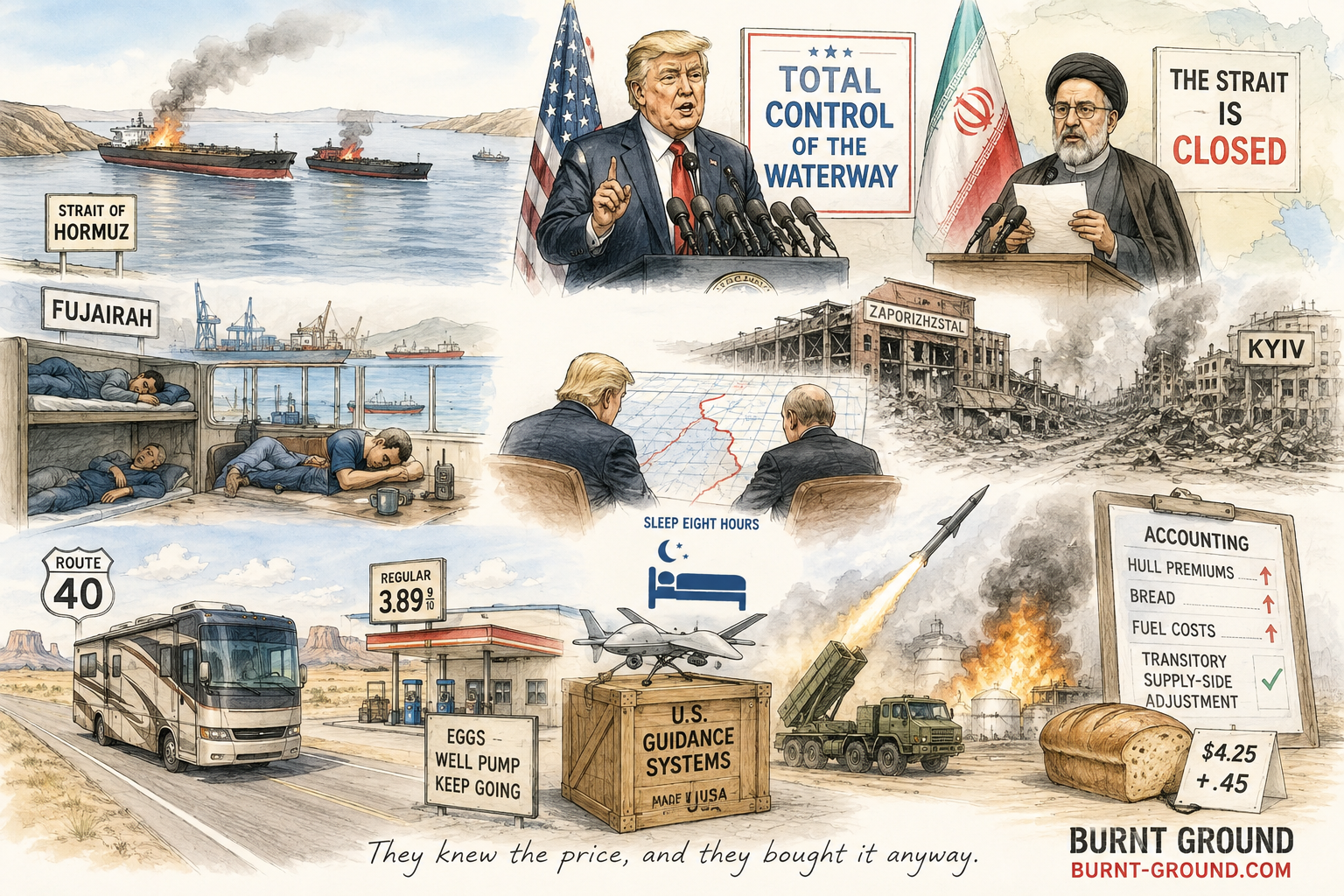
Two oil tankers took fire in the Strait of Hormuz on Friday morning. In an ordinary week, one hundred and thirty commercial vessels make the transit. This week the channel is mostly flat, grey water, and silence.
Trump stood in front of the microphones and announced that the United States has total control of the waterway. Iran issued a press release stating the strait is closed. The merchant crews tied up in Fujairah sleep in their bunks and wait for someone to tell them who owns the water.
In Ukraine, the accounting looks different only because it leaves concrete dust. On Tuesday, a ballistic missile took down the machine shop at the Zaporizhstal steel works. Seven men were killed before the morning shift change. In Kyiv, the debris fell into the warehouses across the Shevchenkivskyi district. The Pentagon briefings refer to these exchanges as precision degradation. The men in tailored suits look at satellite overlays and see theater-level strategy. Trump pulls up a boundary line and looks for leverage. PrumpTutin studies the exact same grid and calculates market share. Both of them sleep eight hours. When an anti-ship missile tears a nine-foot hole through plate steel below the waterline, nobody in Washington has to listen to the engine crew drown in heavy fuel oil. They never smell burning diesel on a saltwater breeze.
I spent years riding a fire engine before I ever sat down to write thirty years of software code. When something burns down to the ground, the smell never really washes out of your coat, and it sure as hell never leaves your head.
The United States has turned invisible warfare into an export commodity. We pack the guidance systems into wooden crates, ship them out to eastern Europe or the Persian Gulf, and announce to the press that we are maintaining regional stability. A drone strikes a fuel refinery outside Samara or Nizhnekamsk, and the whole night sky turns an oily orange. On cable news, it looks like Fourth of July fireworks over the river. Thirteen refinery workers died on the asphalt between the storage tanks. Our domestic economy barely blinks. Insurance underwriters double the hull premiums on every tanker entering the gulf; a loaf of supermarket bread goes up forty-five cents; and the economists at the Federal Reserve issue a bulletin calling it a transitory supply-side adjustment.
Last month Lanying and I took our thirty-five-thousand-pound motorhome out across Route 40, running through the high desert toward California. Out there, the dirt sits dry and yellow for fifty miles at a stretch without a single fence post. The people pulling up to the two-pump gas stations off the interstate are trying to scrape together forty dollars for regular unleaded, buy a carton of eggs, and keep the well pump turning. They do not read policy white papers about naval corridor enforcement. We assemble the guidance circuit boards in clean rooms over here so we can tell ourselves the fire is staying somewhere else.
The killing runs on software algorithms now. A subroutine balances the target value against the estimated collateral casualty count, checks the threshold, and authorizes the fire command. The arithmetic of who gets to breathe is handled by a processor cycle. I spent half a lifetime writing instructions for machines. Computers are fine tools for routing freight, balancing ledger columns, and sorting inventory. They do not have a line of code for mercy.
They knew the price, and they bought it anyway.
The ammunition bunkers empty out. The missiles strike whatever coordinates were entered into the guidance package. We pray to god for peace on Sunday and check the defense contractor quarterly earnings on Monday. Eventually the diplomats will sit down around a mahogany table in Geneva, pull out expensive fountain pens, and tell the television crews they preserved the international order. The strait stays empty. The dead do not get up off the dirt when a politician signs a treaty.