
and the trouble begins-
Salvation or disaster, and the people who get to decide have been told they can go to prison for deciding.
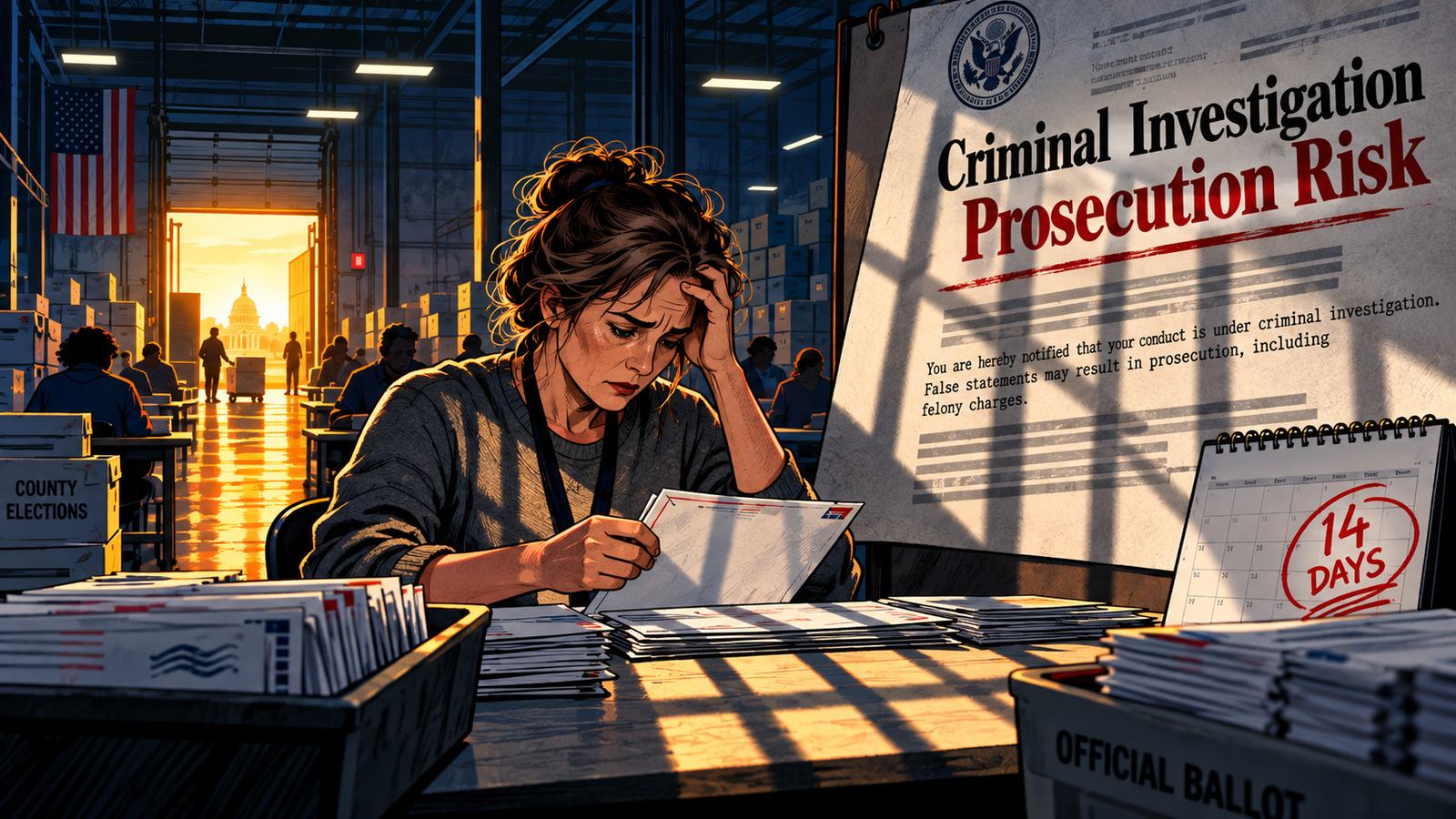
Two weeks until the United States finds out whether it still runs its own elections or whether the Justice Department does. Two weeks to salvation or to disaster, and nobody can tell you which, because the people who will decide it are not senators or generals. They sit at folding tables in a warehouse in the City of Industry, California, verifying signatures on mail ballots, and this week the federal government told them they could go to prison for doing it.
Trent McCotter, the acting deputy attorney general, sent a letter to California saying that local officials who process and tabulate ballots from people on a federal list of suspected noncitizens put themselves at risk of criminal investigation and prosecution. Not the voter. The clerk. The woman who opens the envelope. McCotter did not write it as a threat. He wrote it as a reminder of the law, which is how a careful man writes a threat.
The list has more than 20,000 names on it. The Justice Department gave California 48 hours to review it, then sued the state the moment the 48 hours ran out, asking a federal court to stop the counting of any ballot that might have come from one of those names. Shirley Weber, the secretary of state, answered that California will run its election under federal and state law, not under unsubstantiated claims and outrageous demands. She is right. She is also a defendant now, which is the point.
Nobody outside the government has seen the list. California asked for the evidence behind it and received a deadline instead. Nevada got the same treatment earlier this year, when the administration announced 1,500 noncitizens on its rolls and the secretary of state asked for proof, and the proof never came. The pattern holds: a number, a deadline, a lawsuit, and then silence where the evidence should be.
Noncitizen voting is a federal crime and ought to be prosecuted. Nobody in Sacramento argues otherwise. The United States has prosecuted it for as long as it has existed, which is why election experts can count the cases. They are rare enough to name. Todd Blanche, the attorney general, announces each one as though he had caught a battalion. A man in Louisiana. A woman in Massachusetts. Seven cases in Texas that prosecutors said send a clear message. The message is not to noncitizens. Noncitizens were never the audience. The audience is every county registrar in the country who now understands what the Justice Department can do to a person with a lawsuit and a press release.
The play does not require a single rigged machine. You do not have to steal an election if you can make the people who count it hesitate. A clerk in Los Angeles County now has to decide, envelope by envelope, whether her job is a federal crime. She has a mortgage. She has read the letter. The sensible thing, the human thing, is to set the doubtful ballots aside pending review. She rejects nothing. She waits for somebody above her to say it is safe. I signed my name to payrolls, tax returns, and contracts for 40 years, any one of which could have cost me the house. I know what a letter on government stationery does to the hand holding the pen. Multiply that by every table in every county, and the count slows down.
Then watch what Trump does with a slow count, because he already showed us. In June, when California’s primary tally ran long for the ordinary reason that California has more voters than most countries, he said they were rigging it. Within a day Bill Essayli, the Trump appointee running the United States attorney’s office in Los Angeles, announced multiple election fraud investigations in coordination with the FBI. He named no target, no location, and no evidence. He did not need any. The announcement was the evidence. In November Trump will not have to wait for a slow count to happen on its own. McCotter has already mailed the thing that can cause one.
That is the machine. Frighten the counters so the count slows. Call the slowness fraud. Send a prosecutor to watch. Sue to block the ballots that fear had set aside. Then, on the night of November 3, when the count in the largest state in the union is not finished, stand in front of the cameras and say you told us so. No tanks. No decree. Just a letter, a lawsuit, and a clerk who wanted to keep her house.
In “Sixty-One Days,” I wrote about the 61 days between the midterms and the seating of the new Congress and what a man like Trump can do with 61 days and a Justice Department that works for him instead of the law. I was wrong about one thing. He does not need to wait for the vote to be over. The Omar raid was the rehearsal for the days after. The McCotter letter is the rehearsal for the days before. Harmeet Dhillon, who runs the Civil Rights Division, sent Weber a letter in July warning that she or any election officer faced serious criminal charges. The Civil Rights Division. The office that once sent lawyers to Mississippi to protect the vote now sends letters to California to frighten the people who count it. The building is the same. The sign on the door has not changed. Everything inside it has.
Nobody is keeping the list, which is itself part of the method. Each move arrives as its own story, and the next one buries it. Count this cycle alone. The prosecutor sent to watch the Los Angeles count in June. The Dhillon letter in July. The noncitizen lists mailed to four states with no evidence attached. The Nevada 1,500. The taxpayer-funded ads. The Iran strikes paused until after the vote. The raid on Ilhan Omar. The 28 Californians charged with voting crimes this week. The 48-hour deadline. The lawsuit. The McCotter letter. That is 11, and I am certain I missed some, because missing some is what the pace is for. Trump cannot survive against a reader who remembers events in chronological order. So remember in order.
So, salvation or disaster. Nobody who tells you they know is telling you the truth. What I can tell you is where to look. Not at the polls. Not at the candidates. Look at the registrars. If the counties count every lawful ballot on schedule, with the letter on the wall and the lawsuit in the docket and the prosecutor in the back of the room, then the republic held this time, because the clerks decided it was worth the risk. If the count stalls and the word “rigged” starts coming out of the White House again, you will know what happened, and you will know who did it, and it will not be the woman at the table.
This year, salvation and disaster enter through the same door. The door is a county warehouse in a city named Industry, and the hand on the knob belongs to someone paid by the hour who was told, in writing, that she could be charged for turning it.
More from Burnt Ground
The Ladder Seven excuses, one destination. Read them in order.
The Man Who Would Cancel November “We should take over the voting.” He told you in February.
Until Confidence Is Restored Testimony before Congress from the Presidential Commission on Electoral Continuity.
The Mechanics of the Panic How a message that lands in the dark becomes a fact by morning.
Paid for by the United States The midterm ad campaign you bought and did not approve.
Watch the Hands The purge of the military, and where to look while it happens.
Books
PrumpTutin: How Trump Sold the West One organism, two capitals.
The Art of the Lie The documented record.
We Used to Be Wise Nineteen chapters on the fifty-year capture.
1776: A Novel The founding, told by a man who was inside it.