
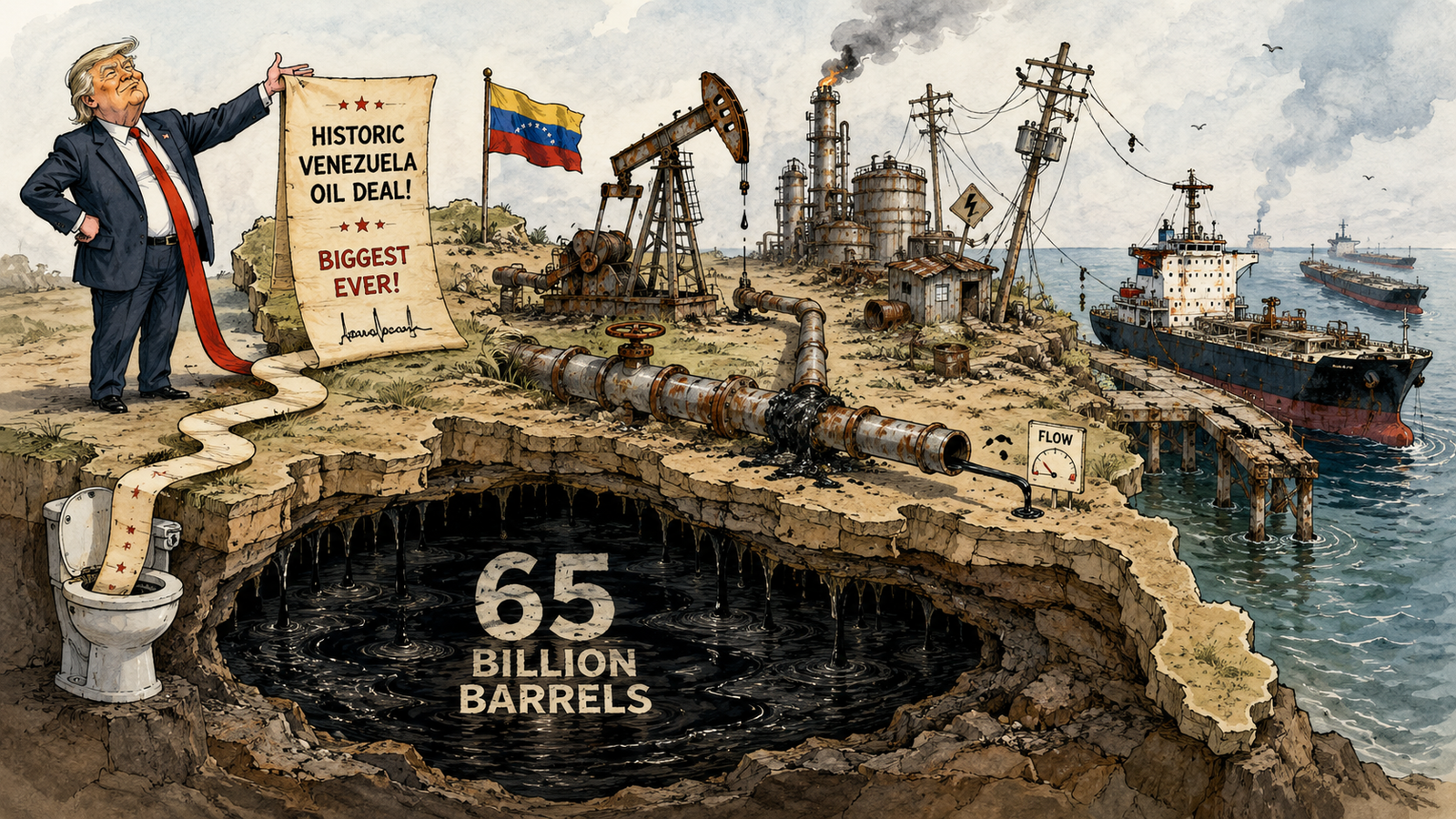
Venezuela holds the largest proven crude reserves on Earth and drills them with two rigs. The announcement moved faster than anything else in this deal ever will.
At the end of July, Venezuela had two active onshore drilling rigs. Baker Hughes counted them. The country holds the largest proven crude reserves on Earth, roughly 303 billion barrels, and it was working them with two rigs.
On Friday, Trump announced what he called the biggest oil deal in world history. Majority United States control of more than 65 billion barrels of proven Venezuelan reserves, negotiated by Secretary of State Marco Rubio and Defense Secretary Pete Hegseth with Venezuela's interim president, Delcy Rodríguez. He said it would substantially lower gasoline prices long into the future. He has never met an industry he did not already understand better than the people in it.
The 65 billion is the least important number in the announcement.
Venezuela has never suffered a shortage of oil. It suffers a shortage of everything required to move oil.
Much of the crude sits in the Orinoco Belt, and it is not the light stuff that flows out of a Texas well. Extra-heavy crude behaves more like warm asphalt than gasoline. Operators blend it with lighter hydrocarbons, called diluent, to push it through a pipeline. Some grades pass through upgraders before shipment. Then it needs a refinery built for heavy, sour crude, which the Gulf Coast has and most of the world does not.
So the oil is accessible in the engineering sense. Chevron never left. Its joint ventures with the state company produce roughly 280,000 barrels a day, and Chevron wants as much as 375,000 by the end of 2028. Wells, pipelines, terminals and tankers already exist. Nobody has to invent anything.
Accessible is not available.
Hugo Chávez fired thousands of PDVSA engineers and managers after the oil strike of 2002 and replaced expertise with loyalty. His 2007 nationalizations drove ExxonMobil and ConocoPhillips out of the country and into arbitration, where they still sit. Nicolás Maduro let the pipelines, the upgraders and the power plants rot. United States sanctions then cut off the parts, the partners and the capital. Four actors, one ruin, and every one of them has a name.
The ports cap everything else. Tankers wait up to 30 days to load because the terminals are old, the power fails and the crude quality varies. Jose, which handles about 70 percent of exports, keeps stopping for equipment failures. At nearby Guaraguao in mid-August, two of seven docks were working. Venezuelan exports have not cleared roughly 1.25 million barrels a day for months, no matter how much crude comes out of the ground. A quarter century ago those same terminals moved more than 2.5 million.
PDVSA says national output will reach 1.245 million barrels a day by the end of August. OPEC's secondary sources put July nearer 1.1 million. Rodríguez says the agreement targets more than 1.5 million. The world burns roughly 104 million barrels every day. Even on the most generous reading of her number, and using the state company's own count rather than OPEC's, the gain disappears into the daily noise of the market, and it arrives over years.
The $100 billion in promised investment matters far more than the 65 billion barrels. That money buys rigs, pipe, pumps, transformers, dock repairs and the experienced hands who left. The Council on Foreign Relations estimates that rehabilitating existing fields would cost $10 billion to $20 billion and add perhaps 500,000 barrels a day within a couple of years. Getting past that means new fields, and roughly $100 billion over a decade.
Money like that does not follow a message that arrives in the dark and is a fact by morning. It follows a contract.
The contract is the part nobody will show you.
United States officials describe a 100-year concession for a new venture between the government and an unnamed private operator. Rodríguez went on state television Saturday and said 25 years. Neither side has released a text.
A 75-year gap in the headline term of the biggest oil deal in world history means one of two things. The parties have not actually agreed, or they have agreed and one of them is lying to its own country.
Either way, the signature at the bottom belongs to an interim president installed after United States forces seized Nicolás Maduro in a night raid in January. Rodríguez served as his vice president for years. Venezuela has held no election that would give anyone standing to lease the country's principal asset for a quarter century, let alone a century, and the opposition says so out loud.
Capital notices that. ExxonMobil's chief executive called Venezuela uninvestable this year until its legal and economic system changes. ExxonMobil and ConocoPhillips are both sitting this one out. They were nationalized twice, and they can read a concession granted by a government that may not outlive its own transition.
The one thing that would unlock $100 billion is legal certainty. It is the one thing this signature cannot supply.
Meanwhile the pressure is all in the present tense. Iran shut the Strait of Hormuz after the United States and Israel attacked it in February, and six months later the strait still is not working. The Strategic Petroleum Reserve has fallen below 300 million barrels, its lowest level since 1983. Regular gasoline averaged $4.08 this week, and August 2026 became the first August on record to stay above four dollars every single day. The midterms are in November.
So watch the rig count. Baker Hughes publishes it every month, and no press release can move it. Twelve active rigs would mean the money actually arrived. Two rigs and a hundred-year lease means the number was the product, not the oil.
Reserves are inventory. Production is flow. A country can own a century of oil and still be unable to put enough of it on a tanker next Tuesday to move the price at the pump.
Venezuela has the oil. What it does not have is a faucet.
Joe Zeigler writes Burnt Ground. His books, including The Art of the Lie and PrumpTutin: How Trump Sold the West, are at Arrakis Publishing.
Further Reading
Reuters, "Tankers stack up as Venezuela sells oil faster than its ports can handle," August 21, 2026. Link
Reuters via CNBC, "Venezuela’s interim president says U.S. energy deal will last 25 years," August 30, 2026. Link
Council on Foreign Relations, "Increasing Venezuela’s Oil Output Will Take Several Years and Billions of Dollars." Link
PBS NewsHour, "What we know about Trump’s deal giving U.S. access to vast oil reserves in Venezuela." Link
AAA Fuel Prices, weekly national average. Link